Regulators with Coimisiún na Meán worked with the EU and ‘biased fact-checkers’ in the period before Ireland’s 2024 and 2025 general election and presidential election, in order to disadvantage conservative or populist political parties, a report from the judiciary committee of the US Congress says.
It claims that popular social media platforms including Meta (Facebook/Instagram) and search engines such as Google were asked to co-operate with “left-wing” NGOs on content moderation during key elections in Europe.
The report says that “most major technology platforms have their European headquarters in Dublin, making the outcome of Irish elections particularly important to the European Commission’s tech agenda,” adding “For the same reason, Ireland’s media regulator, the Coimisiún na Meán, is one of the most powerful in the world.”
The Committee’s findings are published in a report released today under the title of “The Foreign Censorship Threat, Part II: Europe’s decade-long campaign to censor the global internet and how it harms American speech in the United States”.
The report claims that the US Panel has previously shown that European regulators classify conventional political discourse on immigration and other sensitive topics as “illegal hate speech.”
It says that TikTok reported to the European Commission that it censored over 45,000 pieces of alleged “misinformation,” including clear political speech on topics including “migration, climate change, security and defence and LGBTQ rights,” ahead of the 2024 EU elections.
And it says that during the 2023 Slovak election, “Tiktok censored the following “hate speech” while facing European censorship pressure”:
• “There are only two genders”;
• “Children cannot be trans”;
• “We need to stop the sexualization of young people/children”;
• “I think that LGBTI ideology, gender ideology, transgender ideology are a big threat to Slovakia, just like corruption”; and
• “Targeted misgendering.”
The Panel also takes aim at what it perceives as aggressive censorship directed by the EU in the 2024 Romanian Presidential elections, based on what the report says was an unsubstantiated claim of Russian interference. “TikTok informed the European Commission that it had “not found, nor been presented with, any evidence” to support Romanian authorities’ key allegation of Russian interference,” it says.
THOUSANDS OF DOCUMENTS SUBPOENAED
The U.S. Congress panel says that, “pursuant to subpoena”, they received “thousands of internal documents and communications with the European Commission” from technology companies.
Further, they say that the EU Commission and Commisiún na Méan engaged with platforms ahead of Ireland’s 2024 parliamentary elections and 2025 presidential election – with social media platforms asked to co-operate with “left-wing NGOs and biased fact-checkers”.
Similarly, ahead of the 2025 Irish presidential election, the Irish media regulator hosted a “Digital Services Act Election Roundtable” with the European Commission and platforms, the report says.
“During the meeting, the European Commission warned platforms that the DSA Election Guidelines required “measures to be taken” ahead of the election, including “reinforcing internal processes” regarding content moderation. During the roundtable portion of the event, regulators asked platforms specifically “what measures [they had] put in place.”
Meta responded that it had updated its “election risk assessment” and “mitigations,” meaning that it put in place additional censorship steps—though it did not specify exactly what steps those were. Google emphasized its use of AI tools to detect misinformation, while Microsoft stated that it removed misinformation that violated its policies and “deranked” (i.e., reduce the content’s visibility) it if the content did not violate its policies,” it continues.
DESCRIBES DSA AS SUPPRESSING CRITICISM
The report described the European Union’s Digital Services Act (DSA) as “the culmination of a decade-long European effort to silence political opposition and suppress online narratives that criticize the political establishment”.
Further, it adds, “though often framed as combating so-called “hate speech” or “disinformation,” the European Commission worked to censor true information and political speech about some of the most important policy debates in recent history—including the COVID-19 pandemic, mass migration, and transgender issues”.
“Since the DSA came into force in 2023, the European Commission has pressured platforms to censor content ahead of national elections in Slovakia, the Netherlands, France, Moldova, Romania, and Ireland, in addition to the EU elections in June 2024. ”
Nonpublic documents produced to the Committee pursuant to subpoena demonstrate how the European Commission regularly pressured platforms ahead of EU Member State national elections in order to disadvantage conservative or populist political parties,” the report also says.
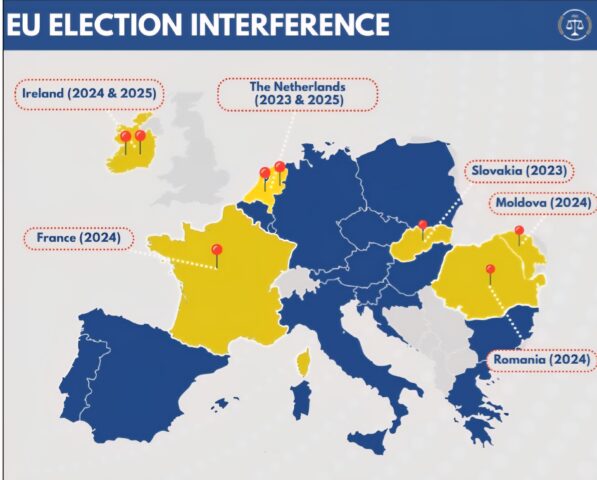
Source: Committee on the Judiciary of the U.S. House of Representatives
The DSA is seen by the European Commission as an instrument to tackle ‘disinformation’ and regulate content on social media platforms, in addition to supporting such directives as the EU LGBTIQ+ Equality Strategy 2026-2030, and being central to addressing “illegal content online, including incitement to hate or discrimination”.
But the Committee on the Judiciary of the U.S. House of Representatives today said it was a law “regulating online speech, to impose global online censorship requirements on political speech, humor, and satire.”
The Panel’s report says that under the auspices of the EU’s Disinformation Code and the DSA Election Guidelines, “the Commission has activated a censorship apparatus known as a “rapid response system” ahead of several recent European elections.”
“Under these “rapid response systems,” European Commission-approved fact-checkers are given the ability to make priority censorship requests in the weeks before and after major elections. These so-called fact-checkers are invariably leftwing and pro-censorship—anything but politically neutral,” the report claims.
SLOVAKIAN AND ROMANIAN ELECTIONS
The report says that “nonpublic meeting agendas and readouts show that the European Commission regularly convened meetings of national-level regulators, left-wing NGOs, and platforms prior to elections to discuss which political opinions should be censored.”
It says the “rapid response systems” allowed government-approved third parties “to make priority censorship requests that almost exclusively targeted the ruling party’s opposition.”
And it says that during the 2023 Slovak election, “Tiktok censored the following “hate speech” while facing European censorship pressure”:
• “There are only two genders”;
• “Children cannot be trans”;
• “We need to stop the sexualization of young people/children”;
• “I think that LGBTI ideology, gender ideology, transgender ideology are a big
threat to Slovakia, just like corruption”; and
• “Targeted misgendering.”
“These statements are not “hate speech”—they are political opinions about a current contentious scientific and medical issue. TikTok itself noted that some of these political opinions were “common in the Slovak political discussions.” Yet, under pressure from the European Commission, TikTok censored these claims ahead of Slovakia’s national parliamentary elections,” the report says.
Further the report is critical of the European Commission for taking “its most aggressive censorship steps during the 2024 Romanian presidential election.”
“In December 2024, Romania’s Constitutional Court annulled the results of the first round of the previous month’s presidential election, won by little-known independent populist candidate Calin Georgescu, after Romanian intelligence services alleged that Russia had covertly supported Georgescu through a coordinated TikTok campaign,” the report says.
But “internal TikTok documents produced to the Committee seem to undercut this narrative,” it notes. In submissions to the European Commission, which used the unproven allegation of Russian interference to investigate TikTok’s content moderation practices, TikTok stated that it “ha[d] not found, nor been presented with, any evidence of a coordinated network of 25,000 accounts associated with Mr. Georgescu’s campaign”—the key allegation by the intelligence authorities.”
“By late December 2024, media reports citing evidence from Romania’s tax authority found that the alleged Russian interference campaign had, in fact, been funded by another Romanian political party,” the US Committee’s report continues. But the election results were never reinstated, and in May 2025, the establishment-preferred candidate won Romania’s presidency in the rescheduled election.”