Ireland’s performance in a leading global competitiveness ranking is found to be higher if Modified Gross National Income (GNI*) is used as an economic indicator instead of Gross Domestic Product (GDP), according to new research.
The National Competitiveness and Productivity Council (NCPC) examined how Ireland’s performance in the IMD World Competitiveness Ranking 2024 is affected when selected indicators are rescaled using GNI* in place of GDP.
It found that Ireland’s competitiveness performance rose by one position in the ranking, with improvements in three of the four pillars used to measure international competitiveness.
The Institute for Management Development’s (IMD) World Competitiveness Ranking is an international benchmark used to assess the international competitiveness of over 60 economies, ranked across four “factors” (or pillars) and 20 “subpillars”.
The new bulletin’s key findings include the assessment that Ireland’s competitiveness performance is “robust to re-assessment using GNI*”, with the NCPC identifying the most significant improvement under “Economic Performance”, which moved up seven positions to 2nd, followed by
Infrastructure, which moved up two positions to 14th.
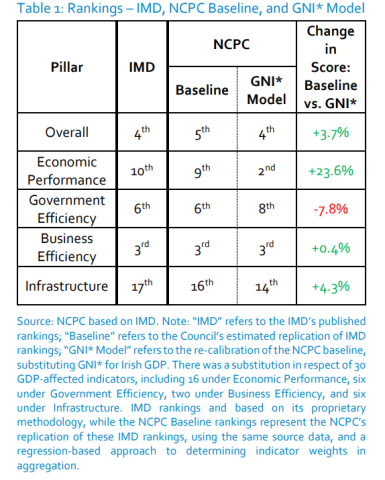
Meanwhile, as part of this re-assessment Ireland’s ranking on Government Efficiency dropped two positions to 8th.
The NCPC published its assessment of the latest set of IMD results in June 2024, which had Ireland ranked in 4th place overall – a decline from 2nd in 2023.
However, it noted that while international indices such as the IMD World Competitiveness Ranking provide valuable benchmarks, “they are not without limitations”.
“They rely on standardised methodologies to ensure comparability across countries, but that can, at times, obscure important economic specificities. Unique features in economic structures can lead to misleading interpretations of competitiveness, when these indicators are compared across countries,” the bulletin reads.
For Ireland, this means that GDP “can distort perceptions of performance due to the outsized impact of foreign-owned multinational activity”.
Developed by the Central Statistics Office (CSO), GNI* is an adjusted metric to account for these effects.
As a result according to the NCPC, GNI* can provide a “more meaningful estimate of national income” and ultimately a more accurate account of Ireland’s relative international competitiveness.
The gains in Economic Performance were the result of a “more accurate alignment of GDP-based indicators with the true scale and dynamics of Ireland’s domestic economy”, while the improvement under Infrastructure came largely from improved ratios in R&D and environmental metrics.
The decline in Government Efficiency reflected weaker fiscal indicators when recalculated using GNI*, such as the tax burden and public debt sustainability.
The report suggests that implementing GNI* may offer a more realistic benchmark for Ireland, especially for international comparisons involving small, open economies.
However, the adjustment does not drastically alter the view of Ireland’s competitiveness, while the NCPC cautions that GNI* is “not a universally appropriate substitute for GDP in this index”.