In a development which will surely be welcomed by many Irish police officers, the news broke yesterday that Garda Commissioner Drew Harris is reversing the controversial “Gender Identity In The Workplace” policy.
This plan – which was originally revealed by my Gript colleague Gary Kavanagh several weeks ago – would have seen the Gardaí forced to use people’s preferred “gender pronouns” during the course of their duties, or face punishment.
Sources within An Garda Síochána have expressed anger and fear over a new policy mandating the use of preferred pronouns, citing a lack of consultation and fear of reprisals if they do not engage in what they view as "compelled speech."https://t.co/qCDO2l6oDg
— gript (@griptmedia) March 18, 2023
For example, if Gardaí encountered a biological male, but the person “identified” as female, then the officer would have to refer to that individual as “she” and “her,” rather than “he” and “him.” And the wording of the scheme said that “strict compliance” was required of all staff. No opt-out was allowed, and if you refused to go along with it, it could “escalate” to disciplinary action.
At the time of that story’s release, many officers expressed their “fear” and “anger” to Gript in private, saying that the plan amounted to nothing more than “compelled speech.” And yet for several weeks, Gript was the only outlet to report on that story, and it was totally ignored by the rest of the Irish media, despite its obvious importance.
Or at least, it was ignored at first. The story did eventually get attention – but only after this publication decided to question Drew Harris about it, in a video which went on to receive over 640,000 impressions in less than a week. Clearly, there was public interest in the matter.
Garda Commissioner Drew Harris tells Gript that if Garda officers use the wrong gender pronouns, it could "escalate" to disciplinary action. pic.twitter.com/EXElEEISx1
— gript (@griptmedia) March 28, 2023
At that point, following significant online attention, the Association of Garda Sergeants and Inspectors (AGSI) came out against the Commissioner’s remarks, and the rest of the media seemed to reluctantly concede that it was a story worth covering.
Now the Garda Commissioner has suddenly announced that he would be reversing the policy altogether.
BREAKING: Garda Commissioner Drew Harris has reversed a plan to force Gardaí to use a person’s preferred gender pronouns, following significant backlash.#gripthttps://t.co/4uMvGQ6y4Y
— gript (@griptmedia) April 4, 2023
In other words, once some probing questions were asked of what was evidently a bad policy, the policy itself then came under scrutiny. And putting bad ideas under scrutiny is one of the main jobs of the media, one would have thought.
But it doesn’t seem to happen very often in Ireland – and maybe that’s why when it does, it gets widespread attention.
For example, take the case of the decision to put Barbie Kardashian, a biological male and a violent sex offender, into a women’s jail.
Gript was the only platform at a recent press conference who asked Taoiseach Leo Varadkar about his government’s policy of putting violent biologically-male transgender inmates into female prisons.
"Is Barbie Kardashian a woman?": Taoiseach Leo Varadkar says that biological males should not be put in women's prisons. pic.twitter.com/wS4vmOPHnT
— gript (@griptmedia) March 21, 2023
That video went on to accrue 2.4 million impressions, again, demonstrating widespread public interest.
It should be noted that this trans prisons story was not a new policy by any means. Since 2019, Ireland has had violent biological males in Limerick Women’s Prison, as covered in the Law Gazette. This has been the state of play for years now.
And yet, what was Varadkar’s reaction when asked point-blank about this policy?
Well, he publicly admitted that the law would need to be changed.
This was promptly picked up by the mainstream media, and now the government is having serious conversations about a full debate on some of its transgender policies.
Varadkar's comments likely to lead to big debate… pic.twitter.com/TCouMsCi27
— The Irish Daily Mail (@irishdailymail) March 22, 2023
Taoiseach Leo Varadkar says ‘biological males should not be in women’s prisons’ https://t.co/hiNlSwS6gq
— Irish Independent (@Independent_ie) March 21, 2023
Again, this showed the importance of public scrutiny. It was a simple question that could have been asked at any time over the past several years, and yet it wasn’t for some inexplicable reason.
Another example of this can be seen from February of this year, when Gript asked Education Minister Norma Foley about radical sex education material in schools, teaching young primary school boys about crossdressing, wearing lipstick and girls’ clothes.
"Encouraging young boys to wear lipstick and girls' clothes": Education Minister Norma Foley questioned on the radical materials recommended for Irish schools, which promote cross-dressing & gender ideology to primary school students.#gript pic.twitter.com/9n9LgczNLL
— gript (@griptmedia) February 22, 2023
Prior to that, the national curriculum body was favourably quoting from those who believe that parents should not have the right to withdraw their own children from explicit sex ed classes – or classes that teach about “porn literacy” and gender ideology.
But when the Minister was pressed on the issue, she committed to give parents the right to “withdraw their students from anything that’s happening in the school environment,” and emphasised her belief in “parental consent.”
Sharp division over teaching of gender identity and use of pronouns in updated sex education syllabus https://t.co/UHhgiD6SwZ
— The Irish Times (@IrishTimes) February 22, 2023
That certainly bucked the trend towards mandatory RSE material.
The point is that journalists doing the most basic part of their job – i.e. asking obvious questions about official policies – is the very least that the public should expect. The only reason bad policies are able to survive for so long is because they go completely unchallenged for years at a time.
The obvious question then is, why don’t journalists do this more often?
For example, the Gender Recognition Act, which was signed into law in July of 2015, is the piece of legislation largely responsible for most of these radical outcomes, such as biological males in women’s prisons. This was the law, after all, that made anyone who has a Gender Recognition Cert – i.e. a piece of paper – another gender in the eyes of the law.
When it first passed, this policy was backed by Fine Gael, Fianna Fáil, Sinn Féin, People Before Profit, Labour, the Social Democrats, and a whole spate of Independents.
And on the day it was signed into law, do you know how long RTÉ spent reporting on it?
Well, all of 23 seconds. You can see for yourself in the archives – 23 seconds is how long our esteemed State broadcaster spent discussing this massively consequential piece of legislation.
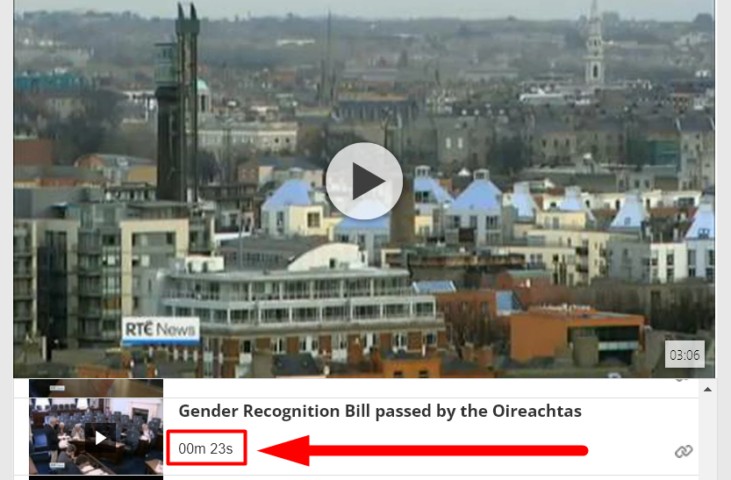
I can tell you one thing; if Gript had been around in 2015, we would have spent a bit more time on it than that.
And so the end result is, the media don’t question these things. The government don’t question it. The so-called “opposition” don’t question it. And so the policy remains, in an “Emperor Has No Clothes”-esque fashion, without anyone involved taking a moment to actually consider whether or not it’s a good idea.
And that is why when a single new media outlet comes along and asks the obvious questions, everyone is taken by surprise.
That says quite a lot about the state of Irish legislative scrutiny, and frankly, none of it is positive.