Irish politicians “are successfully dodging” the issues related to surrogacy, one campaigner has said ahead of an event to be held in Dublin by a US egg donation and surrogacy agency next week.
There have been calls for the media to cover the event promoting international surrogacy, with Meath Senator Sharon Keogan urging RTE’s LiveLine to “let women speak” about their views of the event, which is being organised for gay men who want to become parents.
‘Babies and Bites Dublin: The Path to Parenthood for Gay Men’ is being held on Wednesday 6th May at the Clayton Hotel on Cardiff Lane. The event is being organised by Hatch Egg Donation & Surrogate Agency – described as a “premier” commercial LA-based surrogacy and egg donation agency which provides in-house IVF through the Pacific Fertility Centre in Los Angeles.
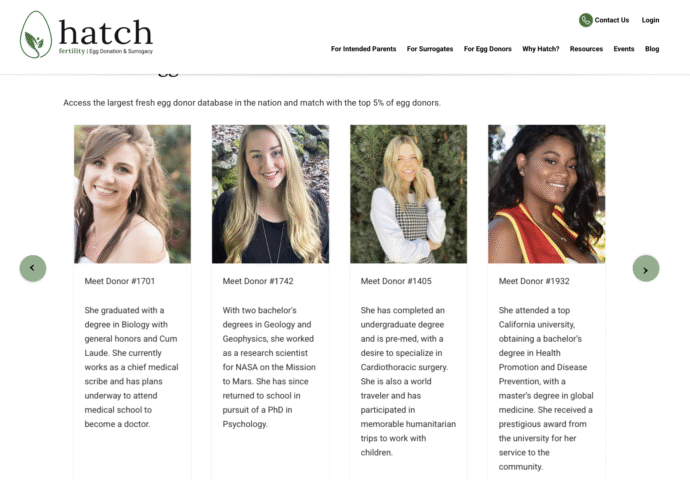
It says it provides “access to the largest fresh egg donor database in the nation,” allowing customers to “match with the top 5% of egg donors.”
The agency, well known for working with LGBT couples, says it will coordinate the entire process, including matching, screening, counseling, legal arrangements, and ongoing support. Its fees typically range from $30,000 – $50,000+ according to its website.
Potential parents can also search through profiles of women who can be selected as egg donors, or the biological mothers of babies – listing personal details including photos, education and jobs. According to Hatch, it has brought babies into 50 countries worldwide.
“Hatch is coming to Dublin! We are excited to invite you to a special educational seminar (with refreshments provided) for gay men who want to learn more about the path to parenthood. Learn how gay individuals/couples have grown their family with one of the best teams in the business: Hatch Fertility and Pacific Fertility Clinic Los Angeles,” said the organisers.
“Come on @rteliveline, let women speak,” said Senator Sharon Keogan, addressing the event, adding the hashtag: “Ban surrogacy.”
The Natural Women’s Council, meanwhile, urged the public to contact TDs and the Minister for children to “demand an explanation as to why a commercial surrogacy event is being hosted in Ireland when such practises are prohibited under Irish law.”
Women’s advocacy group, The Countess, reacted: “Are women’s bodies and babies just commodities now? Who is enriching themselves through the surrogacy industrial complex?”
Sarah Holmes, an advocate with Genspect, told Gript that there is political silence around the event and the problems associated with surrogacy in general, as she called on politicians to speak up, and for the Department of Children to answer questions relating to the US company visiting Ireland.
“This feels like a mother and baby home 2.0 scenario,” said Holmes. “The poor women who are acting as surrogates most often are in other countries and not on our doorsteps. We are pretending that it’s not happening or it’s not a bad thing. The question which I think is key is this: Why is it that you’ll never see a rich woman in Foxrock acting as a surrogate for a poor woman in Ukraine or India?
“People say surrogacy is all just altruistic, but we know that’s not the case. Almost every single surrogacy case that is supposedly altruistic involves a rich Western family and a poor woman from countries like Ukraine or India or Pakistan. Why is that? Why are we not seeing rich Irish women having babies for poor, foreign women?”
The Health (Assisted Human Reproduction) Act 2024 – which became law in July 2024 – provides a framework for regulating domestic and international altruistic surrogacy in Ireland, banning commercial surrogacy. The law mandates legal, medical, and counselling requirements, with oversight by the newly established Assisted Human Reproduction Regulatory Authority (AHRRA). The law also aimed to legislate for international surrogacy.
However, opponents of the law say that despite a push for safeguards, they say problems with the law remain and that worldwide, countries have failed to legislate away the ethical problems with international surrogacy. The Irish Human Rights and Equality Commission – which serves as the National Anti-Human Trafficking Rapporteur – expressed its concerns in a letter to then Minister for Health, Stephen Donnelly.
Holding a role in monitoring the State’s performance in combating human trafficking under the EU Anti-Trafficking Directive, this required member states to “explicitly criminalise exploitation of surrogacy, and to introduce mandatory penalties for users of services of trafficked victims”.
Holmes said that while commercial surrogacy is illegal in Ireland, she feels it is “impossible” to “police the practice,” adding: “You cannot always stop money changing hands.”
“You cannot police it, and you cannot always stop money changing hands. And if you open the door to surrogacy – even if you’re saying it’s altruistic and family to family, it’s still not something which is centred on the baby. You’re bringing life into this world on your own contract and you’re still creating, deliberately, a broken lineage for a child who may then have more complex and potentially stressful issues down the line.
‘POLITICIANS DODGING THE ISSUE REALLY WELL’
“With regards the specific event in Dublin next week, the company organising it – Hatch Egg Donation and Surrogacy Agency – is an American company. So questions must be asked as to why they are coming over and advertising on Irish soil. It is clear that they are looking for customers, even though it is supposed to be illegal to buy babies through commercial surrogacy here.
“Surely there are questions around the ethics of a hotel hosting an event like this. I know for a fact that the hotel has been made aware of the event and the problems with it by different people who have contacted me. Where are the politicians speaking out on this? I believe Irish politicians are dodging this issue really well, and none of them want to speak out against it. We’ve heard nothing from Fine Gael, Fianna Fail or Sinn Fein. Surely, you would think politicians would have something to say about a big US firm coming in to promote commercial surrogacy – arguably, the buying of babies – on Irish soil? It’s shocking, and I genuinely can’t believe there isn’t more of a fuss about it.
“I’ve tried to get the Irish media to pick up on this event and have some sort of a discussion. I tried to get Liveline to cover it having contacted them three or four weeks ago, and same with Newstalk. So far they haven’t. I’ve rang and I’ve tagged them and emailed, because it baffles me why we are not willing to have this conversation. How is it that we are allowing people, including those with criminal convictions, to go to an event, get linked up with a big American company, who will help you buy a baby for yourself if you have the money? It’s awful.”
“When it comes to surrogacy, we also have to consider the woman who is bearing the child. Who is thinking about the mother and the risks to her health? What about the mental health of these women five years down the line, or their physical health?”
She also pointed to cases in countries like Ghana which she described as “problematic” – which have seen multiple embryos implanted at a time leading to multiple pregnancies.
A recent case in the African nation sparked calls for regulation after a 30-year-old surrogate mother delivered four healthy quadruplet babies. It has also been reported that legal experts in the country are calling for advertising and brokering in surrogacy to be legally regulated to prevent exploitation of young women and students seeking “quick money.”
“As soon as you make a baby a commodity, you’re opening the door to all sorts of human rights violations. This is an industry lacking any sort of safeguards and as we’ve seen from the experience of countries worldwide, it’s incredibly hard to police, if not impossible.
“We’re dealing with a possible situation where you have a woman donating her egg, and we do not know her circumstances, to men who are living in Ireland who could be convicted sex offenders and criminals, so that they can have a child. Unlike adoption, there is no regulation and no system here to perform background checks on the intended parents involved in surrogacy. There is no regulation, so anyone can essentially purchase a baby.”
Others who have drawn attention to the event include Róisín Michaux, who wrote on X: “Would be nice if we could stop ignoring these major social issues. Has nobody learned anything from the disastrous trans debacle?”
Cllr Emer Tóibín also called for media coverage from RTE, saying that the event and subject matter “is of concern to many of us.”
The Department for Children has been contacted for comment.