New figures from the Centre for Disease Control in the United States show that the overall number of women dying in pregnancy and childbirth decreased significantly in 2023 – the first full year of figures since Roe v Wade was overturned, a decision which led to abortion restrictions across many states.
Abortion supporters had argued that maternal deaths would increase as a consequence of the Supreme Court decision to strike down the 1973 Roe v Wade decision which had ruled that the right to abortion was constitutionally protected.
However, the report from the CDC’s National Center for Health Statistics found that 669 women died of maternal causes in 2023, compared to 817 women who died of the same causes in 2022. The figures showed that the maternal mortality rate for all mothers in the U.S. regardless of race has dropped to 18.6 deaths per 100,000 live births from 22.3 in 2022 – a fall of almost 17%.
The CDC said that the decrease was significant for white non-Hispanic and for Hispanic women – but that the observed decrease for Asian was not statistically significant, while maternal deaths amongst Black women rose slightly. Maternal mortality amongst Black women (50.3) continues to be significantly higher than rates for White women (14.5), Hispanic women (12.4), and Asian women (10.7).
“This report presents maternal mortality rates for 2023 based on data from the National Vital Statistics System. A maternal death is defined by the World Health Organization as “the death of a woman while pregnant or within 42 days of termination of pregnancy, irrespective of the duration and the site of the pregnancy, from any cause related to or aggravated by the pregnancy or its management, but not from accidental or incidental causes” (1). Maternal mortality rates—the number of maternal deaths per 100,000 live births—are shown in this report by age group and race and Hispanic origin,” the CDC said.
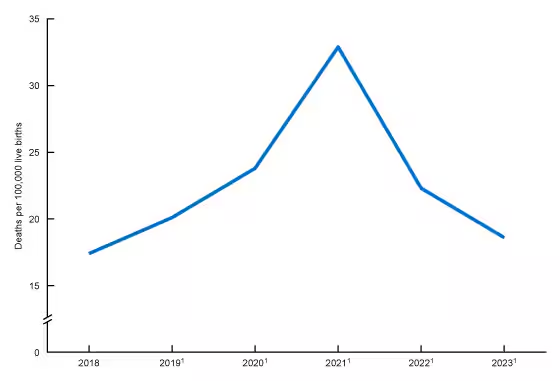
Source: Centre for Disease Control
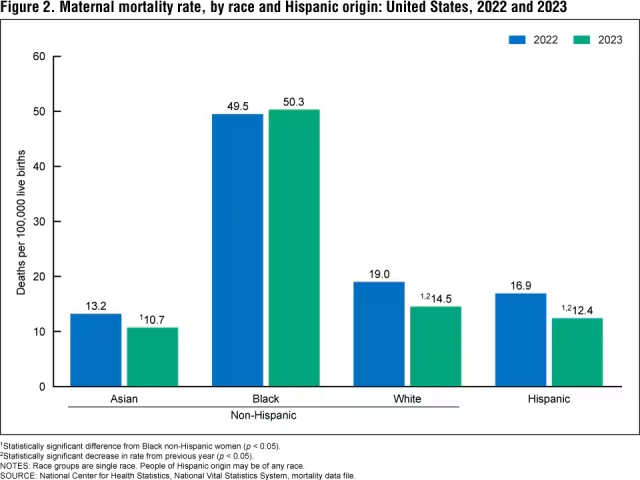
The CDC noted that maternal death rates decreased significantly for women ages 25–39 and age 40 and older between 2022 and 2023.
“Rates in 2023 were 12.5 deaths per 100,000 live births for women younger than age 25, 18.1 for those ages 25–39, and 59.8 for those age 40 and older. The rate for women age 40 and older was nearly five times higher than the rate for women younger than age 25. Differences in the rates between age groups were statistically significant,” the report found.
Maternal mortality in the U.S. has been higher than in other western countries for some time, with some experts pointing to income disparity impacting on access to maternal healthcare.
Dr Susan Bane, an Obstetrician Gynaecologist, says that overturning Roe v Wade has not led physicians to alter the approach to pregnancy complications, and adds that “determining causes of maternal mortality is a challenging but necessary endeavor to protect women from harm and ensure high standards of prenatal care nationwide.”
“The pro-life community must lead the push for increased data clarity that holds physicians to high standards when treating pregnant women. While any maternal death is a tragedy, abortion regulations have not been responsible for a single maternal death nationwide; women’s lives are protected in all fifty states. Instead, a pattern of substandard care for women may be the true culprit when it comes to rising maternal mortality in America,” she wrote.
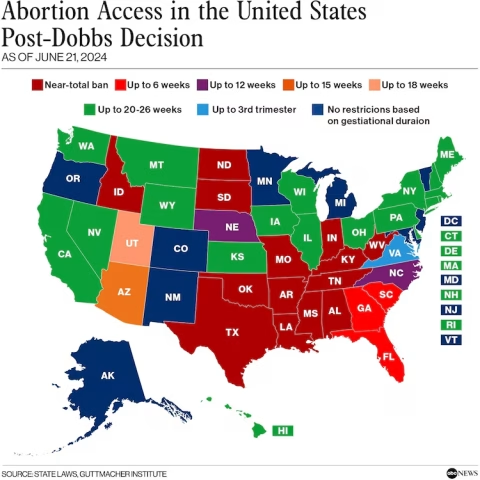
The Guttmacher Institute, which supports legalised abortion recently issued its mapping of abortion bans and restrictions in post-Roe America.
Michael J. New, an associate scholar at the Charlotte Lozier Institute, said that “the fact that the U.S. maternal mortality rate fell by nearly 17 percent in 2023 is extremely newsworthy. This was the first full year after the Supreme Court’s Dobbs decision”.
“By the end of 2023, 15 states had either effectively banned abortion or had laws in place protecting preborn children after six weeks’ gestation. Countless mainstream media pundits predicted that strong pro-life laws would hurt public health,” he said.
“However, CDC data show a decline in maternal mortality since 2022 and a decline in infant mortality since 2023. Overall, it is sad, but unsurprising, that many media outlets have chosen to downplay the positive public health trends that have occurred post-Dobbs,” he added.