Information supplied to Rural Independent TD for Laois/Offaly, Carol Nolan appears to confirm EU statistics that a proportion of the Ukrainians who fled their country following the Russian invasion of 2022 have returned home. However, figures contained in the latest Eurostat breakdown might seem to contradict this.
Deputy Nolan had asked the Minister for Justice Helen McEntee “to provide the total number of Ukrainian citizens who have been welcomed to Ireland since the beginning of the Russian invasion of their country, and the number who are known to have subsequently left the State.”
In her response, the Minister stated that, as of Sunday March 31, there were 104,670 Ukrainians within the state who had been granted Temporary Protection status. This was of a total of 105,771 persons from all parts of the world who had been given Temporary Protection.
Minister McEntee said that of the overall total of Ukrainians who had been granted Temporary Protection that 1.508 had returned to Ukraine voluntarily but that this number might be higher as
“while her Department records those who have applied and been granted Temporary Protection and those who have formally withdrawn their Temporary Protection, but Department records do not reflect the number of people who have left the country without formally notifying of their withdrawal of Temporary Protection.”
EU figures released this week show that at the end of February there were 4,234,595 persons from Ukraine who were residing in all 27 member states. While the numbers who have been granted Temporary Protection increased in some member states such as Germany, Poland and Czechia; others including France and the Netherlands have seen similar reductions in numbers to Ireland as claimed by the Minister.
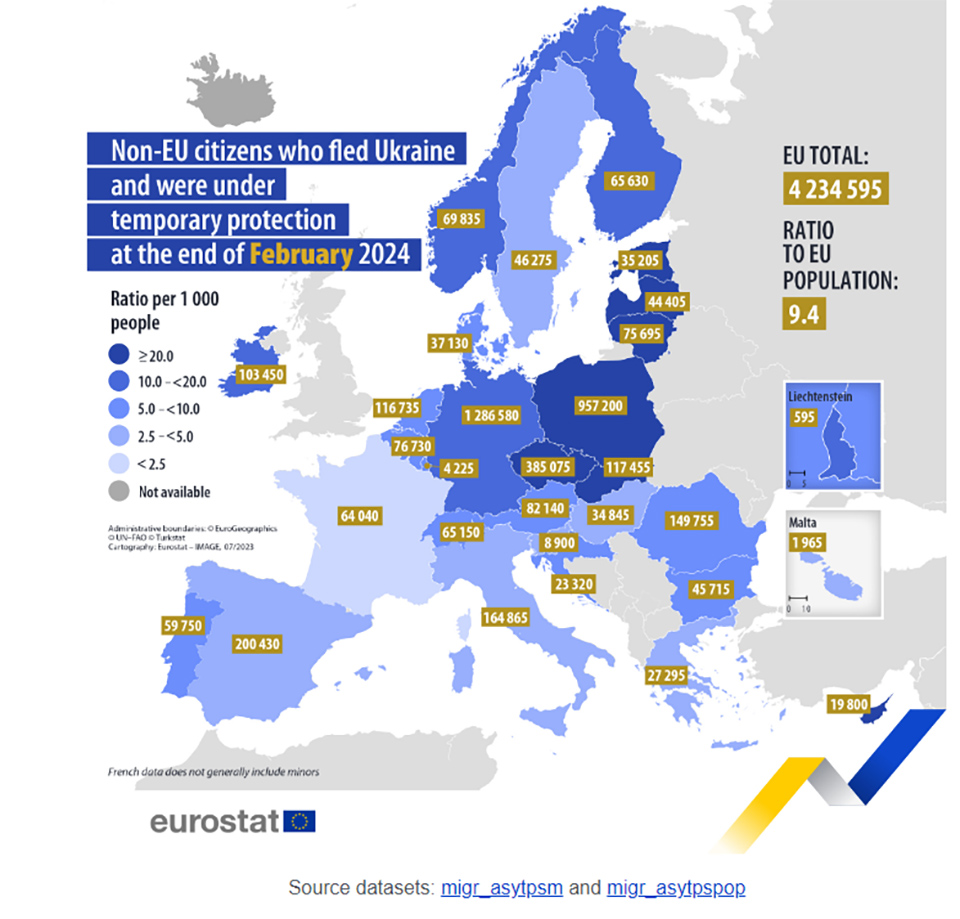
As can be seen from the Eurostat graphic, they place the numbers of Ukrainians who were under Temporary Protection in Ireland at the end of February lower than the Minister – at 103,450. A more detailed tabular breakdown supplies an even lower number of 102,370 for February. The total for the EU is also lower so presumably the table refers to numbers at the end of January. The total may have increased again during March.
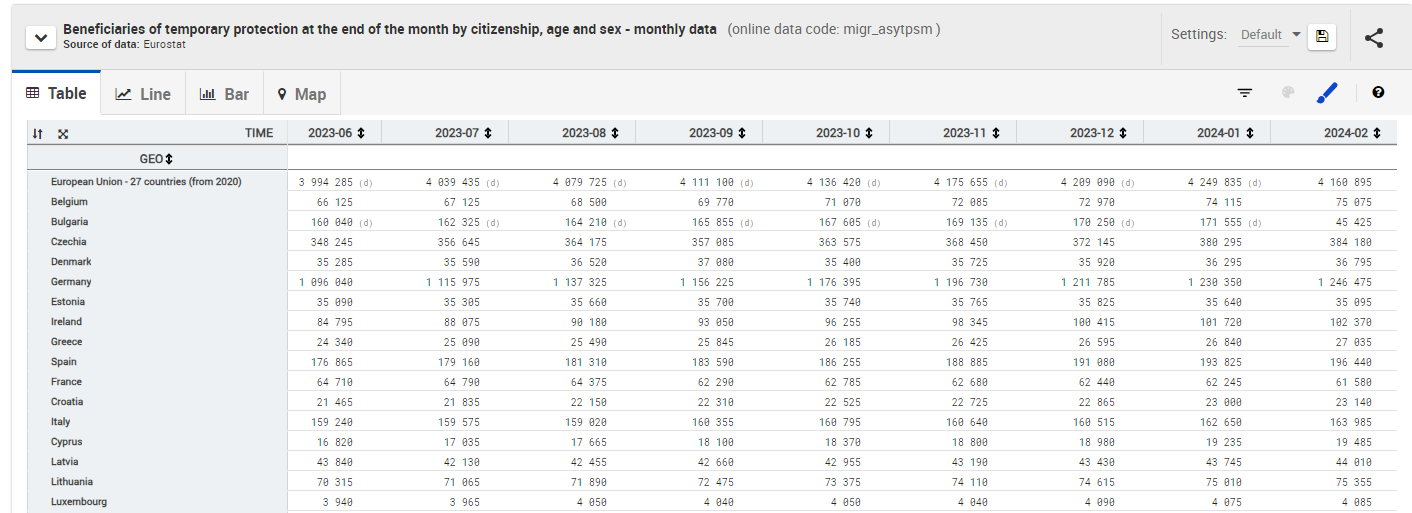
The EU total shows that the numbers of Ukrainians in Temporary Protection fell from 4,249,835 to 4,160,895 in the last month recorded. This would equate to a reduction of 88,940 or a 2.1% fall in one month, the only reduction recorded since Temporary Protection began to be granted two years ago.
However, the overall numbers would seem to have increased again to the end of February. The figures for the Irish state show no such fall in numbers at any stage.
The table shows that, to the end of February 2024, almost an additional 2,000 Ukrainians have arrived this year to that point.
However, if we accept the Minister’s Departmental statistics then the overall total of Ukrainians granted Temporary Protection since 2022 stands at 106,178.
Of that number, the Minister states that 1,508 are known to have left the state which would mean that 1.4% have returned to Ukraine or perhaps moved to another country.
The tabular information, however, indicates that there has been a steady increase. There were 84,795 Ukrainians under Temporary Protection in June 2023 and that had, according to the EU figures, grown by 17,575 or 21% since June 2023.
It is not immediately apparent from the EU statistics, whatever about those from the Department of Justice, that the announced restrictions on the rights of Ukrainians coming to Ireland to claim social welfare benefits and others have had much if any impact on the numbers arriving to claim Temporary Protection.
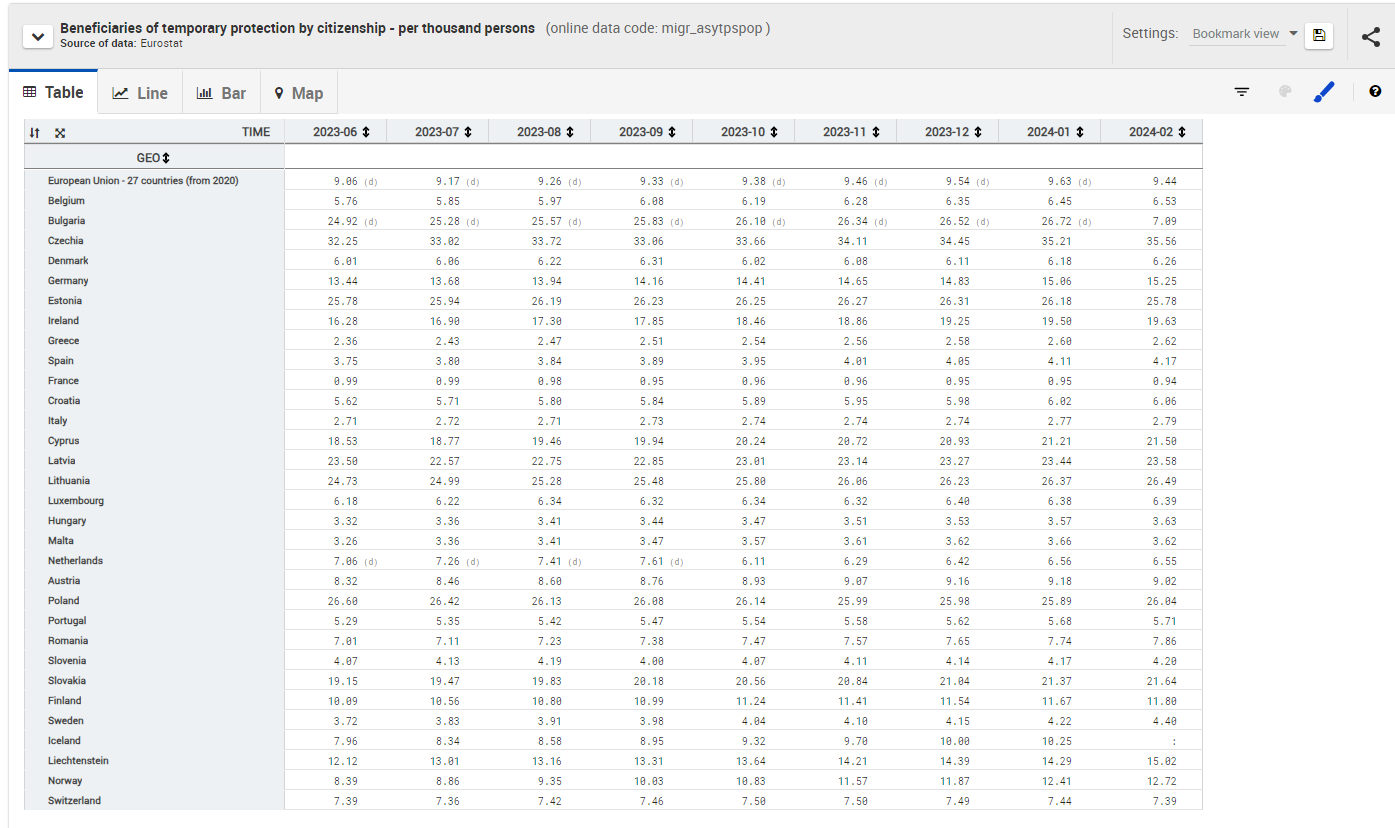
As the table above also shows, Ireland continues to have one of the highest ratios of Ukrainians as a ratio of population. While the overall ratio for all 27 EU member states stood at 9.44 per 1000 of population in February this year, the ratio for Ireland was twice as high at 19.63 per 1000.
That means that Ireland has the 8th highest ratio of Ukrainians under Temporary Protection of all 27 member states. Only the frontline countries; Poland, Latvia, Estonia, Lithuania, Czechia and Slovakia along with Cyprus have taken in a higher proportion.
The evidence shows the Irish state in comparative terms has been far more generous than all of the western EU member states. Germany now hosts over 1.2 million Ukrainians but has a lower ratio than Ireland at 15.25 per 1,000. France has a ratio of less than 1 per 1,000 and has just over 64,000 – almost 40,000 fewer than Ireland.
So too do Portugal, Denmark, the Netherlands and Austria. The disparities in overall numbers and in relative terms have only recently been seriously addressed by the Irish establishment. However, it was more the public disquiet at the impact that the seemingly growing numbers continue to have on communities – if we accept either the EU or the Departmental figures – which forced the government to react in a manner other than to imply that anyone questioning all of this has some other motive or were being manipulated by the “far right.”