In international diplomacy, there has to be some allowance made for flowery rhetoric. Politicians never feel more like politicians, after all, than when they are standing at that lectern with the President of some other country, making grand pronouncements on world affairs. That’s why a lot of them enter politics in the first place: The (often testosterone driven) thrill of being a great man of history, directing the affairs not just of the nation, but of humanity itself.
So we can forgive Micheál Martin, perhaps, for the following line about Ireland and Ukraine:
“”For as long as Ukraine needs our help and support, Ireland will be there for you,” he said. “Your struggle is our struggle. Success be our success. (sic) We are with you for as long as it takes.”
That is one of those statements politicians make that probably sounded nice on the page if one does not consider the full implications. To date, our support has cost us very little, and gained the Ukrainians almost nothing.
Indeed, were the Ukrainian front lines to suddenly collapse in the morning, and were Russian tanks to reach the borders of Europe having annexed the whole of Ukraine, then there’s a fair chance that life in Ireland would go on mostly as normal. Their struggle in Ukraine is existential. Were things to go badly wrong, their very existence as a state or even as a distinct people would be threatened. Ours, by contrast, is mostly ideological.
In fairness to An Taoiseach, he is not the only European leader to have spoken in such existential terms about the war in Ukraine. Indeed, if expressions of solidarity were a weapon that could be utilised on the battlefield, the Russians would already have had to move all their industries and capital city east of the Ural Mountains, as Stalin prepared to do in late 1941 as Nazi soldiers threatened Moscow. The problem for Zelensky is that the Irish “struggle” against the Russian invasion of Ukraine does not – and could never have be expected to – delay the progress of a single Russian battalion. That’s why he’s here: He wants to make sure that next time, if there is a next time, his countrymen can rely on more than sheer “solidarity”.
And it’s working. There are signs, actually, that more Irish people are coming to the conclusion that the Ukrainian war does, and could, impact this country’s wider interests.
At the weekend, the Sunday Business Post published its regular Red C opinion poll. A little-noticed question in that poll asked whether Irish voters would support joining NATO. The results were eye-opening:
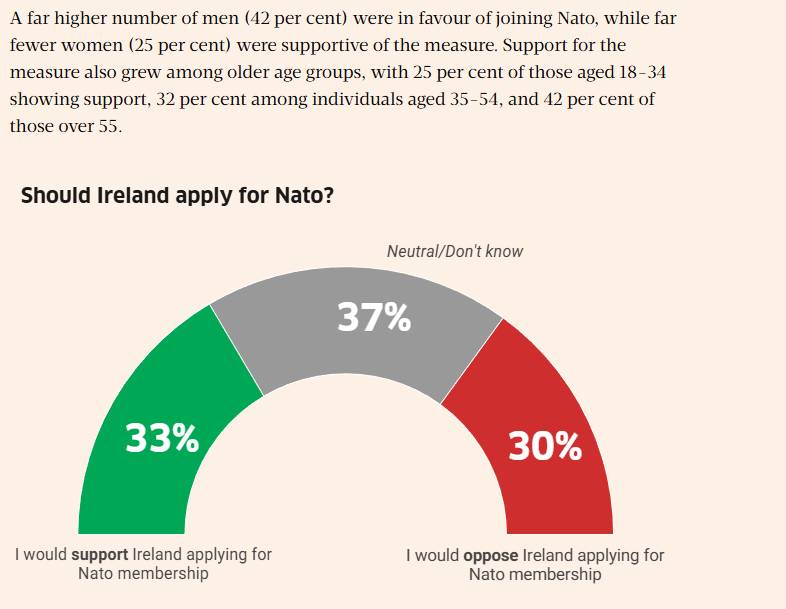
A narrow plurality – 33% to 30% – say they favour joining the Anglo-American-led alliance. Perhaps more significantly, the greatest number of those polled – 37% – say they have no opinion on the matter either way. That suggests that they are, at minimum, not exactly ideologically committed to neutrality.
You might see, looking at those numbers, why the Irish Government is quite confident that it can ditch the triple lock (for starters) without paying an enormous political price.
It is significant, too, that Zelensky came to Ireland, of all places.
Officially, the purpose of the visit is to thank Ireland for its support and pay tribute to the country for its objectively very generous treatment of Ukrainian refugees. But it is very likely that the visit has another purpose: To shower Irish politicians with a modicum of international glamour and attention with a view to Ireland’s disposition in the wider EU question of defence. Or in plain English: Zelensky wants a post-Ukraine-War Europe to be his ally, and to be a strong and armed ally. Ireland has traditionally been one of the most determined opponents of EU militarisation. Getting Dublin’s support for a much more militarily muscular European Union on Ukraine’s western border is obviously and clearly in Zelensky’s interests, and is the likely purpose of his visit.
If that was – and I strongly suspect I am right – the purpose of his visit, then he will leave happy. He has come to Ireland to shower our politicians with international attention and to ask them for their support at EU level. When the Taoiseach says “your struggle is our struggle”, it will then prove much more difficult for him (not that he really wants to) to turn around in Brussels and announce that he thinks the EU’s move towards more muscular collective defence is a bad idea.
Zelensky – though mired in a corruption scandal of epic proportions at home – has proven himself throughout this three-year war to be a canny and skilled diplomatic operator. That should be recognised. He has managed to parlay genuine alarm at Russia’s actions into prolonged and sustained financial support for Ukraine, and considerable military hardware for his armed forces. He has also managed to somewhat “tame” Donald Trump despite a significant element inside the White House who are convinced that Ukraine is “not their fight”. Meanwhile, he has parlayed Trump’s hostility to the war into a convincing pitch to Europe to arm itself and position itself as a military power capable in the longer term of defending Ukraine.
His final act, I suspect, as part of whatever peace deal is agreed is gotten across the line, will be to commit EU and NATO countries to “security guarantees” to Ukraine, or in other words (as Britain and France did with Poland in 1939) a commitment to defend Ukraine should the Russians – as is their way – decide to come back for another bite of the country in a decade or so.
It should be noted that any EU security guarantees for Ukraine would, of course, include Ireland as a member of the EU. And since his struggle is our struggle, it is not impossible to imagine a situation where Ireland finds itself committed to more than rhetorical aid, should the conflict re-open itself in the early 2030’s.
Ireland’s neutrality, such as it was, is slowly ebbing away. But then as the Sunday Business Post discovered, for a much larger portion of the population than is commonly imagined, that in itself is seen as no bad thing. Thanks in part, I’d hazard a guess, to Zelensky’s diplomatic and rhetorical efforts over the past few years.