Over the Christmas period, while overseas, the X algorithm fed, onto my phone, a tweet from Kerry restaurateur and activist Paul Treyvaud.
“Dear Donald Trump, Elon Musk, Donald Trump Jnr, White House”, it read. “Ireland is in crisis mode”:
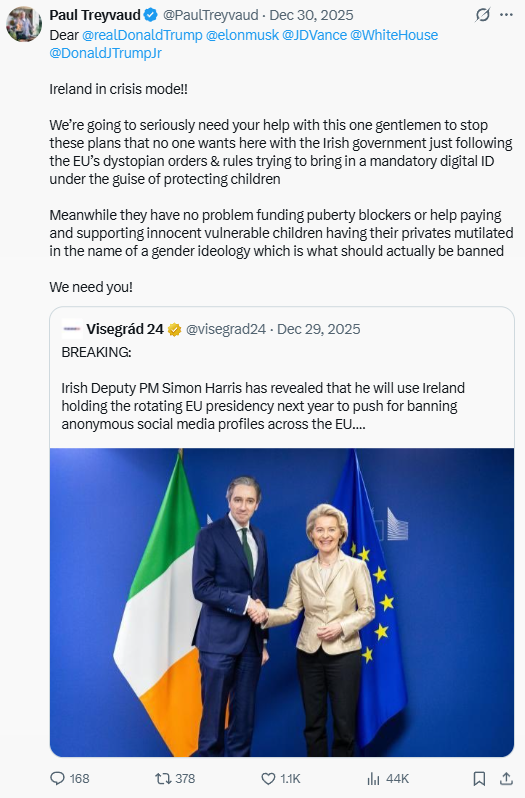
I should state here for the record that I like and admire Mr. Treyvaud, who has been a courageous and passionate advocate for Irish tourism and small towns over recent years when far too many people like him stayed quiet. He and I were both featured in a Virgin Media documentary in 2023 in which his own lucid and insightful contributions on the impact of migration on small-town Ireland put my own to shame. And on much of his activism and his critiques of Government policy, he has been utterly vindicated. He has also taken considerable risk in repeatedly speaking out, given the hostility he has certainly earned his restaurant and business from those who disagree with him. I find him, in the round, to be a very admirable and sincere character.
What follows therefore is a critique of the sentiment, not the man. A sentiment and a tone which is increasingly widespread.
As we enter 2026, Ireland has a couple of distinct, interlocking, and easily identifiable problems. These fall into two categories: Those caused by distinct policy failures, and those caused by cultural shortcomings in our governing class and in the mindset of the electorate that promote habitual policy failures.
Into the first category we can put what is obviously an overpopulation-relative-to-resources problem: Too much immigration over the past fifteen years has created accommodation and capacity problems that have impacted house prices, public sector delivery, traffic, crime, tourism, and infrastructure. There are relatively few areas of policy failure in Ireland that cannot be linked – directly or indirectly – to the fact that the population has grown much faster than the state can sustain infrastructure growth.
Into the second category we can put the cultural problems that allowed for this to happen: A political class which simply does not understand cause and effect or understand that every policy – including the fluffy nice ones – come with foreseeable and evident downsides. For example, making GP appointments free for children under the age of six will inevitably increase the demand for GP appointments, adding pressure to the health service. Or that putting more restrictions on landlords will encourage some landlords to sell their rental properties, creating bottlenecks in the rental market. Or that growing population faster than one can build infrastructure will lead to problems across multiple sectors.
This is where I find myself in stark disagreement with Mr. Treyvaud, and perhaps more of a nationalist than some who label themselves as such while preaching doom and despair: Because Ireland does not require external assistance to solve these problems. Resolving them is within our own capability, over time.
In fact, I would argue, the cultural problems within the electorate and the political class that caused these issues in the first place are now being replicated in the populist, nationalist right that desires to replace the status quo, but can’t quite figure out how to do it.
First, there is a kind of learned helplessness, in which a certain tone is adopted where all of the problems in Ireland are things done to us, rather than by us. There is a tendency to blame external actors, whether it be the European Union or the global capitalists at BlackRock or in more conspiratorial circles, the young global leader programme of the World Economic Forum. But this does not stand up to scrutiny: Other modern culturally left-leaning countries exposed to similar forces, like Denmark, have ended up with few of the problems that Ireland has despite being capitalist members of the EU and home to more than a few WEF young global leaders. This suggests on its face that domestic political decision making is much more important than what is “imposed” on you, either by the EU or, in Mr. Treyvaud’s hopes, by Mr. Trump.
Second, there is a retreat into a kind of miseryguts hopelessness, in which the power of the Irish people to right their own ship absent external influences is denied. How to understand the appeal for American aid? Clearly it is not aid of the direct, Venezuelan kind in which Trump orders the removal of the Irish Government and the installation of some kind of pro-Trumpist regime in Ireland – since no true Irish nationalist could argue for the overthrow of our sovereignty. No, it’s clearly a pitch for political aid in the form of external pressure and internal assistance for opponents of “the regime”.
But this is a dead end: Both Mr. Trump and the ideology to which he has given his name are deeply unpopular in Ireland. Given that fact, and even assuming the US President cared enough, external pressure on the state is as likely to create a “rally around the flag” effect as it is to provoke actual change. And as for direct aid for opposition groups? We’re so marginal and fringe within our own country that we need the Americans to help us get some kind of foothold.
The other problem here, frankly, is social media itself: It has proven itself a useful tool for fermenting and sharing public discontent over the various problems in Ireland, and an entirely useless tool for organising effective political responses to those problems. Paul Treyvaud in this situation is a useful example of what I mean: Somebody who is, in his own right, a very effective communicator and a clearly highly intelligent figure who is more than capable of articulating a vision for the country, but who instead in this instance is positioning himself as an internal fifth columnist for Mr. Trump, eager to join the “liberating” forces in whatever form they may take.
A nationalist right in Ireland that spends most of 2026 talking to itself on social media and fantasising about Trumpist aid from overseas is a nationalist right in Ireland that will find itself as politically irrelevant at the end of the year as it was at the beginning. When I wrote about the state of politics in Ireland a year ago, I noted that there were almost five years remaining until the next election in which those who wished to bring about change in the country had the time to build something meaningful. One fifth of that time has now elapsed, and, look though I might, I do not even see scaffolding and foundations, let alone the outline of a building.
Importing the language and rhetoric of foreign politicians will not work. Pleas for other countries to aid a political cause will not – and should not – work. Telling the Irish public that everything about their own country is rotten will not work, most especially as you do so while tying yourself to a US President who is unpopular here. If Irish people desire an alternative to their political culture, they will need to build it themselves in a positive, uplifting, and – crucially – approachable way. The clock is ticking.