I was struck, yesterday, by a quote from Luke Ming Flanagan, the Independent MEP seeking a third term in Brussels from the voters of Midlands North West on June 7th. Speaking to our friends at the Journal, Flanagan had this to say about how his approach to the job has changed over the last decade (emphasis mine):
When he was first elected to the parliament, Flanagan was known as a critic of the European institutions and some might say it was on that premise he won his seat.
However, after nearly a decade in Brussels, Flanagan tells The Journal he can see the merits of the European Parliament.
“I’m not euro skeptical anymore,” he said.
“I am seeing that it actually works. From the point of view of feeding ourselves, I think it’s important we do it together. From the point of view of climate, it’s important we do it together. From the point of view of biodiversity, it’s important that we do it together.
It’s a very revealing exchange: The Journal, in fairness, notes that Flanagan was elected to Brussels on the basis that he would be a euro-critical, or euro-skeptical voice. This is borne out by his leaflet in the 2014 election, courtesy of the amazing Alan Kinsella of Irish Election literature:
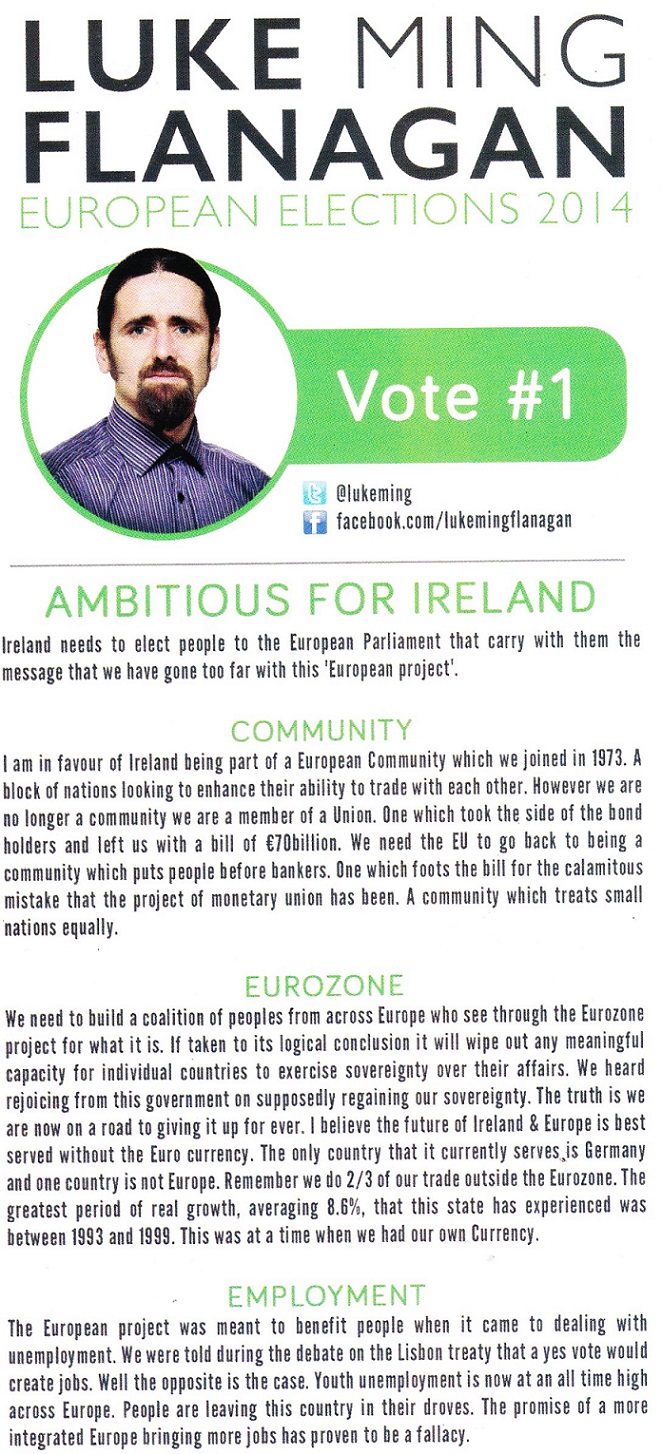
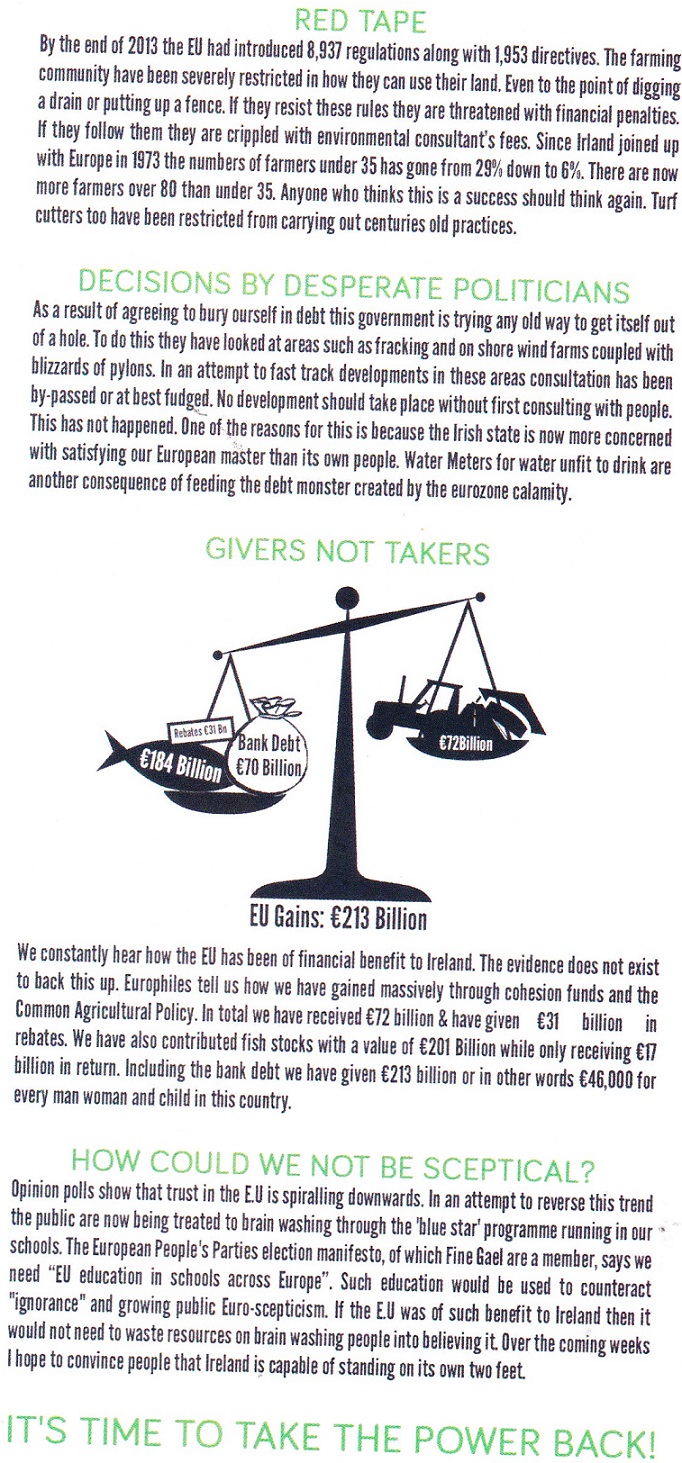
Read that leaflet: It’s all about returning power from Brussels. The 2014 Luke Ming Flanagan wants to cut red tape. He wants to abolish the euro and bring back the punt, or some other national currency. 2014 Luke Ming Flanagan says that the EU hasn’t been of financial benefit to Ireland, and had cost us (to that point) some €213billion – an extraordinary sum by anyone’s measure. He says he wants the “EU to go back to being a community which puts people before bankers”, which seems to be a call to reverse much of the EU integration resulting from the Maastricht, Nice, and Lisbon Treaties.
That was the platform on which the voters of Midlands North West initially elected Flanagan. Objectively, very very little of it was accomplished.
The 2024 version of Flanagan has not, it should be said, abandoned euroskepticism entirely: He is resolutely opposed, he says, to any kind of EU policy on common defence. Aside from that, however, this is an almost entirely different politician to the one sent to Brussels a decade ago to return sovereignty to the people.
Why is that?
Part of the reason, I’d argue, is that Brussels is so remote from one’s constituents: An MEP who goes to Brussels will spend far more of their social time and work time with other MEPs than they will spend with the people who elected them. The natural human desire to conform and fit in – especially in a new place – is significant. A natural mellowing is almost certain to occur, as even the most hardened euroskeptic may find that some of the eurofederalists are genuinely nice people whose ideas – however terrible – are born of good and virtuous intent.
There’s also the iron law of bureaucracy to consider, which posits that over time people become institutionally loyal to the institutions that they work in, often to the detriment of the purpose of the institutions themselves: Thus a long-serving teacher will defend a school from criticism because it is his place of work; often forgetting that his place of work is designed to produce well-educated students first. It would only be natural for someone who has spent a decade of his or her life working at the heart of the EU to develop an institutional loyalty to the EU, and the instinct to defend it from its critics. By no means is Flanagan alone in this failing – it happens to people right across the political spectrum.
The other problem is what we might call the difficulty level – a concept people who play computer games will be familiar with. Put simply, the kinds of changes Flanagan proposed in 2014 are very hard to accomplish, and would have put him at odds with many colleagues. Implementing them would have required superhuman powers of persuasion. Faced with an impossible task, many people will naturally lower their ambitions and re-cast the job altogether. Flanagan’s new message, therefore, is that while he might be unable to return powers from Brussels, he can at least still stand up for Irish farmers at the agriculture committee. This is easier to accomplish – therefore, it probably feels more like the right thing to do. Humans have a natural bias in favour of the doable, rather than the principled.
One of the problems with this kind of change though is that it is detrimental to democracy. Flanagan’s views of the EU may have changed because he has worked in it and experienced it and discovered that it’s not so bad after all – but that doesn’t mean that the views of those who elected him in 2014 have necessarily changed in tune with his. Many of them may still believe that they are voting for a euroskeptic who’s going to take the fight to Brussels, as opposed to somebody who is going to take the fight to Brussels’ critics.
Flanagan is a very different candidate now: An incumbent, with universal name recognition, as opposed to an upstart outsider trying to crack the system. He is still favoured to win, but as an insider this time rather than an outsider.
This is the circle of political life: The political system – whether it be in Dublin or Brussels – is excellent at capturing and co-opting politicians to become defenders of the system. Today’s outsider is tomorrow’s “we must work within the system” pragmatist.
It’s one of the reasons, I think, why term limits are an excellent idea. Luke Ming Flanagan can’t be blamed for becoming a much more pro-European moderate after a decade in Brussels. But at this rate, by the next election, he’ll be 180 degrees removed from the Euroskeptic voters sent to Brussels to fight for them.
Voters should be more conscious of that than they are, I think.