RTÉ’s Upfront last night hosted an interesting discussion on whether Irish should no longer be made a compulsory subject for state exams.
The debate took place in the context of the fact that tens of thousands of Junior and Leaving Certificate students are already exempted from the subject,, largely apparently because having to study Irish for exams is a cause of “anxiety.”
Brenda Power made the case for the ending of the requirement on the basis that Irish is “not a living useful language,” and that there is “no advantage” to knowing Irish.
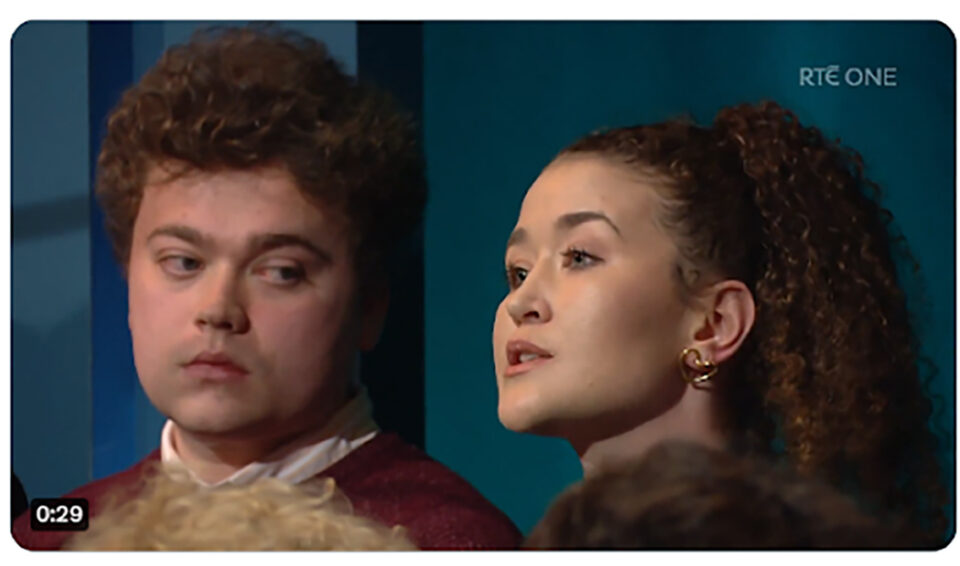
I will jump right to the end of the programme because that utilitarian claim was answered succinctly by an audience member who questioned the concept of “usefulness” itself in the context of education and teaching things that “don’t bring home money.” “Is there room for philosophy?” she asked.
Power did make one good point regarding how the language is taught – which she also referred to on the Upfront WhatsApp which featured a discussion on the same subject between Power and Patricia Nic Eoin. Power expressed the belief that teaching of Irish should be immersive with the emphasis on encouraging proficiency in the spoken language.
Julian de Spáinn, Ard Rúnaí Chonradh na Gaeilge, agreed with Power on the way that the language is taught. However, he correctly pointed out that deficiencies in that regard have been down to the manner in which the state since its foundation has dealt with how Irish is taught and treated, within the context of the ethos of a state that is supposed to be committed to the revival of Irish as the language of the people of Ireland.
De Spáinn noted that the momentum behind the living language outside of the Gaeltachts has come from the Gaelscoileanna which have been established by parents and communities and which have helped to foster not only a successful means of teaching Irish, but have also contributed to the popularising of Irish in the community generally, as reflected for example by the phenomenon of Pop Up Gaeltachts around the country.
Fianna Fáil’s Niall Collins appeared to attempt to take some of the credit for the Gaelscoilleana on behalf of presumably his own party and the state. Well, anyone familiar with Gaelscoils in Dublin and elsewhere will know that the state for many years was not only far from supportive, but in some cases placed barriers in their way. It was not unknown either at one time for parents involved to be the targets of Special Branch attention.
If the opinion of 3 of 4 of the panel, and of the vast majority of the audience and of those who have commented online is any guide, then most people are opposed to doing away with “compulsory Irish” – if for no other reason than as Snn Féin’s David Cullinane said, that at least having been taught Irish in school provides a foundation for anyone who wishes to expand their knowledge and use.
There is of course a whole other dimension to this. Preventing Irish from being marginalised and eventually destroyed – as has long been the desire of the most deracinated of our people across all political views and social backgrounds – is not sufficient.
If the language is to thrive then there needs to be practical and radical measures taken. The Gaelscoils and other community driven efforts are vital, but the state from the very beginning one hundred years ago ought to have made Irish the basis for all education and all state administration.
It ought also to have ensured that the places where Irish was still a living language were part of the economic development of the country – especially in fishing and other neglected local natural areas of advantage – rather than being allowed to all further into the poverty and lack of opportunity and work for the people living there who emigrated in huge numbers.
The failure to do was excoriated by Máirtín Ó Cadhain and others and contrasted to the platitudes of a ruling elite who lacked the vision and the political and economic will to make a reality of the commitments made by those who had put them into power after the English left the 26 counties.
Any serious effort needs to begin with each individual who believes that the language is not only important, but that its use ought to permeate all aspects of public life in Ireland. The late Breandán Ó Doibhlin pointed out that 15% of the population speaking Irish as a first language would represent a critical mass at which point it would become a central part of the life of the country. We are a distance from that, but it is an achievable and modest target.
My own connection is modest. I read a lot in Irish and listen a lot to Raidió na Gaeltachta. The opportunity to speak is rarer but there is certainly more now, both in person in Dublin and other parts of the country outside of the Gaeltacht and through various online forums than there was in the past. That is my perception at least.
One of the contributors to Upfront, who came here as an immigrant as a child but was educated in a Gaelscoil, noted how knowing Irish had made her more aware of what being Irish actually means. That is something that many Irish people appear to have lost sight of.
And while the language as a living means of communication in a modern context is hugely important, it would be a mistake to regard it simply as that, and to jettison the literary and oral and musical tradition that embodies its ancient soul. No one would seriously argue that English be taught in schools by replacing Shakespeare and Dickens and Shelly with hip bop. Or perhaps they would!
That high tradition will not endure if the surviving Gaeltachts continue to be subject to external assault in the relentless quest to make everything a function of how the progressive Irish state facilitates its own absorption into corporate-driven blandness. The living communities will not survive if this generation is forced like previous ones to leave because they cannot afford to live where they were born, or cannot find work close to where they were born.