Most of those who turned up at the Justice Committee yesterday to listen to a presentation from, and present questions to, Garda Commissioner Drew Harris and several of his colleagues including Assistant Commissioner Angela Willis who is in command of the Dublin Metropolitan region, focused on urgent matters facing the force.
The two main themes were the level of resignations within AGS as compared to recruitment, and of course public safety in the midst of ongoing concerns regarding anti-social and criminal behaviour on the streets of cities and towns. Questions were also put to Minister Helen McEntee when she appeared before the Committee later in the afternoon.
The Minister said that while the failure to meet the target of 1,000 new Garda recruits to Templemore training college was disappointing, that they would manage to have more than 800 new students in Templemore by the end of the year.
It was apparent, however, that most of the TDs and Senators who participated were expressing real concerns on behalf of their constituents regarding both the reality and the perception of real crime.
Not so two of the other TDs who decided that there were more pressing issues to be pressed, again. For a moment, while listening to Dublin South Central Green Party Justice Spokesperson Patrick Costello, I thought that I had committed an not uncharacteristic technical error and reloaded the Oireachtas video of the Joint Committee meeting of October 24.
The reason being that Deputy Costello repeated in almost the same words his concern that the Gardaí are not “doing anything” about what he clearly believes is the most urgent policing matter in the state; viz, the For Roysh.
These boys and girls are apparently only one black shirted – or black bubble-jacketed – March on Dublin away from seizing power and misgendering people like there was no tomorrow.
Costello also managed to throw in by way of contrast the “heavy-handed” – which he quickly qualified as “robust” – approach to protests, of which he presumably approves, such as illegal occupations, to the promiscuous attitude of The Man towards the Fash. Fair enough, he did not use that word but you know yourself.
He was talking about people who are behind a “new wave of violent protest” and who are apparently all set to extend this widespread campaign of terror to teachers and schools.
Costello happens, for the time being, to be a TD for the Dublin South Central constituency which covers not only some of the most deprived parts of the country, according to the recent Pobal mapping of deprivation zones, but also some of the areas worst affected by crime and anti-social activity in the state, never mind Dublin.
It would be safe to assume, I think, that the threat of For Roysh extremists wreaking havoc due to their “anti-democratic view of the world” is pretty far down the list of things crime related worries that occupy the minds of residents of the Liberties, Crumlin, Walkinstown or Ballyfermot. Unless of course the For Roysh are the ones doing all the muggings, house-breakings, drug dealing, shop-lifting and so on and so forth. In which case I profusely apologise to Deputy Costello.
Speaking of drug dealing, another left liberal TD but of a different party; namely Labour’s Aodhán Ó Riordáin, also returned to one of his favourite topics and one which he had also broached at the Committee meeting two weeks which had been attended by members of the Garda Representative Association.
That day, Ó Riordáin expressed his disappointment with the Restaurant Association which had objected to the proposed heroin injection centre on the south quays. Deputy Ó Riordáin had implied that the nearby St. Audeon’s school which had objected to the proposal had been funded in their legal action against the injection centre by others, which anyone listening to the exchange would have assumed meant the Restaurant Association of Ireland or local businesses.
Yesterday, Deputy Ó Riordáin questioned the Garda Commissioner about the force’s attitude to injection centres and to the issue of possession of drugs for personal use.
Ó Riordáin put it to Harris that it might be helpful, and indeed persuasive in getting other people to accept having shooting galleries on their doorstep or beside their child’s school, if the Commissioner was to express his support for such a happy and “more humane” way of ensuring the comfort of marginalised junkies.
Naturally enough, Drew Harris was not falling for that one. He confined himself to observing that such centres bring their own “downsides,” including complaints by local people (seemingly a trivial matter for our left liberals) and other “policing issues.” Harris was not having a bar of the “personal possession” one either, nor of Ó Riordáin’s implication that the Gardaí ought not be arresting people for this.
Harris made the completely obvious fact, as Gript and other more worldly types have previously, that introducing personal possession laws are a god send to drug dealers. That is the men who ultimately sit at the top of the pile in some sunny bolthole and order assassinations and tortures.
Harris told Ó Riordáin that any increase in the number of arrests for “single possession” is because the Gardaí know, as does anyone who lives in an area where illegal drug dealing and use is prevalent, that a large proportion of the business is conducted through what Harris described as the “couriering of single amounts.”
Legalising possession for personal use would be a boost for the drug cartels on par with the state deciding to supply trucks to deliver merchandise from the supermarket warehouse to their retail outlets.
Portugal is to the left liberal advocates of legalisation of drugs what Sweden was to the advocates of mass immigration. Both models are obviously flawed but of course our own lot who pride themselves on their cosmopolitanism are notoriously slow to cop on to failure in other parts of “Yourip” before they get the chance to mess up this place first. So, given that they prefer to deal in simplicities, ponder the simplistic table on drug ODs from the Sweden of shooting galleries.
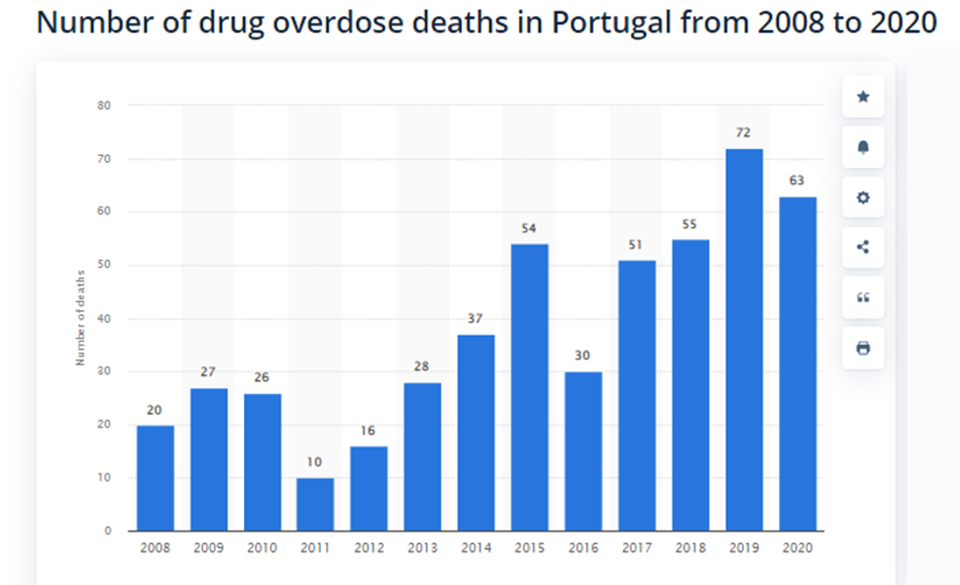
Drug overdose deaths in Portugal 2008-2020 | Statista