If you are a Fianna Fáiler or a Fine Gaeler looking for crumbs of comfort in yesterday’s Irish Times MRBI opinion poll, the good news is that such crumbs are there. The parties have a combined share of 38% of the vote, edging out Sinn Fein on 34%. Individually, 18% and 20% are not good results, but collectively the two parties that most identify with centrism in Ireland (honestly, or dishonestly) can still say that their steady as she goes brand of politics commands more support than Mary-Lou McDonald’s more radical (again, a matter of interpretation) approach to politics and policy.
But that’s where the good news ends, because underneath the hood of the poll, the results are brutal. Look at this graph, which is courtesy of the Irish Times:
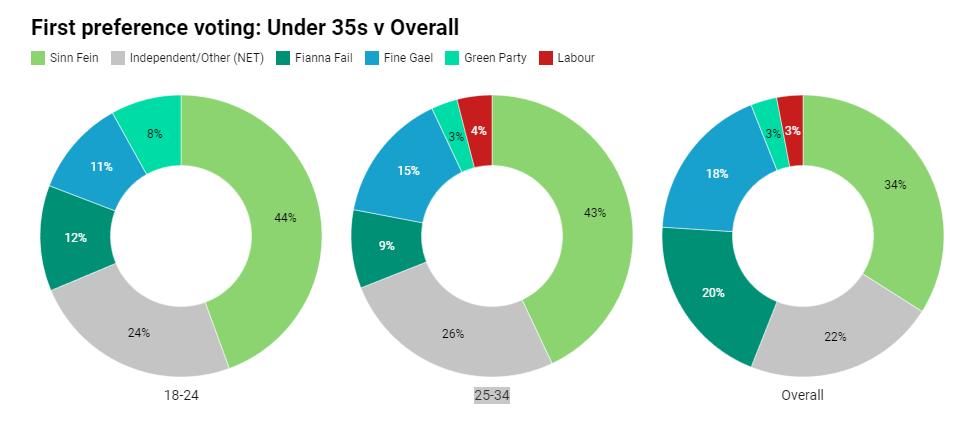
Amongst the youngest voters, FF and FG combine for just under a quarter of the vote. Sinn Fein and Independents, by contrast, muster over 70% between them. Only the Greens, with the very youngest voters, have any other support at all amongst the youngest voters.
The youngest voters, incidentally, are also the voters who are going to be with us for the longest time. And the overwhelming message from these numbers is that as far as they’re concerned, political centrism is as good as dead.
Most of the attention, naturally, will focus on the affinity of those voters for Sinn Fein. That, I think, is to look at things in a much too short-term way. The much more interesting result is the huge chunk in that age-group who have abandoned mainstream party politics altogether, and are looking to independent candidates, or others.
Indeed, if you accept that a vote for Sinn Fein is a vote for radicalism, and a vote against the political system as currently constituted, then you might say that 7 in 10 Irish young people are actively seeking some kind of radical alternative to business as usual. That has implications in the longer term that are probably much more interesting than simply looking at the next election.
It is a racing certainty, based on how Irish politics is currently aligned, that Sinn Fein will enter Government at either the next election, or the one that follows. And it is a racing certainty, because it always happens, that many people who voted for Sinn Fein will become disillusioned with the party after it takes the reins. This has happened to every Government in history, and there is no reason to expect it to change.
The question then is where those voters ultimately go, once they’ve – to one extent or another – lost faith in a Sinn Fein Government. Fianna Fáil and Fine Gael would probably hope and assume that they will simply learn their lesson, and go back to the old way of doing things. This is the “a period in opposition would do us good” line of thinking. But there’s every reason to believe that is untrue.
For one thing, a large cohort of voters in that agegroup already exists who do not support Sinn Fein and do not support Fine Gael or Fianna Fáil. For another thing, it can convincingly be argued that much of the vote currently with SF is as much an anti-FF/FG vote as it is a pro-Sinn Fein vote. For a third thing, political scientists widely agree that Sinn Fein is hoovering up votes from both angry young left wingers, and angry young nationalist-leaning voters whose concerns relate to things like law and order and immigration. They will not be able to satisfy both wings.
And for a final thing, Independents and Others have intrinsic value, but very often votes parked in that column are votes that are really saying “I have nothing and nobody to vote for”.
In other words, if the current hunger for change is being expressed in support for left-wing radicalism, there’s every reason to believe the response will not be a return to centrism, but a shift in favour of right-wing radicalism.
Either way, the message is clear: Young voters have had it with Fianna Fáil, and Fine Gael, and Labour, and broadly speaking the rest of what you might term the centrist establishment. That shift might be cushioned in the near term by older voters – some of whom are still locked into the voting habits of a lifetime. But there’s a lesson even in that: The voting habits of a lifetime last. Younger voters who’ve turned on the old Irish establishment today will be very, very hard to win back to it. We may well be living through the first, and last, FF/FG Government.