The Irish Times has amended its headline in a report on an Irish Medical Council (IMC) hearing in regard to Dr Marcus de Brún, removing the term ‘misinformation’ from the piece.
Following the hearing, both the Irish Times and RTÉ reported on the finding of the regulatory body, saying that Dr de Brún, a Dublin GP – who is a former member of the Medical Council – was found “guilty of misconduct over Covid-19 misinformation social media posts”.
However, neither article subsequently mentioned “misinformation” anywhere in their reports on the IMC findings – and Dr de Brún says that he had never been accused in the allegations before the IMC of ‘misinformation’, nor had the regulator found against him for ‘misinformation’
Dr de Brún said that after the Irish Times had been contacted the headline had been changed, but said he didn’t expect an apology “any time soon”.
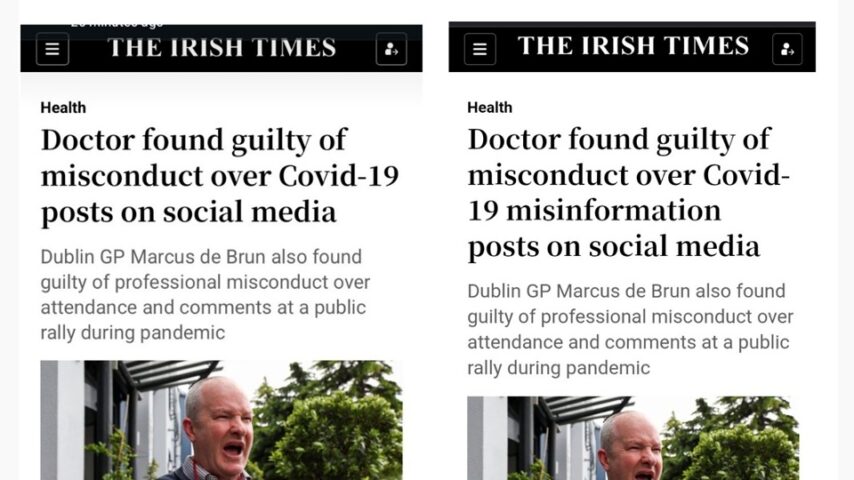
Speaking to Gript, Dr de Brún, said that the word misinformation “wasn’t mentioned once, either in the allegations to the Medical Council or in the hearing, yet it appeared in both headlines.”
He said that he found it curious that the same word had been used by both publications in the headlines, but not in the body of the report.
It is common practice for a headline and sub-heading to be written by an editor or sub-editor.
“I have never been accused of putting up misinformation by the regulator,” Dr de Brún said, adding that it was his belief that accusations of misinformation were used during the lockdowns to “rein in medical professionals “who might have disagreed with Covid policy.
“It’s a word that is used to suggest the person is being misleading” he said, saying that he felt it was a often used as distraction to take away from the deaths in the nursing homes and other things that happened during the Covid period.
He said that in this instance, the media involved were “using the word misinformation to create misinformation”.
“I always thought that questioning was essential to the medical profession – including having the freedom to question guidelines or medical treatments,” he said.
The Dublin GP gave the Thalidomide scandal and harm caused by swine flu vaccines as examples where the right of medical professionals to speak freely had significant positive consequences for the prevention of harm.
He said that questioning public guidelines seemed to be portrayed as something close to a crime, and that the IMC’s ethical guidelines for doctors do not demand blind obedience to public guidelines but instead allowed doctors to exercise independent clinical judgement and act in the best interest of patient safety.
He said, for example, that doctors who had concerns or who were apprehensive regarding the speed with which the Covid vaccine came to market found that debate was completely shut down.
Dr de Brún was found guilty of professional misconduct by the Irish Medical Council on June 4th over social media posts during the Covid period that had been critical of public health guidelines and of Covid-19 vaccines.
Dr de Brún told the IMC that he raised concerns on social media because when he had attempted to do so with the IMC those concerns were “flatly dismissed and ignored”.
The IMC also upheld complaints regarding Dr de Brún’s attendance and comments made at a public rally in August 2020, where they said he failed to maintain social distancing or wear a face mask.
The chairperson of the IMC inquiry, Prof Deirdre Murphy, said some of the comments made by Dr de Brún were “grossly irresponsible”.
She claimed posts that suggested lockdowns were unnecessary and introduced for nefarious purposes were “very concerning”.
However, Dr de Brun told the inquiry that he had used strong language in social media posts in order to get to get people thinking about the issue
“I still believe vaccines for children were grossly wrong,” he said – adding that he had attended the rally in August 2020 during the lockdown as nursing home patients were dying at an alarming rate “because of government policy and neglect”.