Irish dancing is seldom the occasion for heated political debate. That, however, changed dramatically when a girls under-14 heat held in Dallas and organised by An Coimisiún Rincí Gaelach was won by a boy who had decided that he was now not a boy.
The boy had previously been successful in competitions for boys, and the fact that he finished 11th in the 2023 boys World Championships has added to the claims that he is competing unfairly against girls.
NEW: A teenage boy who identifies as a girl is heading to the Irish Dancing World Championships after placing first in the girls U14 2023 Southern Region Oireachtas.
I spent all of this week talking to the outraged parents of girls he danced against.https://t.co/ONDBNT1TK4
— Mary Margaret Olohan (@MaryMargOlohan) December 7, 2023
The Daily Signal reported:
“Oh, my gosh. It’s going to make me cry,” said one mother, whose daughter danced in the same competition as the trans-identifying boy in the Dallas, Texas, event. “I never thought I was going to have to deal with this. And my heart breaks for my daughter and the other girls that are having to deal with this. They are too young to have to deal with topics that are going on in society, that are adult topics, that they don’t quite comprehend yet.”
“They just look at it as unfair,” she added emotionally. “And it’s really hard to explain to them what’s going on and why they have to accept it. That’s what society’s making them do. As a mom, I want to be an advocate for my daughter. But at the same time, I have to protect my family.”
In support of the trans dancer, some have argued that there is no physical advantage in Irish dancing, but that has been disputed by others.
Their point is that the integrity of the competition itself has been undermined by the fact that a biological male could be allowed to compete against girls, simply on the basis of a subjective decision on his part to identify as a female.
So while it may not strike anyone as obviously unfair or even absurd as other controversial decisions in athletics and college basketball, the decision by ACRG to allow the boy to compete does in fact make a nonsense of the grading of Irish dancing on actual gender grounds.
Irish dancing has fallen. The next World Irish Dancing Championships are in Glasgow in March 2024. It will be interesting to see how Ireland responds @CLRGIrishDance https://t.co/LNdR98FKXA
— Colette Colfer (@ColetteColfer) December 8, 2023
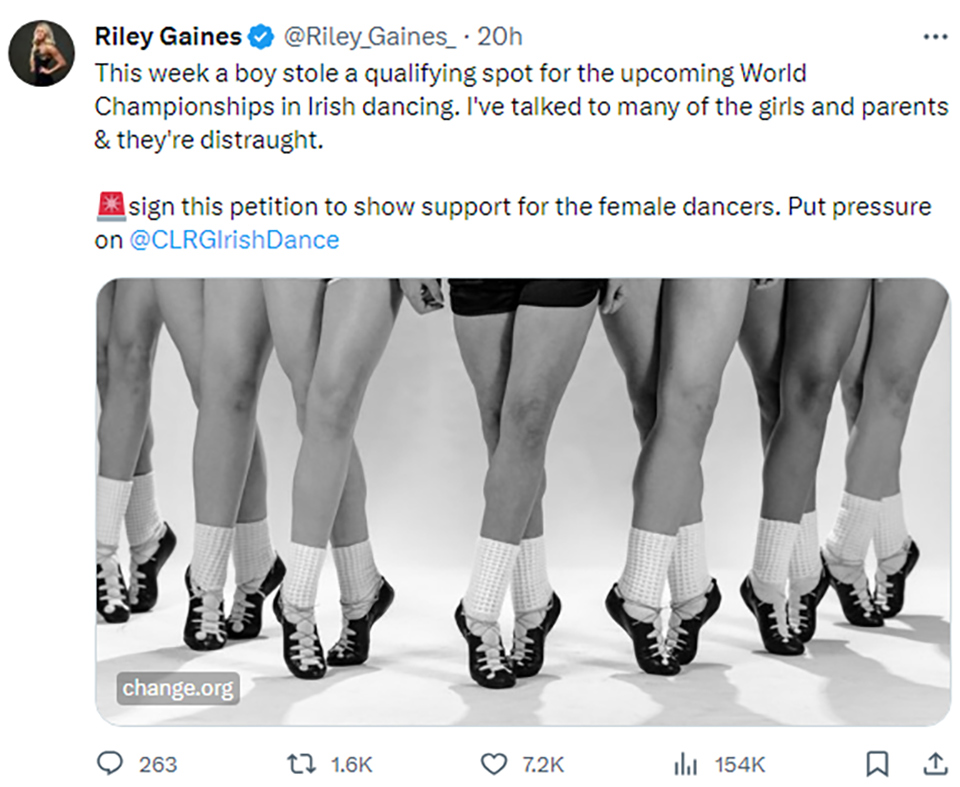
One of the most vocal critics of this over the past number of days has been Riley Gaines, the former University of Kentucky swimmer who tied with a transgender participant, Lia Thomas, at the 2022 NCAA swimming championships.
The fact that the boy was allowed to even compete in the US Southern Region Oireachtas had been objected to prior to the event by parents of the girls taking part.
Since then, others have joined the ideological fray, arguing for one side or the other. The American Irish liberal outlet, Irish Central, chose to see it as a victory for equality and fairness. What is not, one may ask.
Activist Gabrielle Siegel seems to have begun a petition seeking names in support of what she claims, on the part of the “Irish dancing community,” is “the right of transgender dancers to participate in our sport.”
Having perused Ms. Siegel’s Twitter, I am not certain as to how intimate she is with the said dancing community.. Among the points she makes is that “Irish dance is, and has always been, a multi-factorial result upon which no assigned birth sex can confer a biological advantage.”
I am not certain as to the exact point of that, but she does appear to believe that Irish dancing is pretty much like chess or another non-contact sport in which both male and female can compete on a level playing field. Which is to miss the point. While you cannot kick or trip one’s opponent – and as a veteran of endless days spent with my sisters in the Mansion House it was once my dearest wish that this might happen so that we could all go home – science would suggest that teenage boys are physically stronger than girls of the same age.
Does this confer an advantage if dancers have to perform over several heats through a long and exhausting day? There is an alternative petition, one that calls for the governing body to “protect female dancers’ rights.” As with others who have objected to the participation of boys and men in sports, the petitioners argue on behalf of the need to protect the integrity of Irish dancing, and to ensure that girls are not unfairly disadvantaged. You can read it here. It was outpolling Siegel’s 2:1 the last time I checked.
In these mad times, it is sometimes good to sit back for a moment and consider where all of this is going. So-called “TERF” feminists have the historical sense to recall why it was once important to preserve women’s and girl’s spaces. It was once regarded as a radical position. It was one time a position of the political left.
What has happened to common sense?