While nobody has the right to attempt to stop any group meeting to peacefully discuss any topic, my kneejerk reaction to the controversy surrounding the proposed Peter Thiel event here was not “Oh, if our enemies are against it, then they must be our friends.”
It was to have taken place in the Powerscourt Hotel but the owners, MHL, cancelled following complaints mostly centred on Thiel’s company Palantir’s associations with the Israeli military. According to reports, six Irish people were invited; three of them from the legal sector, one a senior civil servant, a “content writer,” and Senator Lynn Ruane who appeared somewhat nonplussed about it all.
The bulk of the invitees are heavy hitters. Among the names found on a leaked list were Elon Musk, former US army general Stanley McChrystal, US treasury secretary Scott Bessent, US senators Cory Booker and Ted Cruz, German MP Jens Spahn of the CDU, British Tory MP Tom Tugendhat, and chess grandmaster and Russian dissident Garry Kasparov. There is also a spattering of major tech/AI company owners.
The topics apparently included war technologies, sex, cults, money and happiness and intriguingly “Build a Party” to be delivered by someone described as a former White House national security official. It is the latter rather than the nerdy Randian (pardon the pun) stuff that might be of interest to ourselves.
Wicklow just happened to be the venue chosen and probably not that much attention would be paid to Ireland but it is clear that certain people are interested in what is happening here and that this is reciprocated by certain people here who crave the imprimatur of the American MAGA Levithan.
There are reasons for the interest of Thiel and others. A recent essay by Peter Ryan, who writes about Ireland from a uniquely Irish-American perspective, looks at some of those reasons in the context of the global economy and the Irish state’s position delicately balanced between Boston and Berlin, as former leader of the now dead (but clearly not forgotten) Progressive Democrats once described it.
Ryan describes the dilemma in the following terms: “Ireland stands at a tech fork in the road: double down on its reliance on American tech giants, or begin the difficult shift towards European tech sovereignty. One well-trodden path leads to dependence and distortion. The other calls for radical change but points towards independence and development. Ireland’s choice will determine the success or failure of businesses across the country and the very character of its politics.”
Ryan points to the growing conflict between the Irish elite’s dual position as “teacher’s pet to the European Union (EU),” and the fact that “its economic interests … are identical to American ones.” Something that was underlined by the Irish state’s support for Apple in the EU tax evasion case, and the almost embarrassed pocketing of a large tax windfall when Apple lost.
The elite, and its satellites’, potential nightmare is that “If American firms see Ireland as unreliable in protecting their benefits and advantages for doing business in Ireland, then American firms may leave. Thus, Ireland must be the attack dog for the American firms inside European politics.” All the while – and despite having their nose rubbed in it by the Commission over Mercosur – stuck in a similarly subservient relationship with Brussels, one that was copper fastened by the humiliating bank bailout.
Ryan poses the possibility that the Irish economy might become the victim of American isolationism which is more aggressive about protecting and expanding its own corporate sector, and the EU’s own plans to create a strong independent tech/AI sector that is not overwhelmed and forced into dependency by American and Chinese Capital and know-how and political power.
The Irish elite seems to have opted for the Americans. Something that is illustrated by its uncritical welcome for data centres which as I noted recently use 22% of the national electricity supply compared to around 6% in the US itself and the UK.
Ryan claims that this is evidence that “even the general Irish economy is being sacrificed for the narrow interests of the American tech firms and the minority of Irish compradors that directly benefit from them.” At what stage do corporate tax revenues, mass immigration driven by the needs of overseas Capital, and the expanding demands on all resources and provisions from housing to policing, become a clear negative?
According to Ryan, this unhealthy relationship will lead to a closer relationship between the Irish elite and MAGA that will be reflected in politics. On the face of it, given the almost unanimous political and intellectual disdain for Trump, that appears unlikely. That could of course change for if ever there was a stereotype of a class which would sell its mother if the price is right, then our ruling “elite” tick all the boxes.
There is also interest from the other side, so it would be intriguing to have known whether that might have featured at the Thiel hootenanny. The spidey senses of some aspirant Irish Trumps have been alert to the possibility of support, although it is difficult to imagine that they might be taken seriously given their lack of traction.
Ryan suggests that it would be ironic if the strong opposition to mass immigration – so far political inchoate – was to be channelled into support for individuals or perhaps a new political party who might use the easy target of illegal immigration while at the same time being tied to American interests whose Irish based corporations are the main driver of immigration for work.
He suggests that if such a formation were to emerge with American backing that “given the non-existent ideological doctrine (outside of emotional reaction) of the American-favored faction of the nascent right-wing populists, it’s likely the ideological vacuum will be filled by prepackaged neoliberalism sprinkled with Trumpian grifter vulgarity and incompetence.”
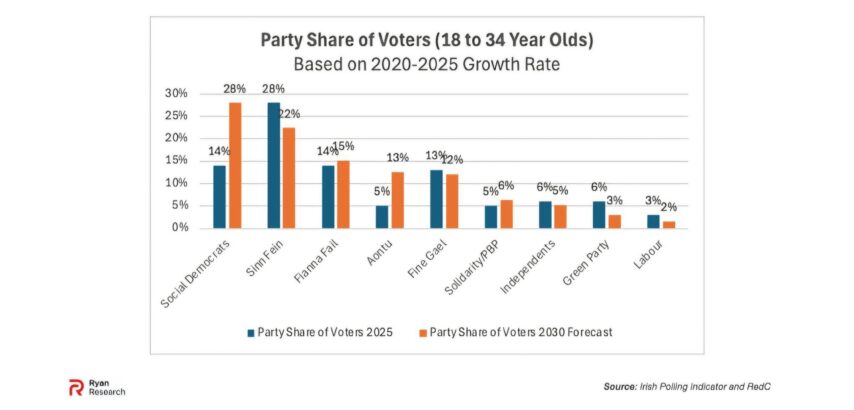
He himself makes an interesting forecast on likely party-political support and government formation based on current voting preferences among younger people. This, Ryan, predicts will hugely bolster Aontú, as well as the Social Democrats in particular and Sinn Féin. None of these parties have a problem with American investment and there are no domestic business or political forces with any incentive to take the EU side in any contest with American tech.
Interestingly, and perhaps counter-intuitively, Ryan believes that the ‘Kneecap generation’ – currently one dimensionally ‘Woke,’ will become a major force for questioning the establishment as it becomes increasingly marginalised due to pressures on jobs and housing from immigration, and with its own avenues of ‘escape’ increasingly restricted by global economic forces.
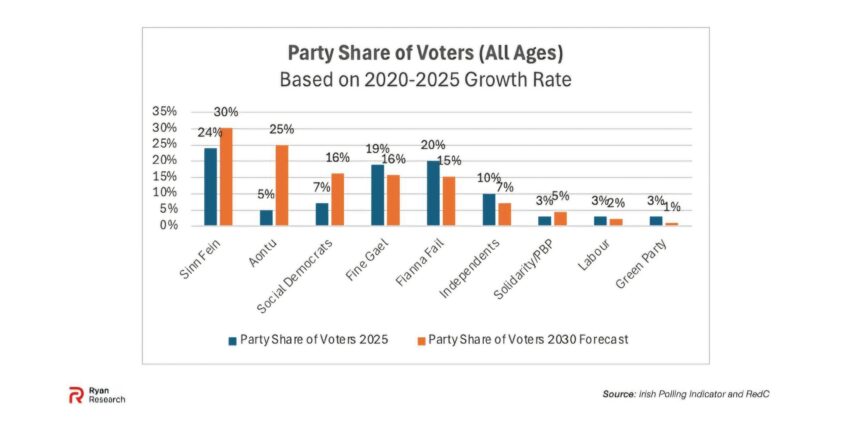
“The second wild card is simply the indigenous culture of Ireland. Ireland faced 700 years of British attempts to stamp out Irish particularity. No matter how many times it was kicked down, it always found a way to get back up and reassert its individuality. In the 17th century, William Petty wanted to exploit Irish land for cattle at the expense of the Irish people. Today, American tech firms want to use Irish land for data centers at the expense of Irish people. There’s no reason why the Irish zeitgeist could not manifest a similar immune response as it did towards the English if sufficiently stimulated. Perhaps this is wishful thinking, but it’s something you can never count out.”
Where the seemingly superficial ‘Kneecap’ generation might make point of contact with those older traditions is through the language and the cultural basis of Irish nationalism. Indeed, there is an apparent paradox where some of those vocal on the ‘nationalist’ right make little secret of their own antipathy to the Irish language in particular and have accused the left of “weaponizing” Irish.
Where the ‘Kneecap’ generation is by and large republican in its reinvented ‘border poll’ mode, a minority on the ‘nationalist’ right have reached out to loyalists.
A mess of contradictions then: ones that might be resolved with reference to Clinton election strategist James Carville’s reminder that when it comes to large numbers of people making key choices “It’s the economy, stupid.”
The more people come to realise that their economic position and security and the ‘social contract’ that has maintained basic stability in the Irish state for 100 years is under threat, the more likely it is that they will seek for the reasons.
Those reasons are inextricably connected to the dominance of overseas Capital here – and the radical reshaping of Ireland that has already been profound but may be in for another steroid injection as AI transforms the global economy of which this island is a powerless, floating industrial and financial centre relative even to the powerlessness of other sovereign states.
Interesting times ahead.