Teachers at the INTO conference today have rejected a proposal that the educational body would work with the Department of Education to remove single-faith religious education from the school day in state-funded schools.
While other sections of the motion which sought to protect teachers with a minority faith or no faith were approved, teachers spoke strongly against what they saw as a “blanket removal” of faith lessons from schools – and pointed to the results of an INTO survey which had found that just one in five teachers objected to teaching religion.
Teachers voted at the Congress by a significant majority in opposing against section 4 of the motion – with 285 opposing while 196 supported the proposal.
The motion affirmed that the INTO Congress remained committed to extending protections to teachers of minority faiths and those with no religious affiliation and acknowledged that requiring teachers to obtain the Catholic Certificate in Religious Studies is a discriminatory barrier to employment, limiting access based on religious grounds.
Those sections were approved as were resolutions to advocate for further amendments to Section 37 to strengthen protections against religious discrimination and make formal representations to all TDs to stress the urgency of legislative reforms to eliminate any form of discrimination against teachers in educational settings, including discrimination under the religion ground.
However the proposal that the INTO work with the Department of Education “to remove single-faith religious education from the school day in state-funded schools, beginning by ending the requirement for teachers to conduct sacramental preparation” was defeated.
Speaking to Gript, teachers said that the “full removal” of religion “seemed very extreme” and had been rejected by teachers because “most parents and teachers and children were not looking for that step to be taken”.
One teacher, Caroline Moore, said that she said it was “important to work out what is filling the gap if religion is being removed” and that she had concerns that what was happening was that ideology such as gender identity seemed to be taking its place.
She said that she had no issue with the sections of the motion that sought to strengthen protections against religious discrimination or with adapting the curriculum to include other religions but that the motion had “gone to extremes” in seeking “the full removal of religious education from faith-based schools – which would essentially end state-funded schools being faith based”.
“INTO’s recent survey only had 19.5% of teachers responding they’d prefer not to teach religion, with 3% wanting to opt out. That is clearly not a mandate to end faith-based schools. What teachers and parents want want is to have a choice” – adding that she and others agreed that children who did not want to participate in sacramental preparation needed to be catered for in an inclusive way.
Another teacher, Helena Byrne, told Gript that it was not discriminatory against children of other faiths to have religious education in schools – and pointed to the UN Universal Declaration of Human Rights which said “parents have a prior right to choose the kind of education that shall be given to their children.”
She said that many parents and teachers believed that “having a firm foundation of faith can help people through hard times” and that “religious involvement and/or practice which Catholic education helps to foster, is proven to improve health outcomes and can help children with anxiety and other issues.”
She said that, in her experience, most families and most teachers were not hostile to religion in schools and that “anti-religion” views were often over-represented in media reporting.
A motion passed at last year’s INTO conference sought to establish a taskforce on the future of school patronage. A survey sent by the union to a random sample of 5,000 members received a response from 1,049 teachers, or a 20% response rate.
The results of that survey showed that 33% of respondents said they taught religion willingly, while 20% said they would prefer if they did not have to teach religion, and an additional 19% said they would be happy to teach a broad religious programme but would prefer not to instruct in only one particular faith.
A huge majority of respondents (87%) said that pupils attended their faith denominated schools who are not of the faith of the school. The survey found that while 57 per cent of respondents believed faith formation should not take place in primary schools, 43 per cent support continuing the practice.
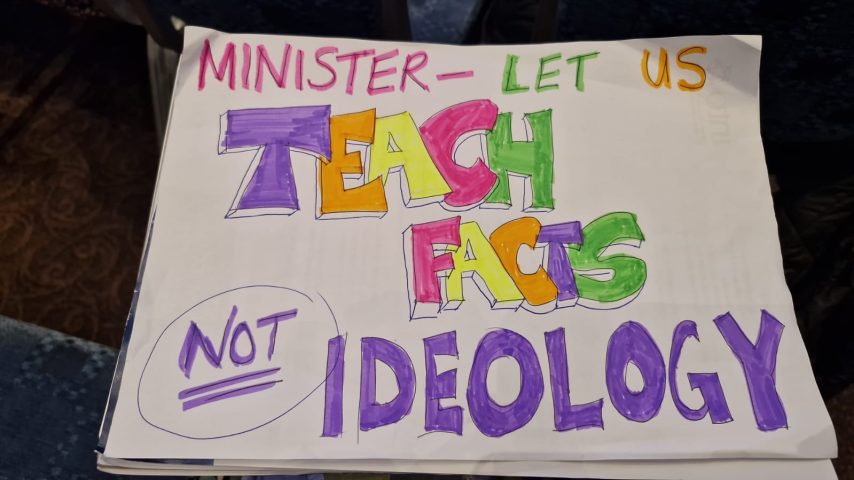
Yesterday, a teacher attending the Irish National Teachers Organisation conference this week said that she and others held up signs saying “Biological sex = Fact” and “Minister: Let us teach facts, not ideology” as Minister for Education, Helen McEntee, spoke to the gathering, because she felt the Cass report raised issues that required urgent attention.
Aisling Considine, who is also a candidate for Aontú, said that motions which sought the removal of gender ideology from the curriculum were not heard at the Congress – and that an emergency motion put forward by Caroline Moore which sought a pause on the use of materials on transitioning primary school children pending the outcome of legal actions taken by Drs Paul Moran and Dónal O’Shea regarding a review of treatments for children with gender confusion was not heard.
“Despite the common law judgement in the UK that recognises woman as being based on biological sex, not gender identity, in the Equality Act 2010, and despite two senior doctors in Ireland bringing legal action against the State’s transgender policy, this government still persists with the farce that a woman is anyone who identifies as such,” Ms Considine said.
“The new Anti Bullying programme ‘Bí Cineálta’ being rolled out in schools across Ireland makes reference to gender identity and trans identities. We wanted to protest the inclusion of ideology in teaching in Ireland so we held up signs saying “Biological sex = fact” and “Minister, let us teach facts NOT ideology!”
Some 88% of primary schools in the Republic are under Catholic patronage, while 6% are a minority faith such as Church of Ireland and another 6% are multidenominational.