On Sunday last, the President of the European Commission Ursula von der Leyen announced a ten-point plan by the EU to deal with the crisis on the Italian island of Lampedusa in the face of the arrival of thousands more immigrants from north Africa.
Von der Leyen’s official tweet, the text of the plan and the fact that she appeared alongside Italian Prime Minister Giorgia Meloni, underlines both the ambiguity and sensitivity of how this is dealt with across the EU.
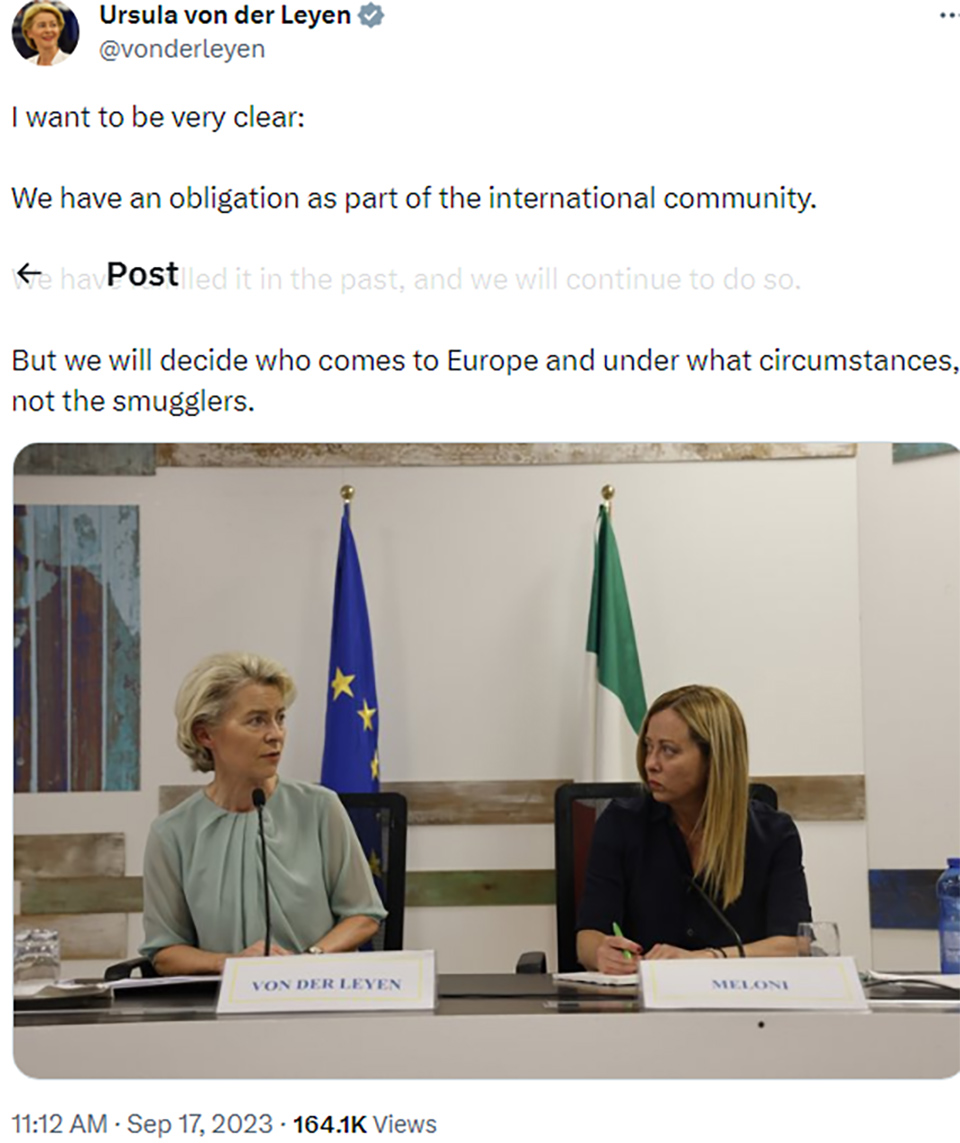
Von der Leyen recognises that contrary to the main narrative as received in Ireland, there are significant push factors involved. The main one being that illegal immigration into Europe is to a huge extent driven not by any passing crisis, of which the Libyan floods and the Moroccan earthquake are the latest, but by a large and well organised criminal enterprise that transports hundreds of thousands of people from Africa and parts of Asia each year.
Meloni, who some have chosen to attack for allegedly failing to keep her election promise to curb illegal immigration into Italy, afterwards stressed that – while she welcomed the plan – the emphasis needs to be on bolstering the measures to tackle the smugglers and to make repatriation of illegals a central part of how the EU as a whole deals with what Meloni described as an “epochal challenge for Europe.”
The plan underlines the ambiguities of the official Tweet.
On the one hand, it refers to the need to assist the Italians in dealing with the impact of the latest of a series of arrivals.
It also refers to stepping up measures by the EU’s border guard, Frontex, to discourage and impede the transportation of people by the smugglers. The ambiguity of the message, however, is contained in Point 8 which while it refers to the need to “disincentivise Mediterranean crossings,” also mentions “while continuing to offer alternative pathways to the EU.”
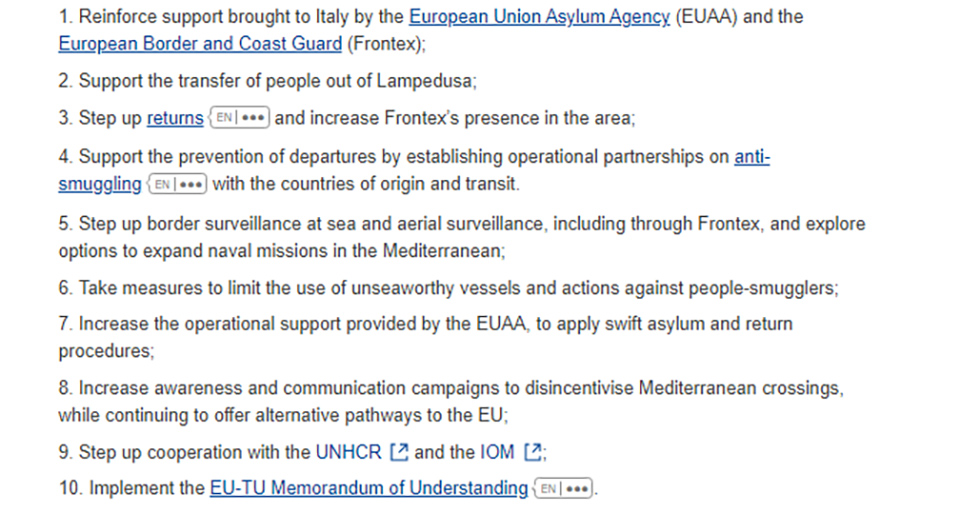
This is why some EU states have reacted quickly and negatively in the main to what they believe von der Leyen is really talking about.
Yesterday, the Polish Prime Minister, Mateusz Morawiecki, stated that the Polish government was recommitting itself to oppose any plan to relocate migrants throughout the EU, and to reject any financial penalties that might be imposed on states which like Poland and Hungary have said they will refuse to take part in any relocation.
Poland will be holding a referendum on migration on the same day as next month’s general elections.
What the Poles are referring to is the Migration Pact that was approved by the European Parliament on April 20. This contains a clause which appears to allow individual national states to set quotas on the numbers of migrants, but this can be overridden by the EU who can insist that states take large and potentially unlimited numbers of migrants should the Commission decide that there is an emergency brought about by the “mass and sudden arrival of third-country nationals.”
The Memorandum of Understanding whose implementation is referred to in Point 10 of the EU plan is the one agreed on July 16 this year between the EU and the government of Tunisia. Having set out a range of economic assistance to Tunisia, the meat of the Memo deals with measures designed to curb the transit of illegal immigrants from Tunisia.
Central to which is that “The two Parties also agree to support the return of irregular migrants in Tunisia to their countries of origin in accordance with international law, whilst respecting their dignity.”
The Tunisians apparently made the valid point that it is only responsible for policing its own borders, and it is clearly incapable of taking any effective measures against the criminal smuggling gangs referred to in the Memo who use Tunisia as a transit point to Europe.
Other EU states, which ostensibly are all for the taking in of migrants, have been quick to make their position on Lampedusa quite plain.
On Tuesday, the French Interior Minister, Gerald Darmanin, said that France would not be taking anyone from Lampedusa and would assist the Italians in sending people back to Africa. Darmanin also cast doubt on the claims of those who have arrived to be genuine asylum seekers.
The Germans have likewise said that they will not be taking in any migrants from Lampedusa who the Italians refuse. Which is rather ironic given the central role which the German political establishment has played in pushing for greater numbers and insisting upon everyone “doing their bit.”
It should also be noted that the current German government is a coalition of the Social Democrats, Greens and Free Democratic Party, all of which have for decades been ultra-liberal on immigration.
As Gript has reported before, all of the Irish MEPS who voted on the Memorandum in April supported it, and the only criticisms have been that it is not even more facilitating to the legitimisation of illegal immigration. Irish MEPs, other than the Greens, are unique in that they belong to groups on the left and centre right which have national parties who dissent from the Commission proposals.
The absence of that critical voice, and the silence among the political establishment and the mainstream media about the implications which the Pact might have in practical terms in the aftermath of Lampedusa, does not inspire confidence. If states like Germany and France, whose leaders adopt the same ideological stance on mass immigration as every party in Leinster House, find no difficulty in bluntly rejecting their taking in large numbers from Lampedusa, then so can this state.