Many, many moons ago, we met a group of Welsh young lads at a Fleadh Cheoil in Sligo, back in the time when the music played on all night until sunrise and beyond, and the sparkling dawn seemed only to bring fresh promise.
At some stage during the wheeling, thrumming session, they sang a song we had never heard before, and they told us had been written about the importance of keeping their language alive. While almost no-one in the bar spoke Welsh, everyone could recognise the defiance and the spirit in the words.
Thirty years later, I remembered that defiance as a man called Dafydd Iwan and a whole stadium of delighted Welsh football fans were giving loud and delighted voice to the same song:
Ry’n ni yma o hyd, Ry’n ni yma o hyd, Er gwaetha pawb a phopeth, Er gwaetha pawb a phopeth, Er gwaetha pawb a phopeth, Ry’n ni yma o hyd
We are still here, We are still here, in spite of everyone and everything, in spite of everyone and everything, in spite of everyone and everything, We are still here.
At one point, Iwan is almost overcome by sheer emotion as tens of thousands of his people sing an anthem to their own language, in their own language – with the greater proportion of them being young fans.
A singer and songwriter with a lifelong commitment to the revival of the Welsh language, he had previously said that he wrote Yma o Hyd to “remind people we still speak Welsh against all odds. To show we are still here.”
Just as in Wales, perhaps even more so, our own language was outlawed for centuries by occupying forces: those who spoke it brutalised and starved; its great artists and cultural standard bearers banished and killed; its breadth and depth diminished by both colonisation and wilful neglect.
Yet it is still here. Against all the odds, it did not die.
In fact, as has been observed elsewhere, the most remarkable thing about Gaeilge is not that it has diminished, but that it managed to survive such sustained oppression at all. But it did.
And whether the naysayers like it or not, is it part of our DNA: woven into our collective memory, a vital, pulsing thread in our history, shaping who we are as a people.
Pearse’s claim that without its language a nation loses its soul is now so familiar that we have lost sense of its powerful insight: that this elusive and intangible and deeply-rooted connection to our ancestors is part of the almost ineffable understanding of who we are and how we are tied to a sense of time and place and people and history.
As he wrote in the Sovereign People, the “repositories of the Irish tradition, as well the spiritual tradition of nationality” lay in the “great, splendid, faithful, common people”: in that spirit which “sorrowed during the penal night, which bled in ’98, which starved in the Famine” – but which “is here still – what is left of it – unbought and unterrified”.
Unbought and unterrified. I love that. I’ll not beg for favour for my own language in my own country, nor feel the need to placate those who attack it. The reasons as to why it should be elevated and protected and allowed to flourish at the heart of our identity should be obvious to every Irish person.
Tír gan Teanga, Tír gan anam. And what are we without our soul but a collection of shiny buildings, and Starbucks, and investment funds, and designer trainers? A husk of a people with all of the emptiness and disconnect that drift will inevitably bring. We deserve better.
It’s why the majority of Irish people, including those who cannot speak Irish, recognise the importance of our language and view it with affection – a warmth often coloured with regret that they hadn’t the opportunity to learn what is theirs by birthright: one of the most ancient and beautiful and vivid and descriptive languages in the world.
Its why, even though centuries have passed since the great Golden Age of Gaelic culture, and since the glory days when our Filí and harpists were esteemed and renowned, we sometimes come across a phrase or a poem or a word or a place name and we feel that sudden pull of recognition, a stirring of something we might have not known existed in our collective consciousness.
Gan sin táimíd stoite, as the poet Mairtín Ó Diréain wrote, we are uprooted, even erased. And deep down, we know this to be true. It’s why most of us would lament the death of a mellifluous, musical language that has connected us to each other and to this land since the dawn of history.
The spoken language does more than preserve our past and our heritage: it brightens and burnishes our memory, dimmed but still existing, of what we once were.
In fact, the goodwill of the millions of people who aren’t Gaeilgeoirí, but would like to be, is a vast, untapped well of potential in the growth of the language. I encounter it around me almost every day in the positive response of others who overhear our conversations as Gaeilge, and its a reminder that, even after independence, our own state failed to create conditions for the language to flourish.
Given that, it crossed my mind last month that perhaps former Fine Gael Minister, Ivan Yates, has a secret marketing role with Foras na Gaeilge, requiring him to act out the role of an Awful Old Blueshirt to stir up a furious reaction in the way his ill-mannered display on Virgin Media did.
“I couldn’t be arsed to learn Irish,” the bould Ivan announced, and his belligerence was rewarded by a warm handshake from the show’s co-presenter who crossed the studio to join in a little display of delight in their shared ignorance.
That’s what you’ll notice about many of those who show such antagonism towards Gaeilge: they are not, despite what they profess, indifferent to the language: rather they are often hostile to it in a way that belies their insistence that their oppositon stems from purely practical, as opposed to political, matters.
It’s hard to imagine such a boorish remark being made about any other aspect of any other culture. Imagine any serious person boasting that he “couldn’t be arsed to read Shakespeare”, or “couldn’t be arsed to listen to opera”, or “could be arsed to see in any value in poetry”.
Nothing is really deleted on the internet. Here's the handshake buachaillí in action.
— Craic Of The Ash (@CraicOfTheAsh) February 12, 2024
Dowling & Yates 🤝 https://t.co/kjkAtcmsRO pic.twitter.com/hVX7PdLiCU
Even if it were true, they wouldn’t boast about it, and be congratulated by the usual useful idiots online who then bewail the newest form of egregious oppression – being “forced” to learn their own language in school.
It is a difficult language, Gaeilge, as anyone who has struggled with an Tuiseal Ginideach will know. Perhaps those who sneer at it – and at those who strive to master it – are more to be pitied than censured. They will never know what is to read Aodhagán Ó Rathaille’s ‘Cabhair ní Ghoirfead’ in its searing original, and to feel part of a culture and a story more ancient than the pyramids.
“Rachad-sa a haithle searc na laoch don chill,
Na flatha fá raibh mo shean roimh éag do Chríost.”(I will follow to the grave the beloved amongst heroes
My people served before the death of Christ)
The whole Virgin Media exchange reminded me of that particular tautological phrase in Hiberno-English: an ignorant cábóg. If you act like a boorish ignoramus, then expect to be treated like a cábóg. And if you choose to show contempt, remember that contempt goes both ways.
But, in truth, this kind of reaction is not uncommon from a certain kind of Irish person, and they have always been vociferous in their creeping, post-colonial, views which seem to stem from an inexplicable national self-hatred: an outlook best summed in the paraphrasing of the old description of the perceived Norman assimilation as ‘níos Gallda ná na Gall fhéin’.
An insight into this strange attitude may be found in an article written, curiously enough, by Kevin Myers, an interesting observer on many issues, but with whom I would usually radically disagree on the question of the language.
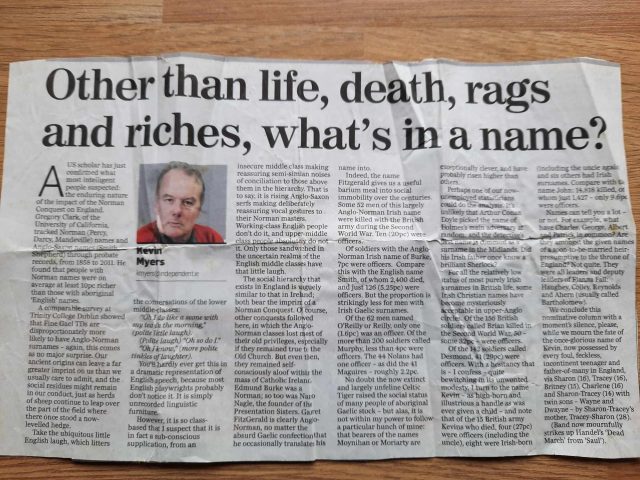
A survey of names in Trinity College Dublin, Myers said, found that Fine Gael TDs are disproportionately more likely to have Anglo-Norman surnames. “Our ancient origins can leave a far greater imprint on us then we usually care to admit,” he wrote.
It’s an interesting thought: the long reach of history may explain the inexplicable antagonism of some who live here towards a language shaped by stone and sky and generations of learning and culture. There are some who define themselves by what they oppose, and where civil war politics still linger – and they may linger more than we imagine – an enmity to Gaeilge is rooted in a resistance to all things which might be shaped by tírghrá, love of country.
Historically, of course, belligerence towards the Irish language came first from invasion, occupation and colonialism. The old enemy, na Sasanaigh, understood well that any attempt to dispossess a people is more successful if they are robbed of their culture and identity, a strategy that has been used by invaders since time began. The iron fist isn’t used to persuade, but to destroy.
In this case Gaeilge, the musical, descriptive language that has been spoken on this island for almost two thousand years, was an obvious target. Its elimination would ensure a loss of identity and historical understanding
Already the Norman invasion had ended the Tailteann, the “renowned synods of sport and law and culture”, and the Statues of Kilkenny sought to outlaw the use of the Irish language, and the playing of hurling, iománaíocht: the fastest field sport in the world, and likely one of the oldest, played by the heroes of epic legends such as CúChulainn of An Táin, and in every corner of both Gaelic and modern Ireland.
In fairness, the Normans may not have had significant cultural and linguistic impact (though the old Anglo-Irish families assimilated culturally, they brought political sea change), but the violent savagery of the Tudors, and the ferocity of the plantations and the penal laws, were deeply destructive and oppressive forces to the language as well as the people.
The poets – Na Filí, descendants of Amergin Glanglúin, renowned and famed throughout Europe for the rigour and discipline of their high art – were put to the sword. The Bardscoileanna (schools of poetry) which followed, also fell as the country was ransacked after the Battle of the Boyne. Harpists, it was ordered, should be executed if found without papers. Our historiography was promulgated in a language that was not our own.
The effects of the Great Hunger were utterly devastating. Millions of people died or were forced away by hunger and fever and ruthless eviction: whole swathes of areas where the language had survived were wiped out.
And yet, and yet. As the Welsh sing, Ry’n ni yma o hyd. We are still here. Tá sí beo fós, an teange seo againne. She lives still, this language of ours. And despite the naysayers and the nitpickers, it is loved and cherished and part of what we are.
In 1988, my Dad and a host of musicians from Comhaltas Ceoltóirí Éireann performed the battle song of Munster, Rosc Catha na Mumhan, with all its ancient sounds, to some 30,000 people in College Green. The response of the crowd, most of whom likely did not speak Irish with confidence, was a rapturous roar of approval prompted by the recognition of same defiance and passion in the singing of Dafydd Iwan.
It’s Seachtain na Gaeilge, and there is, according to the Lord Mayor of Dublin, an uptick in those seeking to learn Irish and to improve their knowledge of the language. That’s to be celebrated. I see that enthusiasm in the sean-nós class I teach each week: the delight in the parsing of old phrases, or in uncovering and understanding these timeless songs.
Other languages, such as Welsh and Estonian and Hebrew, are now thriving, or at least seeing welcome growth again, because of a determined and sustained effort made by the authorities in those countries who understood the importance of the national language.
Manchán Magan, author of Thirty-Two Words for Field, is doing important work in preserving and popularising the old, almost-forgotten words. Is seodaí iad, ná cáill iad. We’ve all seen sclimpíní at some stage in our lives. Now we have a word to describe them.
It is within our gift to restore the language. Use what you have: listen to Raidió na Gaeltachta and TG4; read Tuairisc and Foinse; join a ciorcal comhrá; call Conradh na Gaeilge to find a class; there’s no shortage of opportunities. And do it with pride.
Labhair í agus mairfidh sí. Séasaimis an fód. The ignorant cábógs can take their complaints elsewhere.