Normally, one might expect that an independent civil liberties watch dog would see state moves to limit and indeed potentially penalise the exercise of free speech – supported by virtually the entire opposition until Sinn Féin realised for the principled reason that it was possibly unpopular – as something they might wish to prevent or at the very least question.
Not so, it would appear. The Irish Council for Civil Liberties broadly supported the introduction of the “hate speech” legislation, and in its election manifesto wish list “welcomes the passage of the Criminal Justice (Hate Offences) Act 2022 into law” and adds: “ To ensure hate crime legislation is effective, implementation measures will be key, coupled with a holistic approach to tackling hate and extremism in Irish society”.
It expands on this to advocate potentially even greater state intervention in the monitoring of political and social opinion. For that is what “developing and rolling out a comprehensive action plan against hate, including to address its root causes in Irish society and to tackle hate crime and hate speech beyond criminal law” would entail, the ICCL says.
There is a whole raft of existing criminal legislation that can correctly ensure that people can be pinched if they decide to develop their strong views in the direction of advocating or directing violence against those with whom they disagree. Extending the remit of the state “beyond criminal law” into the monitoring and perhaps “correction” of unsavoury views can only mean that the state will act as a censor of dissenting opinion.
The ICCL surely must have some muscle memory of the time when it was among those who opposed Section 31 of the Broadcasting Act. Not from any necessary support for Provisional Sinn Féin but because they and many other people realised that it was suppressing legitimate nationalist opinion well beyond the republican movement and had a stifling impact on journalism in RTÉ even where, as now, there was not an innate enthusiasm to censor dissent in the first instance.
And of course in Ireland there are a panoply of liberal leftist NGOs – as there was a certain communist organisation in the 1970s – which are only too willing to assist and which the state appears willing to accommodate within the criteria for the appointment of “trusted flaggers” by Coimisiún na Méan to oversee what might be offensive to the liberal leftists and their carefully selected “protected groups.”
To ensure that those NGOs retain their powerful position within Irish society – one that many would argue has been exposed as a minority one given the results of the two referendums, the level of public dissatisfaction with immigration policy and the disquiet over the NGO supported “hate” legislation – the ICCL wants to insure a guarantee of state funding for the sector but more importantly to “Amend Section 22 of the Electoral Act 1997 to remove the disproportionate restrictions on donations for civil society.”
The latter demand is of particular interest to the ICCL and some of the other leading advocacy NGOs because some of them would not exist and certainly not on the scale on which they do had it not been for the seed capital and ongoing massive funding from overseas billionaire Woke foundations including particularly the Atlantic Philanthropies. So they obviously wish to protect and extend the capacity of external forces to fund an ideological agenda here.
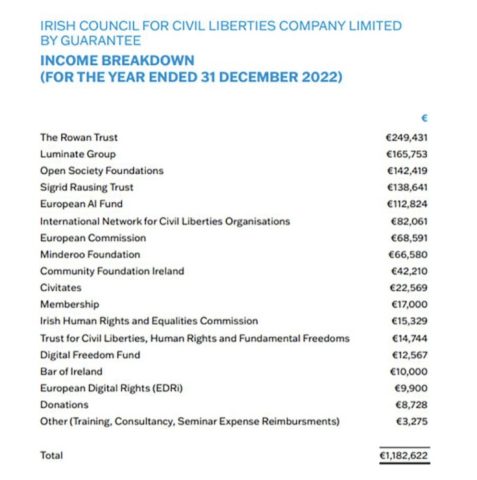
The ICCL’s own accounts and funding history are a case study of how this funding has placed certain concerns at the heart of public discourse. Indeed, it is a study in how basic civil liberties issues around policing and prisons and the criminal law were replaced as priorities by an ideological agenda around abortion, gender identity, mass immigration and restricting conservative and nationalist dissent.
That agenda is reflected in the ICCL election manifesto where they demand further liberalisation of “access to abortion services,” to improve “trans-specific healthcare” and the decriminalisation of drugs. That bias is also seen where in a section subtitled “Guarantee Freedom of Thought and Conscience” the sole ask is for the abolition of religious oaths.
Nothing of course about those Catholics and people of other and no religion who object to being obliged to provide abortion “services” or to perhaps go along with the absurdities thrown up by gender extremism.
The ICCL also includes specific political demands that have absolutely nothing to do with civil and human liberties. Then again, neither has abortion. Among the wish list is the demand to “tackle inequality in Irish society” which judging by the asks which are itemised have likewise to do what the old left once despised as “petit bourgeois liberalism;” gender equality specifically which of course no longer solely or even chiefly refers to biological females.
No mention at all of socio economic inequality, which similarly is not the purview of civil liberties either but its absence is telling. Just as was the irrational belief on the part of the American Democratic Party – the apple of the eye, mentor and in some instances the funder of our own liberal left – that it could win the Presidency on the basis of abortion and legitimising illegal immigration.
It was no accident then that Harris lost even more of the traditional working class and even part of the ethnic support base of the Democrats that are shifting ever more to the MAGA Republicans led by Trump who focused on the economy and issues such as illegal immigration which directly impact working class and in particular working class Hispanic communities. .
Those of us inimical to that same poison here ought therefore to welcome the ICCL and the rest of the liberal left’s in this country blindly staggering down the same road. Even if, as John McGuirk pointed out here yesterday, Irish dissidents of the right are behind the curve when it comes to transforming dissent into a serious political challenge.