There were significant celebrations in Kildare town – the home place of Saint Brigid – when a relic of the Saint arrived there 1,500 years after her death and in time for her Feast Day this week.
The occasion brought hundreds of people to St. Brigid’s Church in Kildare on Sunday morning for a special Mass, where a procession into the church was held.
It was led by three women riding horses and dressed as mediaeval Irish knights, who, as legend has it, accompanied the relic to Portugal centuries earlier.
The procession to return the relic of St Brigid to the parish church in Kildare town was led by three children on horses representing the knights who are said to have secretly taken the fragment of her skull to Portugal during the reign of King Henry the 8th @rtenews pic.twitter.com/dJ7WtQGoBf
— Samantha Libreri (@SamanthaLibreri) January 28, 2024
Speaking on Sunday during his homily, Bishop of Kildare and Leighlin, Bishop Denis Nulty, welcomed “Brigid’s homecoming” on the 1,500th Anniversary of one of Ireland’s patron saints.
Despite the percentage of the population who identify as Catholic seeing its sharpest decline ever, sitting at 69 per cent in the 2022 census (the lowest number recorded), the attention the return of the relic received should instil some hope in the faithful that all is not lost. Seeing images of people of all ages gathering to see the relic, in an age where faith can often appear dead, or at least dying, is interesting.
So too is the fact that the return of the relic of St. Brigid was covered so widely in the media, indicating perhaps that the Catholic saint remains an important figure to many Irish people, even at a time when the ‘Catholic’ faithful can feel increasingly under a siege.
While Brigid was buried beside the main altar at a monastic church in Kildare, with her grave soon serving as a shrine for pilgrims who visited, her remains were moved some 300 years later when the Vikings were raiding Ireland. The relics were moved to Downpatrick Cathedral for safekeeping – and placed in an unmarked grave beside Ireland’s other patron saints, Saint Patrick and Saint Columba.
However, in the next few hundred years, unfortunately, the location of the grave was lost. It wasn’t until 1885, when the then Bishop of Down prayed to be shown the resting palace of the three saints’ relics – and a beam of light descended upon a spot on the church’s floor, that the remains were rediscovered, as per church history.
The relics would remain at the church for the 400 years which followed – before it was destroyed by Lord Leonard Gray, who had been appointed by King Henry VIII. The relics were able to be saved and tradition holds that three Irish knights secretly took a fragment of St Brigid’s remains – believed to be from her skull – to a town called Lumiar near Lisbon, Portugal, where they were venerated.
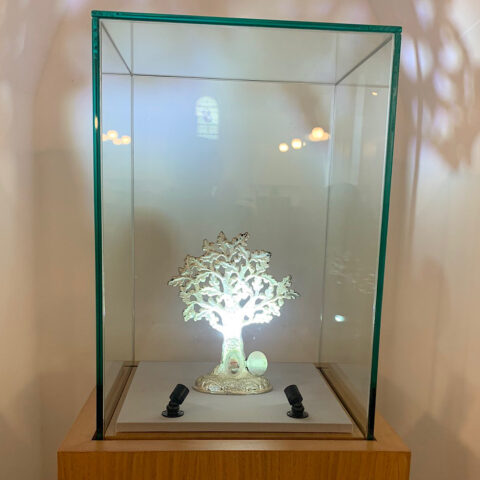
A portion of the relic of St Brigid was returned to Ireland in 1930s by the order she set up – the Brigidine Sisters in Carlow – and will now be moved to St Brigid’s church in Kildare, where a specially designed shrine is to be set up.
“Brigid will be no stranger here,” Bishop Nulty told the congregation, as he welcomed “Brigid coming home to her own Kildare, Cill Dara, the Church of the Oak, the place of Brigid. “
“St. Brigid was a huge figure of authority in the early Church, baptised by St. Patrick, professed by St. Mel, Spiritual Adviser to St. Conleth,” Bishop Nulty continued.
He told those gathered how the saint had “listened to God’s voice in creation all around her, in the streams, the hills and the plains.”
“When you walk out to St. Brigid’s Well out the road, he said, “You appreciate the God of Creation. Just as her cloak stretched over the Curragh plains, so too she stretches her hand of welcome, hospitality and affection over us this historic day.
“A day when we welcome home to Kildare the relic that has come to us, from the Brigidine Sisters in Tullow who in turn received from Lumiar, just outside Lisbon in the 1930’s.”
“Today we have brought her home!” he told those gathered. “At least a relic taken from the bone fragment of her head, which rests in the church of St. John the Baptist in Lumiar outside Lisbon., having been brought there by three Irish knights in 1273, who are also believed to be buried within the church.”
A wonderful celebration in St. Brigid’s Church, Kildare as we installed the relic of St. Brigid, a gift of the Brigidine Sisters, a fitting commencement to the celebrations of the 1500th Anniversary of the death of St. Brigid @KANDLEi @KildareCoCo @CatholicNewsIRL pic.twitter.com/FiGLyEDI2o
— Bishop Denis Nulty (@BishopDNulty) January 28, 2024
“Obtaining the relic of a saint like Brigid is no easy feat. I visited Lumiar in October 2021 with the singular intention of securing a relic for St. Brigid’s Church. I was privileged then to hold the relic of her head which is contained in a splendid brass casket.
“Sadly I couldn’t squeeze it into my Ryan Air flight bag!” he joked.
The Bishop acknowledged that with early saints, “it’s always hard to divide facts from fiction” – noting how the process of formal canonisation was not established until 1159.
“Many of our early saints – Brigid, Patrick, Colmcille, Conleth and several others achieved sainthood by popular acknowledgement,” he explained.
“As with many of those saints, the line between fact and fiction blurs with the passing of time. As Sr. Rita Minehan reminds us “the more one tries to unravel the mystery, the more the mystery deepens.”
“So what might be the reference point for Brigid in today’s Kildare?” he asked, saying that it is “too simple” to install a relic and leave it at that.
“She would call us to do much more,” he said.
“What were the character traits that defined St. Brigid of Kildare? To mention just a few, she was hospitable, she was a peacemaker, she was a strong woman of faith.
“It was here she established a monastery that in time would separately house men and women, Kildare was then a powerhouse of formation. How she secured the site for her monastery is a story well known to every school child in the country. The local chief told her she could have as much land as her cloak could cover.”
Sister Rita Minahen, who is part of the Brigidine sisters in Kildare, said it was a special day.
“It’s very meaningful because we wouldn’t have a Kildare without her – Kildare owes its existence to St Brigid,” she told the Press Association.
Meanwhile, the chairman of the Kildare Tourism Board, David Mongey, described the occasion as “momentous,” telling PA that St Brigid is still relevant 1,500 years on from her death in 524.
“What amazes me is, 1,500 years later, she’s still remembered with love in Kildare and Ireland,” he said. “Her words, her wisdom and her actions mean more today than they ever did, when you think about how we treat our land…how we treat each other and how we treat ourselves,” he said.
“It’s a homecoming of St Brigid’s relic after 1,000 years or more – she’s finally coming home to rest in her native town in Kildare.” He also foresees an increase in tourism because of the relics.
“I think, as a tourist body, if we think of Santiago de Compostela and the great Camino of the north of Spain, where all roads lead to Santiago, to the head of St James, the relic of St James, now Kildare has a finishing point to create pilgrim routes all over Ireland to see St Brigid,” Mr Mongey said.
Sr Minehan, one of the founders of Solar Bhride, said that others around the world will join a minute’s silence at noon on Thursday to pray for peace.
“We are sending out a message that we actively oppose warfare in our world and the proliferation of arms,” she said. “It’s rather frightening what’s happening in our world. It’s sorely in need of peace, and Brigid was renowned as a peacemaker,” she explained.
Also on Thursday, thousands of students in Kildare plan to make a human formation of a large St Brigid’s cross to celebrate her feast day.
There have been plenty of events – from elaborate light shows to festivals to workshops – in the last number of years which have celebrated St Brigid as a feminist and as a pagan goddess. What stands out this year, though, is the authentic and Christian celebration of a Saint who is clearly still relevant in Ireland as someone who helped spread Christianity here.
There are daily attempts to discredit Catholicism, especially in a country where the Church often appears to be falling apart at the seams – caused by one crisis after another, including demographic collapse. It is implied and sometimes said explicitly, that Catholics are not relevant and that this country has freed itself of the ‘shackles’ of the church. That it’s time to move on, and people will be better off without it.
Yet the faith is still real and relevant to very many people. It still survives, despite all the things in our culture fighting against it. Believing Catholics are not always represented in the media narrative or on platforms like RTE. In fact, that is rare. But the positivity and enthusiasm sparked by the return of St. Brigid’s relic surely goes to show that there is still a considerable demographic of people in Ireland for whom the Catholic faith is important, or at least means something.
And I’m glad, at a time where St Brigid has been twisted and moulded into something she was not, in order to fit the narrative of modern Ireland, that Catholics are once again taking ownership of an important Saint, and reminding the world who she really was.
