A Eurostat report from last week illustrated some of the anomalies of the Irish state in comparison to the other 26 member states with regard to migration.
I looked at the Eurostat figures which showed that of a population increase of over 211,000 between the beginning of 2022 and 2023, some 75% was accounted for by the inward migration of persons born overseas. A similar imbalance can be recognised in relation to GDP as a metric within the EU.
Most of the media coverage which refers to population growth, virtually unprecedented in the history of Ireland either pre or post the securing of independence for 26 counties, is invariably celebratory. On the most inane level you will even hear people refer to An Gorta Mór as if the two are related, and that having 22% of the population born in another country is compensation for an attempted genocide.
In similar terms, the fact that the Irish state has one of the highest per capita Gross Domestic Products (GDP) in the EU, and indeed on the entire planet, is regarded as evidence that we are all doing wonderfully. Apart from the fact that, subjectively, many people clearly do not share that sentiment, or even that such crude statistics tell us nothing about the social, cultural or economic health of a society, GDP is a poor measure of even the economic state of Ireland.
💰 In 2023, gross domestic product (GDP) per capita expressed in purchasing power standards ranged between 64% of the EU average in 🇧🇬 Bulgaria and 240% in 🇱🇺 Luxembourg.
What about your country❓
Find out more 👉https://t.co/Plz6dwcwk8 pic.twitter.com/KuVSuaYWQZ
— EU_Eurostat (@EU_Eurostat) March 26, 2024
What the Eurostat statistics show is that, measured against the EU average, citizens of the Irish state in 2023 enjoyed a Purchasing Power Standard (PPP) of more than twice (112% higher) than the average for all of the 27 member states. Only Luxembourg scored higher and for very similar reasons.
Chief of is that the index is based on the per capita GDP of each member state. The huge discrepancy in the Irish index is explained in a note to the Eurostat presentation. It states that:
- Ireland: the high level of GDP per capita in Ireland can be partly explained by the presence of large multinational companies holding intellectual property. The associated contract manufacturing with these assets contributes to GDP, while a large part of the income earned from this production is returned to the companies’ ultimate owners abroad.
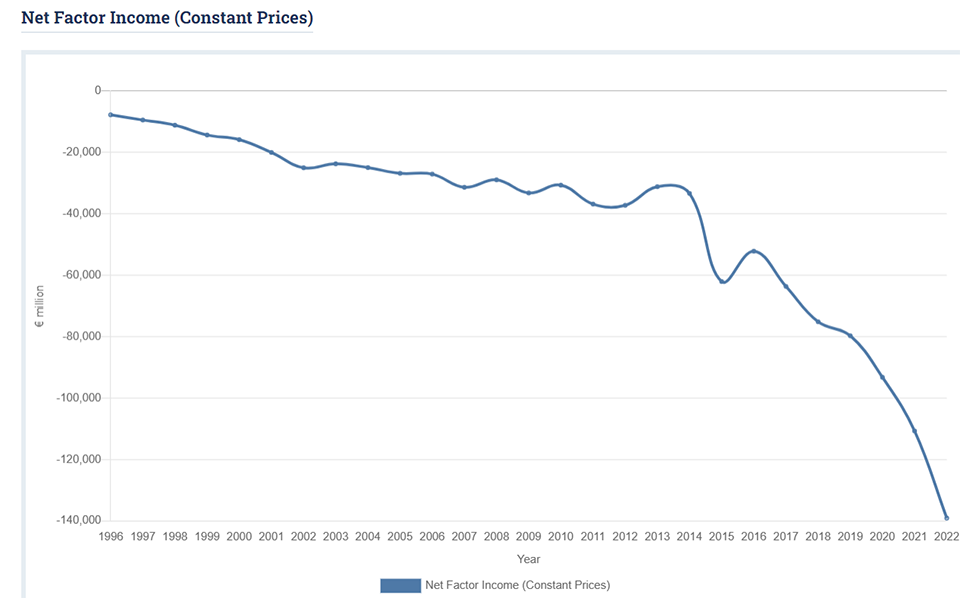
This return of a substantial part of the wealth created in the Irish state “to the companies’ ultimate owners abroad” is known as Net Factor Income. That transfer of profits makes up by far the largest proportion of the part of GDP that is exported and therefore not part of the wealth of anyone living in Ireland. A CSO table from 2015 shows how that trend was developing and seems to be the most recent information available here.
The Central Statistics Office (CSO) here is quite forthright in describing this as a “negative” and describes the phenomenon in similar words to Eurostat as being the consequence of the fact that “ for many years past, the amount belonging to persons abroad has been much greater than the amount received from abroad, due mainly to the profits of foreign-owned companies.”
The Irish Fiscal Advisory Council has described how these “outsized flows due to the activities of multinational entities” has led to “distortions” in how the performance of the Irish economy is measured. Another factor are the “redomiciled PLCs”; multinationals which have their headquarters here but which as the CSO says, “conduct little or no real activity in Ireland. The functions of management and leadership and other productive activity are mainly carried out elsewhere in the world.”
A graph compiled on the basis of the CSO’s own charting of the growth of Net Factor Income here between 1996 and 2022 is a stark illustration of the huge transfers of wealth out of the Irish state. That increased from a negative of €7.76 billion in 1996 to €139.1 billion in 2022.
The difference that this makes between the amount of wealth created within the state, and the amount of wealth that remains in the state can be seen in the difference between GDP and Gross National Product (GNP) – which is what is left once the outflows and inflows are taken into account.
Thus, while GDP in 1996 was €104 billion, GNP was €99.6 billion. While GDP had grown substantially to €475 billion in 2022, when those mostly negative income transfers were taken into account, GNP was €335.9 billion.
In terms of purchasing power, if it is measured as a per capita share of GDP, which is basically the metric used in the Eurostat figures, each Irish resident theoretically had a €91,346 slice of the “national wealth,” that is GDP. However, once the Silicon Valley boys and the rest had pressed the transfer button in their An Post banking app, this was magically reduced to €64,596 if GNP was to be divvied up equally between us all.
Apart from such trivia, the stark reality is that once the repatriation of profits and other income transfers abroad are taken into account, the actual corporate wealth of the Irish state/society – or economy given that most of our leaders and commentators appear to regard them as synonymous – is 29.3% lower than you might believe if you were to accept GDP as the Golden Calf to whose eternal upward curve we as a “community” are pledged.
There are folk who will tell you that we would be lost without all those foreign benefactors. Just as bitter tears were once shed at the prospect of Lord Castlerackrent leaving his estates in the bog and throwing salmon gillies and kitchen slavies onto the scratcher after the Relics of Oul Dacency were forced to downsize after the Land War and various wiring dysfunctions in their stately homes.
One of the totems of this is that the same lads who took €139 billion out of the state in 2022 were kind enough to pay €12 billion in tax here the same year. A crude calculation on those figures would suggest that they paid 8% of their income in tax. They also contribute, of course, substantially to turnover and account for a significant proportion of exports.
If the economy and GDP is the measure of a Nation, then happy days. Everything else; mass immigration leading to radical demographic and social change, perpetual housing shortfalls, cultural tensions and so on are the inevitable consequence of that. The governance of the Irish state is really reduced to being a domestic logistics manager for the corporations.