Today in the Western world, we hear an awful lot about “fighting disinformation.” It seems to be a constant refrain of the modern politician.
As of this year, Ireland has established not one, but two separate State bodies with the legal power to suppress what they deem to be “disinformation” – namely, the Electoral Commission, and the Media Commission.
At the European level, EU lawmakers recently passed the Digital Services Act with similar aims, and Canada’s ruling government party this year passed a policy resolution calling to combat “disinformation” online. Australia’s government has just put forward the “Combating Misinformation and Disinformation bill,” and the examples don’t end there. The instances of this are numerous, and growing across much of the Western hemisphere.
Reacting to this, many people have already made the point that such ideas are extremely dangerous for the future of freedom of speech, for reasons that should be obvious. When governments seize the power to shut down alleged falsehoods, they are actually giving their friends in state agencies the power to regulate the truth itself (as I explained in an exchange earlier this year with Ireland’s Media Minister).
"Can't answer a simple question, when you're literally regulating truth itself": In a slightly heated exchange, @Ben_Scallan questions Ireland's Media Minister Catherine Martin about the EU's Digital Services Act, which aims to censor alleged "misinformation" online.#gript pic.twitter.com/KYmuIDTHgj
— gript (@griptmedia) August 25, 2023
But before even delving into those sorts of objections, it’s worth reversing for a moment and wondering where this sudden ubiquitous obsession with the phrase “disinformation” even comes from. After all, it’s clear from Google Trends that there was a very unusual worldwide spike in the term’s usage around the middle of 2022.
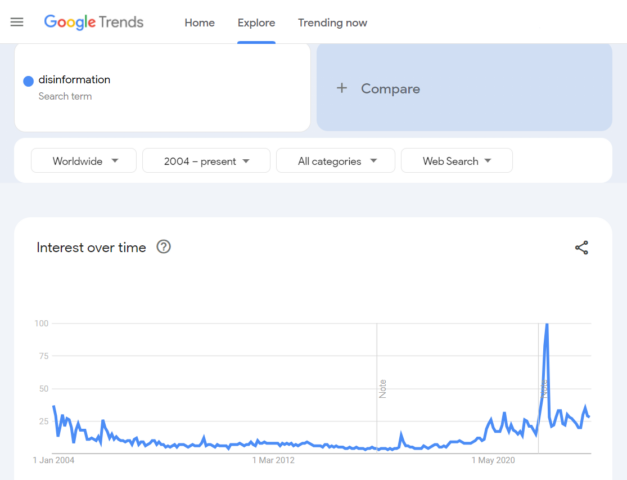
This seems fairly odd, considering the fact that “disinformation” is not a new word by any means. It’s a Cold War-era KGB phrase derived from the Russian “dezinformatsiya,” and back then was typically used to refer to information which was deliberately designed to deceive and manipulate public opinion. Originally, when one referred to “disinformation,” they were typically talking about governments and state actors lying to the general public for propaganda purposes.
But now, in the modern era, the focus of the word has been completely reversed. Now the public are the ones who are accused of “disinformation” if they dissent from the government’s narrative on an issue like immigration, Covid-19, climate policy, or any other sacred cow that the political establishment doesn’t want questioned.
Rather than governments and intelligence agencies being accused of spreading “disinformation” as a form of propaganda against the public, it’s now the people who are allegedly spreading “disinformation” about government policy. We’re now to believe that it’s the public who are the propagandists, and the state who are the victims of propaganda.
So why has this stunning reversal taken place, and why are governments everywhere repeatedly using the same word, which up until recently was relatively obscure?
Well, if you consult a dictionary, “disinformation” is defined as “false information which is intended to mislead, especially propaganda issued by a government organisation to a rival power or the media.” And while there’s nothing wrong with this definition per se, the thing is, we already have a more common, more concise word that fits the same definition: it’s called “lying.”
When you accuse someone of spreading “disinformation,” you are accusing them of spreading what we used to simply call “lies” – just in a more long-winded and less efficient way. It means the exact same thing, but uses more syllables. It is to abandon the idea of speaking a regular human from earth, and instead to speak in cumbersome political gobbledygook and NGO technobabble.
But politicians have to use euphemisms like this, for one simple reason: if they spoke plainly in a way that was easy to understand, it would immediately become clear how insane and dangerous their ideas are.
If politicians actually said what they meant – namely “We want to regulate lying” – people would immediately react with ridicule and outrage in equal measure. They would point out that politicians are widely regarded as some of the biggest liars in our society, and are the last people who should be involved in the truth arbitration business.
It is a universal feature of democracies that most ordinary people, rightly or wrongly, regard their politicians as a shower of corrupt crooks and treacherous mercenaries who will say anything to get ahead, as long as it advances their own self-interest. So in most people’s eyes, for a politician to say “We want to start regulating lies, and deciding what is true” would be like putting a sex offender in charge of a school. It would almost be laughable if it wasn’t so serious.
And so, politicians couch such radical policies in more technical-sounding jargon to minimise their own exposure to scrutiny. But the meaning remains the same.
The next time you hear a politician tell you they want to regulate “disinformation,” remember: they are literally talking about appointing people like themselves to be the judge, jury and executioner of the truth itself. And that should seriously concern us all.
