As Gript, and some practising economists in the real economy, have pointed out; the National Development Plan and the related and grandiosely named Project 2040 have been rendered pretty much redundant by radical demographic and societal changes that have escalated since the time they were drafted.
That much has been acknowledged by the Economic and Social Research Institute (ESRI) which on Friday published a report, The National Development Plan in 2023: priorities and capacity, the news release about which states that “the earlier level of ambition may have underestimated what is needed.”
The reason being that the economy and demographics of the Irish state are almost completely at the mercy of external forces, and therefore by definition immune to any domestic forecasting or planning.
ESRI director, Alan Barrett, refers to the challenges facing the plan and the state which is responsible for it, in the context of the growth of “our population and our economy.” Well, that depends on how you define “our” I suppose.
Much of the economy is in the hands of overseas corporations, and while the population of the state has grown greatly the proportion of that population that was born in Ireland continues to decline, and to decline steadily. As we showed last year, an examination of the Census figures shows just 81% of people living in Ireland were born here – a figure which has likely decreased again since the Census in 2022.
A healthy economy and a healthy society – especially one that is technically at almost full capacity and full employment – would first of all ensure that there are jobs and places to live for its young people. And yet, educated young people are leaving the state in large numbers, quite a number of them leaving jobs they have here for the reason that they cannot afford a place of their own to live in.
In the two years between April 2021 and April 2023, the Central Statistics Office (CSO) recorded that 53,100 persons of Irish citizenship came back to live in the state. 56,100 persons of Irish citizenship left.
Which means that at a time that “our population” is experiencing almost unprecedented growth – of more than 175,000 between April 2021 and April 2023 – that more Irish citizens are leaving than are returning, and that Irish people constitute the largest group of people leaving the country.
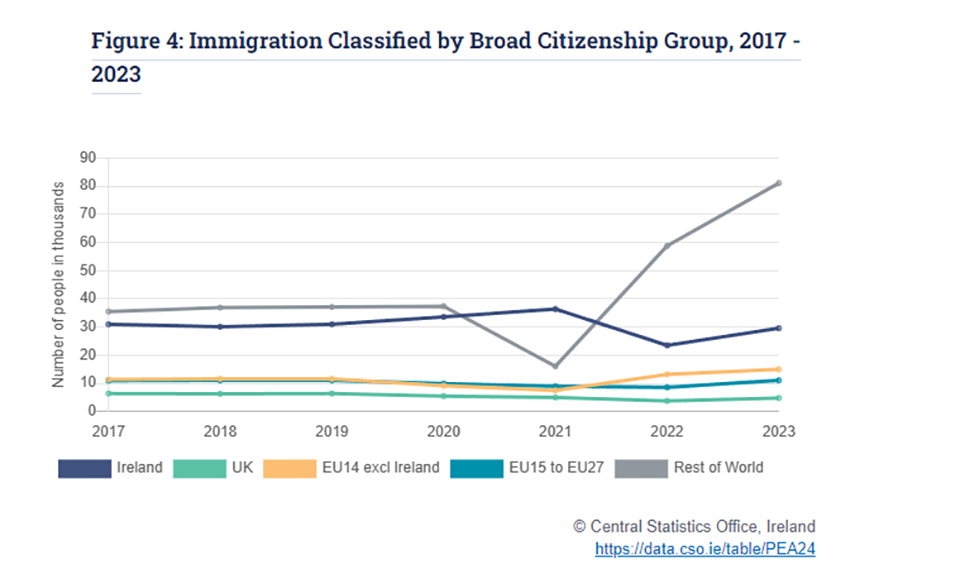
The largest group of people coming to live in the state are from the “rest of the world” outside of the EU and the UK. A total of 193,400 came in the past few years – and that trend predates the influx of people claiming asylum from Ukraine. The year of the Covid was the only year since 2016 that this was not the case.
The long-term trend is driven by two factors. The first of these is the demand for labour, and the second is the Irish state’s seeming inability to resist external and internal demands – much of it also motivated by the fact that it contributes to business and NGO bank accounts – to set any sustainable limit on the numbers of people wishing to claim asylum in the state,
With regards to the economic aspects, the ESRI report tacitly admits that the NDP was just wrong. This is pitched in terms of how it was perhaps under ambitious. Not sure how you might exactly summarise what they are saying but that perhaps encapsulates it. The reason being that the “plan” was completely contingent on factors completely outside of the control of the Irish state and its governing class.
No fault of theirs although, as above, Gript and others pointed out three years ago that the whole Plan was already flawed because they were basing future projections on population and other forecasts that were patently way off the already observable trends from which they were making their projections.

This was especially true of housing, where in 2020 the ESRI itself estimated an annual requirement of 25 – 33,000 new builds each year. In this report, they point to “the likelihood that existing targets for housing supply might understate need, given the stronger than expected increase in the population seen in the recent release of results from Census 2022.”
“Might underestimate.” It was already apparent in 2020 that the trend of immigration driven largely by the demands of overseas capital – increasingly now supplemented by immigration that is not at all economically beneficial to citizens – would require that far more houses would be needed than any official or other most other source was claiming.
If the population is growing at the average rate of 75,000 a year (as it has over the past five years) and if that trend is upwards, then you do not need to be Werner Heisenberg to realise that all of the housing plans are meaningless.
And as off the radar as are the current Government’s housing plans, the left opposition is even more surreal. They seem to believe that it might be possible not only to build enough houses to meet current social housing and private sector demand, but to add to the demand by continuing to accept tens of thousands of new immigrants every year, many of them attracted by the promises of housing and social welfare provision.
Sinn Féin’s record in the north, where the Housing Executive list grew to over 40,000 during their time in government at Stormont, does not suggest they will be any more successful than the current incumbents. The groups to their left also appear to favour seizing other people’s houses in order to fulfil their plans.
The whole notion of a ‘National Plan’ is itself absurd if it is based on forecasts about factors that the “planners” have absolutely no control over. Or, as in the case of immigration, if they have surrendered control over to external factors, including whatever mechanisms underpin the movements of labour as required by international capital. (This is conveniently cheered by the “Left” which benefits through the NGOs and, it hopes, through a new clientelist voter base.)
The default in any discussion on these matters, is that the economy is thriving and we have no choice even if there are plenty of indications that a thriving economy appears to co-exist with worsening situations with regard to housing, crime, the emigration of young Irish people, health deficiencies and so on and so forth.
As Gript has also pointed out before, if we measure the success of the economy by GDP or GDP per capita then we are creating an idol of something that is pretty much meaningless given that around 25% of the wealth created in the Irish economy is taken out of the economy mostly in repatriated corporate profits.
That amounted to over €121 billion in 2021. As our current series on the transfer by the state of tax revenue to unproductive providers of asylum accommodation and services shows, much of the current wealth being generated is of little or no benefit to the economy, and certainly not to the citizens of that economy.
Which is what it appears we have become. Citizens of an economy.
Now, you accept that Ireland Inc. is little more than an industrial estate or a financial centre, then it is happy days. There is nothing to discuss.
Except, of course, that there is.