The International Protection Accommodation Service (IPAS) has suspended a vulnerability assessment programme that was put in place to assist an applicant who required additional services in the event that they were previously subjected to torture, rape, or other form of serious psychological, physical or sexual violence (female genital mutilation) or whether the applicant was a person with a serious mental health problem, such as bipolar disorder and schizophrenia.
IPAS say the ongoing emergency situation with respect to accommodation availability for single male applicants contributed to the suspension, as this “has placed further pressure on IPAS resources, including our capacity to conduct vulnerability assessments.”
The vulnerability assessment programme had been in operation since December 2020 and was overseen by the Resident Welfare Team within the International Protection Accommodation Service and administered using a voluntary questionnaire and referral process.
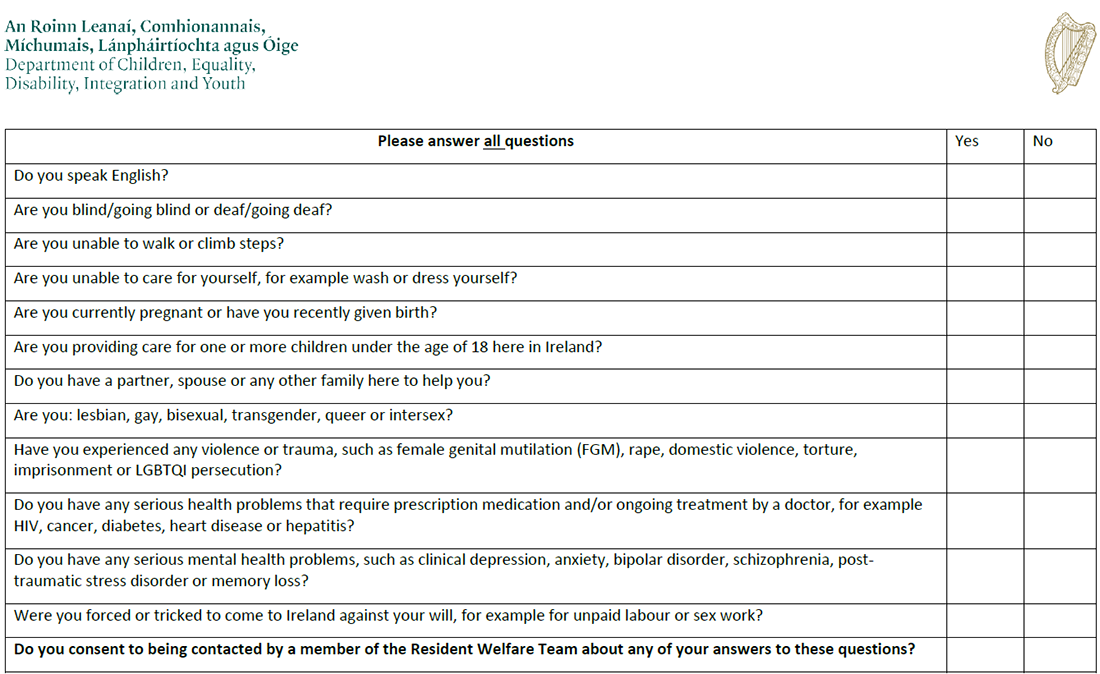
IPAS in its announcement of the suspension pointed out that since 2021, over 29,000 persons have arrived in Ireland seeking International Protection, and this was contrasted with an average arrival figure for International Protection applicants was 3,500 persons per annum for the years 2017 and 2019:
“The ongoing demands on the service due to the significantly increased numbers of arrivals has resulted in extreme pressure on the vulnerability assessment programme, including constraints on available accommodation across the IPAS portfolio, longer waiting times for assessments and lack of resources.”
Galway TD Éamon Ó Cuív had previously asked the Minister for Children, Equality, Disability, Integration and Youth, Roderic O’Gorman to provide data on the number of vulnerability assessment questionnaires which have been reviewed by the resident welfare team.
In his reply to Deputy Ó Cuív the minister confirmed that the number of vulnerability assessments that had been reviewed by IPAS since 1st February 2021 to 31st December 2023 was 4,901.
Under EU and Irish law, a person is deemed vulnerable where they fall into one or more of the following categories: a minor, an unaccompanied minor, a person with a disability, an elderly person, a pregnant woman, a single parent of a minor, a victim of human trafficking, a person with a serious illness, a person with a mental disorder, a person who has been subjected to torture, rape or other form of serious psychological, physical or sexual violence.
If IPAS determined that an applicant belonged to one or more of these categories, their reception needs were then considered in the light of the vulnerabilities identified.
However, IPAS in its policy document on the Vulnerability Assessment process remind applicants that services for all international protection applicants, not just those who complete the questionnaire are mainstreamed, and all applicants can access them through the same referral pathways as Irish citizens.
For health services, including referrals to disability and mental health services, this is through primary care, GP referral and emergency services, while education is also fully mainstreamed, and children have the same access to supports as Irish nationals.
In this respect, IPAS assures applicants that despite the suspension of the Vulnerability Assessment programme, support remains available for International Protection applicants in IPAS accommodation centres through a number of channels.