Following on the controversy regarding the circumstances in which suspected Clapham acid attacker Abdul Ezedi managed to be granted asylum in the UK despite having been convicted and jailed for sex offences, the Church of England now finds itself the focus of considerable anger.
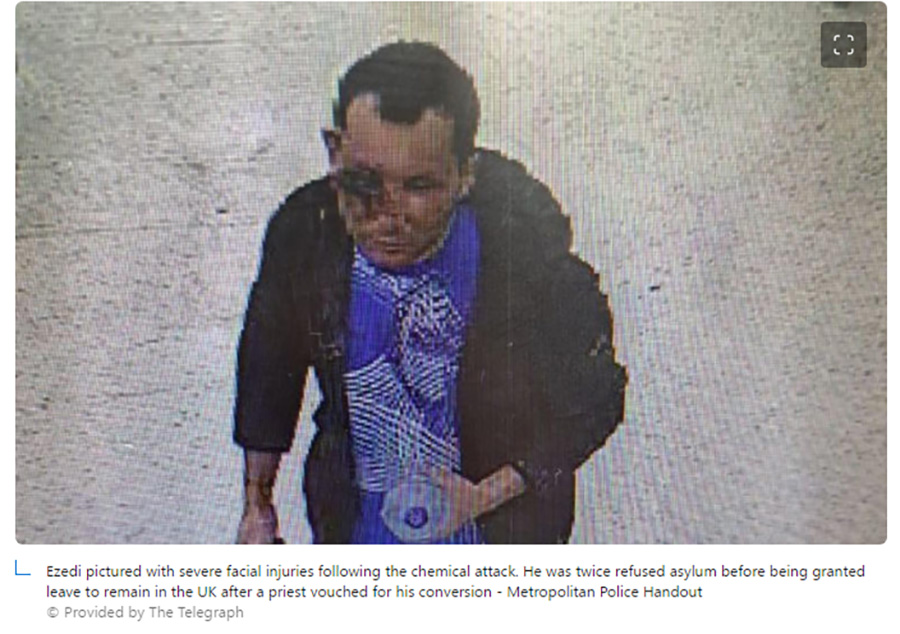
The anger stems from the revelation that Ezedi had his appeal against two Home Office refusals overturned on the claim that he had converted to Christianity. Reports that his claim had been backed up by “a priest” have now been clarified by the Telegraph:
The suspect in the Clapham chemical attack converted to Christianity with a Baptist church that “welcomes strangers”, The Telegraph understands.
The Church of England and the Catholic Church in England and Wales have both denied that Ezedi was converted to the faith via their denominations.
However, a spokesman for Baptists Together, a movement of more than 1,800 local churches supported by regional associations, colleges and national specialist teams, has said it will “always adopt a posture of welcome and compassion to those fleeing war”.
Ezedi is from Afghanistan which is obviously an unsafe place for Christians. However, the fact that persons claiming asylum from Islamic countries convert following a refusal and then claim that they would be in danger as “apostates” if they are sent home is regarded as open to abuse.
Ezedi, who has not been captured yet, threw a corrosive substance over a woman and her two young daughters in Clapham, London, last Wednesday, January 31.
As of this morning is still reported to be a fugitive. There has been speculation that he may even be dead or close to dying as a consequence of injuries he himself inflicted upon himself accidentally during the attack.
Although it has now been clarified that Ezedi’s claim to have become a Christian was supported by one of the Baptist communities, it has been the Church of England, and in particular the Archbishop of Canterbury. Justin Welby, who have borne the brunt of criticism because of the stance adopted by the Church of England to those seeking asylum in the UK.
He could refuse to appear on the basis of his special status in the upper house, although that would only exacerbate the criticism being directed against him.
Over the last week it has been disappointing to see the mischaracterisation of the role of churches and faith groups in the asylum system.
Churches up and down the country are involved in caring for vulnerable people from all backgrounds. For refugees and those seeking asylum,…
— Archbishop of Canterbury (@JustinWelby) February 7, 2024
Critics of the Church, including Tory MPs and Nigel Farage, have focused on what they claim to be the Church’s complicity in supporting dubious claims for asylum.
Indeed, they have gone further and pointed to an official document given to clergy on “supporting asylum seekers” as proof that the Church authorities are ideologically committed to undermining and blocking attempts to restrict illegal immigration.
Local vicars near RAF Wethersfield busily baptising lots of adult male asylum seekers held at the base. They are replicating the Ezedi gambit en masse and the clergy are assisting them. ⬇️ https://t.co/s3fEkECfPx
— Patrick O'Flynn (@oflynnsocial) February 3, 2024
That document contains detailed guidance on how clergy can support claims by asylum seekers to have converted to Christianity as part of the kind of appeal successfully made by Ezedi and his legal and other support team.
The tenuous nature of this is indicated by the fact that clergy are advised as to what to do “if the person has converted to Christianity after a previous refusal, that may be the basis of a fresh claim.”
And if claims are refused , the document says, the applicant should be supported in their campaign to have such a refusal overturned. While it states that “we cannot encourage illegality, of course,” they admit that most people who are refused stay anyway – something that frustrates and angers people in the UK just as it does people in Ireland.
What of the Church’s position here in regard to such matters? During the Roscrea protests, the Catholic and Church of Ireland bishops of Killaloe; Bishop Fintan Monahan and Bishop Michael Burrows, issued a joint statement which struck the same line as the state, opposition parties and NGOs. They included a reference to “We Irish, more than most, know what it is like to be a stranger in a foreign land.”
There have been similar statements at even higher levels over the past number of years condemning protests and the racism which the Churches, along with the rest of the establishment, appear to believe is intimately connected to any questioning of the now clearly failed and deeply unpopular asylum system in Ireland.
It has been ironically noted by some members of the Church of England that among the Archbishop of Canterbury’s greatest admirers are people who evince few other signs of being sympathetic to England’s Christian heritage.
The same might perhaps be said here of persons whose default position is to attribute almost every flaw in the Irish psyche and past historical woes to the Catholic Church in particular. Yet the same people are happy to quote bishops when it suits their own purposes.
They were also happy to avail of the funding of the Catholic NGO Crosscare and the hospitality of the former Catholic University of Maynooth to host a series of seminars and a report which implicitly included Catholic opposition to abortion as one of the indicators of being Far Right.
Cutting a switch for your own back is the phrase that springs to mind. .