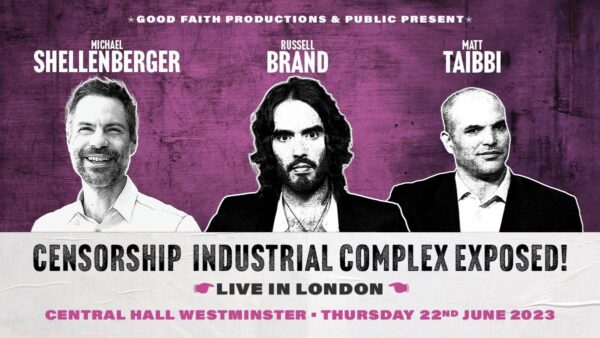
Ireland’s hate speech bill has attracted international attention for the draconian measures it contains – and one of the leading voices for free speech commenting on our legislation has been Michael Shellenberger, the writer and campaigner who says that what we are now seeing is a “war on free speech”.
Tonight Shellenberger will join the ever-feisty Russell Brand and journalist and writer Matt Taibbi for a gathering in London where they will “explore and expose” what they call “Censorship Industrial Complex”.
In a piece for Unherd, Shellenberger explains what he means by that term.
He argues that the war on free speech now has “global aspirations” – and that the collaborating roles of governments, powerful corporations and multinational organisations (like the EU or the UN) make the clampdown on free expression more far-reaching and therefore more dangerous.
Rising levels of hate speech and misinformation, we are told, make it more urgent than ever for governments, corporations and multilateral organisations to adopt stronger measures to protect vulnerable populations online.
It is for this reason that Biden’s Department of Homeland Security recently created a “Disinformation Governance Board”, the European Commission crafted a new Digital Services Act and Code of Practice on Disinformation, and the UN is proposing a “Code of Conduct for Information Integrity on Digital Platforms”.
All of these initiatives are allegedly the product of good intentions; all of them, however, are rooted in the same fallacy: there is little evidence to suggest that hate speech and misinformation are on the rise. On the contrary, Western countries are more tolerant of racial, religious and sexual minorities than ever before. To take one example, the percentage of Americans who approve of marriages between white and black Americans has risen from 4% in 1958 to 87% in 2013 to 94% in 2021.
The author and campaigner says the threat of misinformation and hatred online is often exaggerated. He points to claims by the Institute for Strategic Dialogue (who are, of course, also a familiar voice on the media in Ireland) which counted tweets criticising George Soros as antisemitic
The Institute for Strategic Dialogue (ISD), for instance, recently published a study that concluded that antisemitism was increasing on Twitter. But there is no definitive evidence of rising hate online. The ISD study counted tweets criticising George Soros which didn’t mention his Judaism as antisemitic.
Elsewhere, “hate speech” includes the reluctance of some people online to use female pronouns when referring to transwomen — even though one might oppose using female pronouns for natal males and harbour no animus toward transwomen.
And he makes the observation that has held true very often in this country: “what people label as “hatred” and “misinformation” is often merely an opinion they don’t like or which they fear will encourage bad behaviour.”
He points to the involvement of social media giants in deleting content that is actually true.
Facebook and Twitter have also started deleting a significant amount of true content. Between 2020 to 2021, for example, Facebook censored claims that the coronavirus came from a Chinese lab, even though that was always as likely, if not more so, than the natural-origin hypothesis. Twitter also censored an accurate New York Post story about Hunter Biden’s laptop while allowing supporters of his father, Joe Biden, to falsely claim it was a result of “Russian disinformation”.
The global campaign to censor disfavoured views on Twitter and Facebook is therefore rather curious. If there is no evidence that hatred and misinformation are increasing, and ample evidence of inappropriate censorship of true and accurate information, why are politicians across the West calling for greater power to censor?
Most alarmingly, Shellenberger shows that governments are funding what he describes as a “crackdown on wrongspeech”. It sounds familiar.
Perhaps it is unsurprising, then, that these efforts all share an elitist, anti-populist strain. Many of the government agencies, contractors and NGOs that are advocating for greater censorship have ties to the military, intelligence and security organisations, spawning what I term the “Censorship Industrial Complex”.
How this is manifested is relatively straightforward: fearing that a wave of populist political victories would undermine Nato, the EU and the Western Alliance, government intelligence, military and security officials engaged in disinformation campaigns, such as the one claiming Trump was a Russian asset and that the Hunter Biden laptop was Russian disinformation, while demanding censorship of populist and anti-war voices.
Together, these measures constitute nothing short of a world war on free speech. After all, the intention of the UN and the EU is to censor disfavoured speech at a global level, specifically by insisting that Twitter and Facebook obey their dictates or face massive fines and nationwide restrictions.
He notes that Elon Musk, the owner of Twitter, is refusing to comply with EU rules on this issue – but says that “it is up to the citizens of the world to insist that governments stop demanding, directly or indirectly through the NGOs they fund, that social media platforms censor disfavoured views.”
“Perhaps most of all,” he writes. “We should feel insulted, patronised and threatened by those elites who are trying to undermine that precious thing we have been fighting for since society was born: our right to express ourselves, however much it might offend them.”