A Dublin conference has heard that the legalisation of assisted suicide or euthanasia in Ireland will pave the way for a broader social acceptance of suicide as an option for unbearable distress, including mental illness.
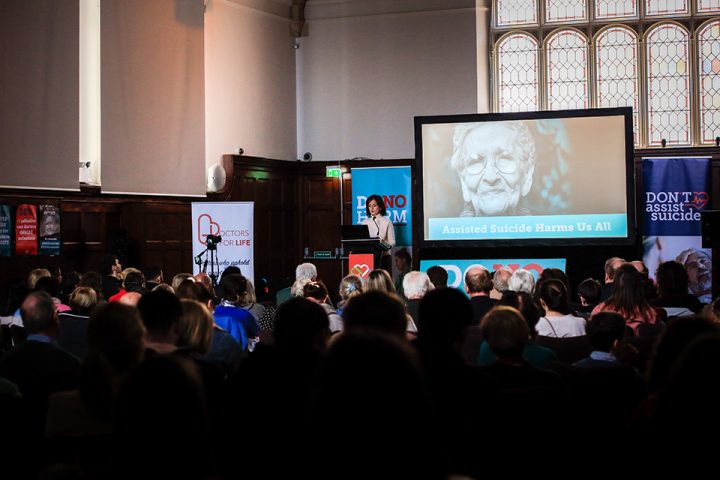
Saturday’s conference, organised by The Life Institute in partnership with groups including Doctors for Life, Don’t Assist Suicide, and Family Solidarity, was held in the Clayton Hotel in Dublin. The event, attended by several hundred people, heard from Professor of Psychiatry, Prof Patricia Casey, Palliative Care Consultant, Dr. Wilhelm Freiherr von Hornstein, Barrister and commentator Maria Steen, and Assistant Professor of International Relations and International law, Yuan Yi Zhu.
In addition to legal and medical experts present, a personal testimony was delivered on the “devastating” impact of assist suicide by one Dublin family, who lost a family member after he travelled to a clinic in Switzerland.
Prof. Patricia Casey, Consultant Psychiatrist at the Hermitage Clinic in Dublin, spoke on the question: “Does assisted suicide assist suicide?”
The Professor Emeritus said that the evidence points to the “very strong likelihood that assisted suicide legislation will also assist in bringing about an increase in (unassisted) suicide through widespread social acceptance (including for mental illness and distress) and contagion over time.
“The slope will be gentle if imperceptible initially, but it will be there and will steepen with the passage of time,” she said, citing research examining changes to unassisted suicide in US states after physician assisted suicide was introduced (Doherty, Jones et all, 2022).
One study which compared data from states before and after legalisation of PAS 1990-1913 found an increase in all suicides by 6.3 per cent with no decrease in unassisted suicide, with cases higher in those aged over 65. The psychiatrist said that such research was not consistent with claims made by pro-assisted dying campaigners that assisted suicide reduces the overall rate of suicide. Elevated rates of unassisted suicide were reported from Switzerland and Oregon in older women, with Prof Casey saying that this indicated “an unmet need for treatment and suicide prevention in this group.”
Prof Casey also referred to an idea of “good and bad suicides” in the event of assisted suicide becoming legal and acceptable, as she questioned whether suicide prevention policies would be viewed as coherent in jurisdictions with assisted suicide. She spoke about a possible “contagion” effect and the possible social acceptance of suicide as an option for unbearable suffering, including mental distress.
Barrister, commentator and writer, Maria Steen, spoke about the legal issues arising with relation to assisted suicide in Ireland.
Ms Steen said that the so-called “progressive” political project has been advanced through judicial decisions, adding that the tactics used in many breakthrough cases were utilised in Ireland in the Fleming case, the judgment in 2013 which involved right to die campaigner Marie Fleming, challenging Irish law. Ms Fleming, who ultimately lost her legal case, as well as a subsequent appeal, had been diagnosed with Multiple Sclerosis 27 years previously and was in the terminal phase of the disease.
The mother of two had claimed that the Criminal Law Suicide Act 1993 discriminated against those who were unable to travel abroad to die without assistance. Marie Fleming’s husband, Tom Curran, later became a prominent euthanasia campaigner and a director of the Swiss euthanasia organisation, Exit International. After the Supreme Court dismissed Ms Fleming’s appeal in the case, Mr Curran, from Wicklow, said he helped his wife fulfil her plan to die on 20 December, 2013 – saying that he assisted her suicide, risking prosecution. He was never prosecuted, but said he had been interviewed at a Garda station.
Ms Steen said that the Fleming case summarised the current state of Irish law, and that the Supreme Court “rejected the proposition that there was in the Constitution a right to suicide and assisted suicide.” The author argued that certain remarks made in the course of the judgement, however, had given “what some see as a nihil obstat or go-ahead to the Oireachtas to legislate.”
“Counsel for Ms Fleming sought to couch her argument in restricted terms – these things always start that way. We saw the same thing in the abortion debates. So it is not surprising that her personal story and her suffering were emphasised, as was the fact that this was a terminal, untreatable disease, and also that Ms Fleming was compos mentis and was still able to make an informed decision.
“In other words, her consent was assured; this was not a decision taken under duress from someone else; her condition was terminal; and she did not wish to die of her illness, but rather at a time and place and in a manner of her own choosing. Her legal team even went so far as to describe the proposed method of her demise, which as the court said, involved a system whereby a lethal drug could be delivered to her and by her, but comprising a complex set of steps that would require assistance from others, so that she could take the final step to kill herself.”
Ms Steen continued: “These things were not strictly relevant to the legal question at hand – but they were highly relevant to the battle for public opinion. In a referendum debate, these would be the things on which proponents of assisted suicide would focus. While Ms Fleming’s illness and its stage and severity, would evoke sympathy in even the most hard-hearted person, they do not go to the central question of whether someone has a legally enforceable right to commit suicide.”
“The seven-judge Supreme Court panel in the Fleming case considered the issue and came to a unanimous decision. The court rightly concluded that the fact that suicide had ceased to be a crime (it had been decriminalised as I have said in 1993) did not establish a constitutional right to suicide. In other words, just because something is no longer illegal does make it a positive right.”
Ms Steen said that while “we can talk about the legality of this issue all day long,” fundamentally, just like the abortion referendum in 2018, “this is not a legal matter. It is not really about the law at all – the law is merely a means of allowing it to happen.”
‘YOU DON’T HAVE TO BRING EVERYONE ALONG – JUST ENOUGH VOICES TO GIVE IMPRESSION CULTURE HAS ALTERED’
“It does not tell us whether it is right or wrong. Our positions on the issue of assisted suicide are ultimately governed by values and morals, and that, in our culture, is where the real fight lies.”
The barrister went on to say that the “semblance” of a cultural shift is “sufficient to bring about the legal change that will make the cultural change real.
“You don’t have to bring everyone along,” she added. “Just enough voices to give the impression that the culture has altered. Initiate a “citizens assembly” or Oireachtas Committee, get “personal stories” highlighted in the media – especially those who are (or rather claim to be) adversely affected by the law sought to be changed – have “experts” speak about the necessity of the change, ignore and bury the testimony of dissenters, especially those with real expertise, experience, and knowledge. For good measure, highlight the fact that the Catholic Church teaches against the proposed change – that will persuade all “right-thinking” people that the change is good. This is how the progressive playbook works.”
The conference also heard about international experiences with assisted suicide and euthanasia from Assistant Professor of International Relations and International law, Yuan Yi Zhu at Leiden University in the Netherlands. who referred to a “worldwide push for legalisation by highly effective and well-financed lobby groups.”
Mr Zhu spoke about the fact that “almost all jurisdictions which have had assisted suicide or euthanasia in place for a certain amount of time have expanded eligibility and/or loosened safeguards.” The academic said that the legalisation of the practise would “coarsen the moral sense of a society” citing polling from Canada which showed a high percentage of the public now support euthanasia for cases where an individual is unable to receive medical treatment, for mental illness, poverty, and disability.
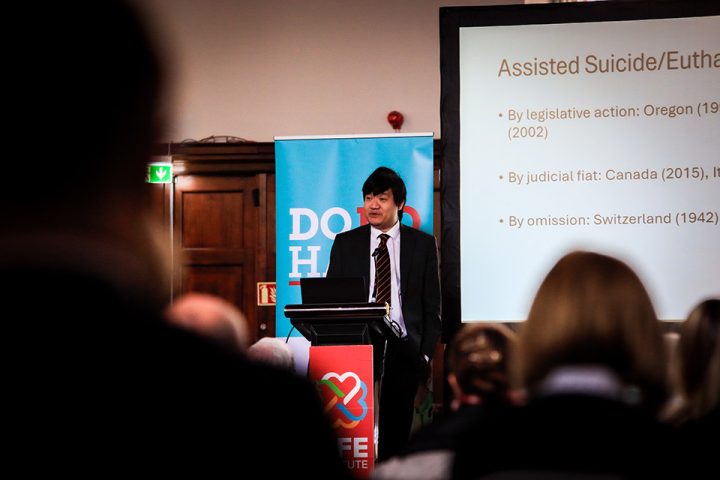
The researcher also claimed that the international experience evidences that “there is no equilibrium for limited assisted suicide/euthanasia laws” and that “if it becomes legalised it will be expanded.”
Palliative Care Consultant, Dr. Wilhelm Freiherr von Hornstein gave his thoughts from a palliative care perspective. The doctor at the Specialist Palliative Care Service in Cavan and Monaghan spoke about palliative care patients finding meaning in suffering. He said he had experienced numerous patients who had made peace with death, as well as peace with family, in their last days. This opportunity, he said, would be robbed from many, if assisted suicide were to become legal.
FINDING MEANING IN SUFFERING
The doctor spoke about the pressure on palliative care services, including limited resources, staffing shortages, increasing regulations, higher demands from patients and families as well as from employers.
“Good symptom management can prolong the dying journey,” he said, addressing common misconceptions about palliative care.
“Palliative care is more than symptom management, and healing and transformation is a process that takes time,” Dr von Hornstein added.
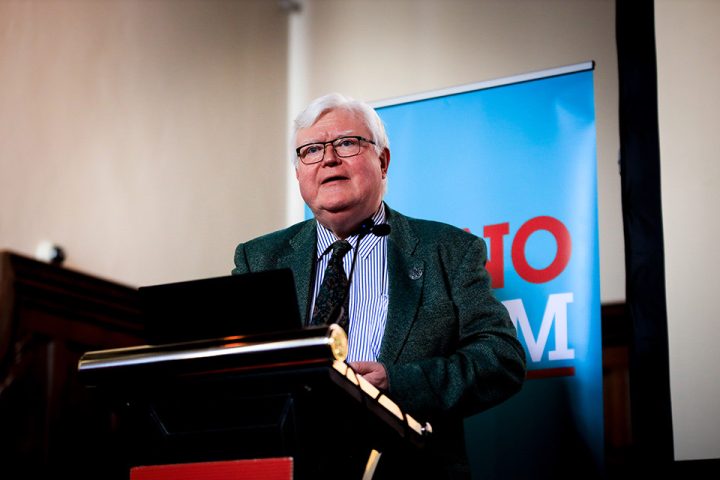
Speaking about one anonymised experience, he said that there “are two different levels of experience for the dying man. The conscious and unconscious The visible and the invisible The tangible and the intangible. The outer and the inner. The surface and the deep.” The palliative care expert said that while in these cases, it is important on the surface to relieve relieve his physical symptoms and anxiety, sometimes without sedation, the aim of this is to that a patient can access a deeper level of meaning, so as to “experience healing and transform suffering into meaning and bring peace to the family.”
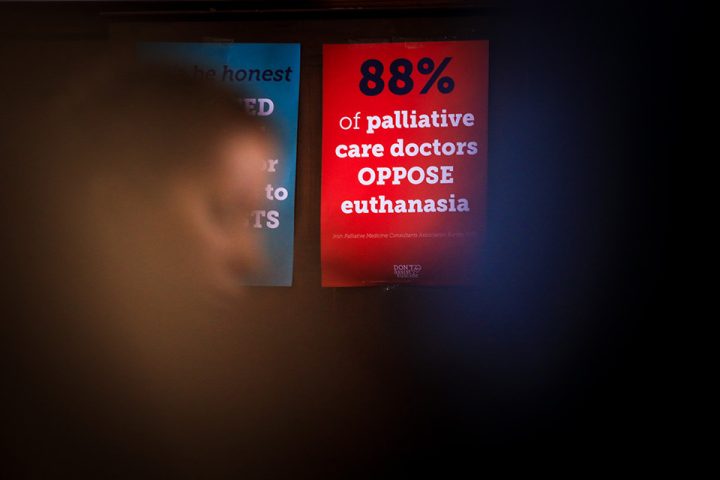
Last October, politicians in the Dáil voted to note a final report by the Committee on Assisted Suicide / Assisted Dying which called on the government to legalise assisted suicide in certain restricted circumstances.
A total of 76 TDs voted in favour of the report, with 53 TDs voting against it in the Dáil. Former People Before Profit TD Gino Kenny, who lost his seat in the general election, called for the Dáil vote and was a long-term advocate for the recommendations to be implemented. Kenny previously said he believed it was “inevitable that legislation will be enacted in the next three years in Ireland,” while Taoiseach Micheál Martin, as Tánaiste haS expressed serious reservations about the recommendation for assisted suicide to be legalised in certain restricted circumstances.