A Galway TD has called for full transparency after a long delay in the publication by the Arts Council of details on spending between 2018 and 2025 which State bodies are required to provide.
Purchase Orders published last week show that the Arts Council has spent €17 Million on payments which are categorised as IT services or recorded as being paid to a Recruitment Agency specialising in the provision of IT staff over the 8 year period between 2018 and 2025.
€11.5 Million was paid out by the Arts body to a variety of companies for IT services, including €2.8 Million to Codec and another €2.8 Million to another company named Ergo.
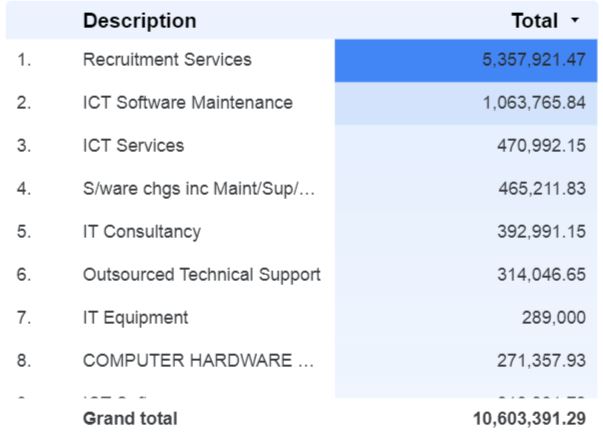
However another €5.4 Million was also paid by the Arts Council under the category of Recruitment Services to Sureskills, a company that specialises in IT contracting. Those payments amounted to 83% of the €6.4 Million spend in the Recruitment Services category during the period. A tracker examining purchases shows that all other payments to Sureskills by government agencies are described as IT expenditure.
Arts Council IT Services spending amounted to €381,071 in 2018 and climbed to €873,976 in 2019 before almost doubling again to €1,590,712 in 2020 and then increasing significantly again to €2,325,100 in 2021 and €2,260,802 in 2022. Spending on IT then reached €2,485,730 in 2023 before falling in 2024 to €776,400 and then to €426,709 in 2025 – with a total €11.5 Million spend in that category.
Arts Council IT Services and Recruitment Services by IT Specialists Spend – Purchase Orders greater than €20K
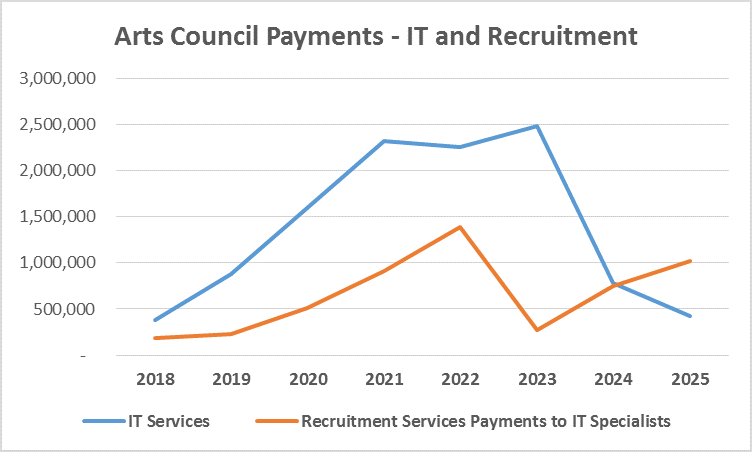
Recruitment Services payments to Sureskills followed a similar pattern: coming in at €187,400 in 2018, and €225,776 in 2019, before also doubling in 2020 to €507,231 – and then also increasingly significantly again to €910,648 in 2021 and then to €1,390,400 in 2022. However, spend in 2023 fell considerably to €271,036 before rising again in 2024 to €745,048.
The 2025 total of €1,020,382 included two payments in Q3 and Q4 amounting to almost half a million euros.
A dashboard produced by Galway East TD, Albert Dolan, enabling analysis of all spending to suppliers by state-funded bodies, shows that payments to Sureskills by every other Government Agency, including the CSO, Tusla and the National Library of Ireland, was categorised as IT spend.
SureSkills say they “specialise in recruitment, technical IT consultancy, service management, and IT infrastructure training.”
State bodies have long-standing legal and policy obligations to publish procurement-related payment data, particularly purchase orders and payments over €20,000. Despite these obligations, the Arts Council failed to publish the required purchase order/payment reports until January/February 2026.
CONTROVERSY
Arts Council spending on IT came under fire last year after it was revealed that almost €7 million was spent on an unsuccessful IT system which sought to streamline grant application processes. This resulted in a controversial write-off of over €5.3 million and led to legal actions being against contractors.
A review of the spend in 2023 indicated that a “commercial off-the-shelf solution” would have been preferable rather than the bespoke system that subsequently developed significant difficulties.
It also found that this “once in a 10-15-year capital project exposed gaps” in the Arts Council’s “governance architecture” – and that the business case for the project “understated” the costs involved.
Gript queried the categorisation of payments for Recruitment Services in the period, asking if the payment is in relation to agency staff rather than recruiting staff costs.
In response, the Arts Council said that “these Purchase Order values do not relate to a recruitment services contract”.
In relation to the € 5,357,921 paid to Sureskills over the 8-year period, they said that “these Purchase Order values relate to the provision of both a managed services agreement and the supply of temporary agency workers across the organisation.”
And they confirmed that the €11.5 Million paid out in relation to IT Services in the period, included the now-scrapped Business Transformation Project.
ARTS ADVISORS: €9.6 MILLION
Deputy Dolan also pointed to a spend of €9.6 Million on a category titled Arts Advisory in the period, saying that the lack of detail in the purchase order report made the spending “visible but not intelligible”.
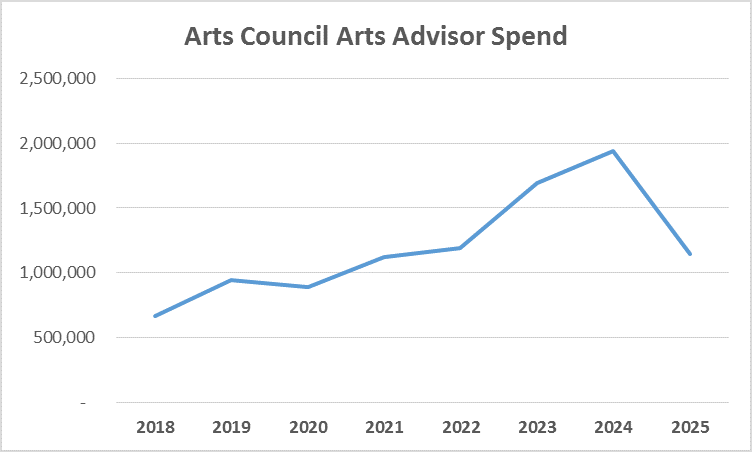
The spending category titled Arts Advisory lists 145 purchase orders which account for a spend of €9.6 Million across 8 years from 2018 to 2025.
The annual amount grew from €669,907 in 2018 to €1,124,487 in 2021 and €1,193,301 in 2022 – and then jumped to €1,692,503 in 2023 and almost €2 Million (€1,941,918) in 2024, almost tripling between 2018 and 2024, period before falling to €1,142,352 in 2025.
The Arts Council says that Arts Advisors “provide additional expertise and strategic advice” and “assess and shortlist funding applications within their area of expertise” – adding that “they may also provide secondary assessments on applications involving more than one artform”.
These payments do not include grants to artists to produce artistic work or events.
The payments schedule shows that one visual artist received €1,126,668 for advisory services over 8 years, including one payment of €570,000 in 2023. Another company providing arts advisory received €585,419 in a six month period in 2024, having been set up just months before the first receipt of payment.
Under publication requirements, the Arts Council, in common with other state agencies are obliged to produce a register of all contracts over €20k, including contract duration, award date and value.
Gript asked the Council for further details on the Arts Advisory spend and whether the largest spend had been subject to contract. They said that “Arts Advisors support the Arts Council by assessing funding applications from individual artists and organisations across a range of schemes, helping to inform fair and robust funding decisions.”
The Purchase Order of €570,000 was related to “the value of a four-year contract that was publicly advertised and awarded through the eTenders procurement process in 2023, in line with public procurement requirements,” they said. “The full contract value has not been drawn down to date. The contract covers the provision of advisory services, including the engagement of sub-contractors where required.”
“CENTRAL WEAKNESS”
Deputy Dolan said that the Arts Council has published purchase-order data covering €51.9 million across 899 transactions between 2018 and 2025. “That is a welcome step and it reflects the direction transparency needs to move. Since entering the Dáil I have been working to assemble this information across the wider system, and the national dataset now tracks more than €95 billion in spending. The expectation from the public is straightforward: if money is spent, it should be possible to follow it,” he said.
The Galway East TD said that one feature of the release of payments “stands out immediately”.
“There is €11.49 million recorded under ICT services. The trajectory is important. ICT orders move from roughly €381,000 in 2018 to €874,000 in 2019, then rise sharply to €1.93 million in 2020, €2.33 million in 2021, €2.29 million in 2022, and €2.49 million in 2023. Only after that do we see a marked reduction, to about €776,000 in 2024 and €427,000 in 2025. That is a sustained multi-year build, then wound down,” he said.
“Suppliers that have been associated in media reporting with the abandoned IT system are present in the dataset. However, seeing names and figures is not the same as having accountability. What remains missing is the ability to connect each payment to the contract that authorised it, the value of the contract and the delivery expected,” he added.
He pointed to what he called a “central weakness in Ireland’s procurement information”, saying: “The chain from tender → award → payment → performance is broken across separate systems. Because it is broken, warning signs are harder to detect and scrutiny tends to arrive after failure rather than during delivery.”
He pointed to the category titled Arts Advisory as illustrating the same problem. “We can see who was paid, but the heading does not explain what work was specified, what outcomes were agreed or how those payments relate to the original commitment. Without a direct path back to the contract and the competition, the spending is visible but not intelligible.”
“Transparency that produces figures without context can create frustration instead of confidence. The practical remedy is not complicated: every payment should carry a reference to the contract that approved it and the underlying tender that defined the requirement, allowing anyone to trace the story from decision to result,” Deputy Dolan said.
“Ireland needs a single, enforceable transparency standard that makes that linkage routine. When money can be followed in real time, problems surface earlier, management improves and public trust is strengthened,” he added.