There have been many tributes paid to Chuck Feeney, the man who established Atlantic Philanthropies as a conduit for the multi-billion funding of third level institutions, NGOs and even entities that had been established by the state, including in Ireland, with the clear and stated objective of bringing about political change.
Among the tributes was one from former Sinn Féin President Gerry Adams whose party was a major beneficiary of Feeney’s own generosity – and whose good fortune in being given large amounts of cash by random donors of millions must be seen as a victory for a party of the left.
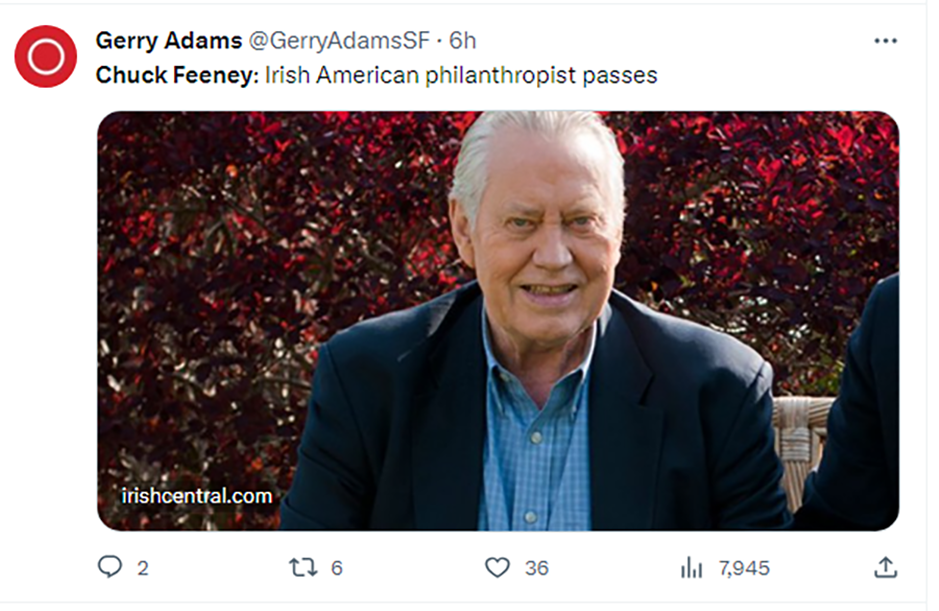
Adams’ sentiments were echoed across the rest of the political establishment including President Michael D. Higgins, and fulsome praise was also forthcoming from many of those in the NGO sector. Among them was Ian Power, CEO of Spunout.
Power said that Atlantic funding had been “transformative to our scale and impact.”
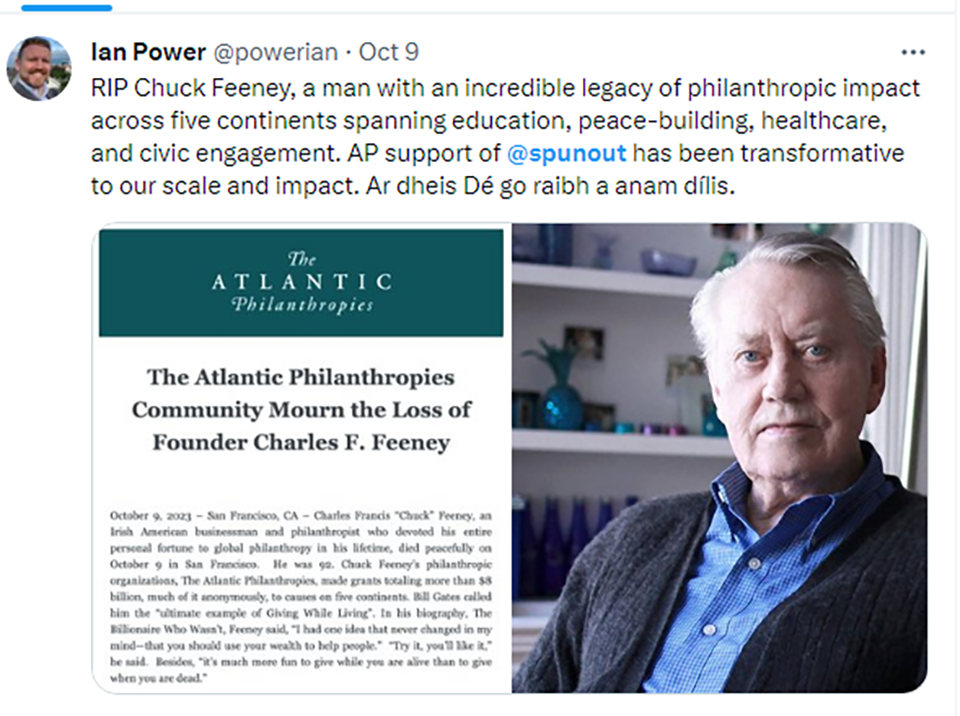
That is certainly not an exaggeration as it would be more accurate to state that Spunout, which under the rubric of Community Creations was granted a total of $1,586,618 between 2009 and 2013, would not exist on anything like its current scale had it not been for this funding. Of course, it was then matched-funded by the State which now funds SpunOut almost in its entirety.
The main tranche of the Atlantic money, granted to Spunout in 2009, was for the purpose of supporting an “an independent, youth-powered national charity working to empower young people to create personal and social change.” The extent to which a billionaire-funded – and now almost completely state-funded – entity campaigning for “political change” is either “independent” or a “charity” is a matter of semantics perhaps.
In 2022, Spunout had a total income of €2,569,652 of which fully €2,369,585 came from the taxpayer, mostly through the HSE. Among the grants it received was one from the Department of Children, Equality, Disability, Integration and Youth (DCDEIY) for the purpose of “raising awareness of climate justice issues amongst young people and empowering young people to take climate action.”
What sort of “climate action” would that be, and indeed what is “climate justice.”? These are ideological projects and ones that ought surely be left to the youth sections of one of the left liberal parties like Ógra Shinn Féin and the Greens rather than be supported by working people’s taxes? Gript has several times referred to this aspect of Spunout, as for example in its campaigning in support of the “new and improved” SPHE syllabus. Again, hardly something that should be supported by tax revenues.
This taxpayer-funded entity also continues to host a page through which you can donate to the widely discredited Black Lives Matter Global Network Foundation which has been sued by members of its own grassroots chapters in an unseemly row over the millions of dollars donated, and allegedly misappropriated, to BLM. Again, one might ask why they ought to be doing this.
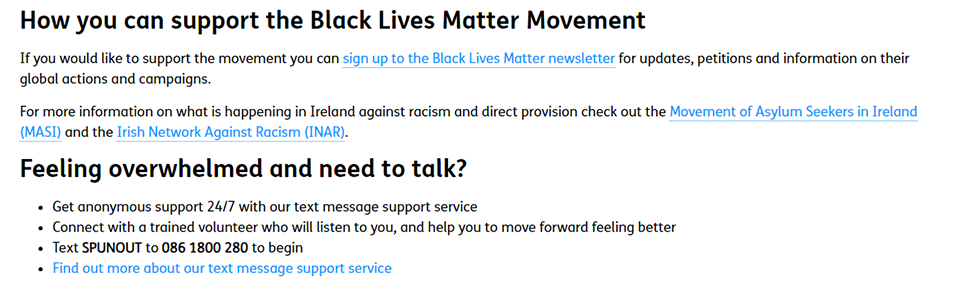
The link takes one to the homepage of the Black Lives Matter Global Network Foundation. This is the entity that was taken to court by “grassroots” chapters of BLM who alleged that funds raised were not being re-directed to those grassroots and may in fact have been diverted to other uses. All of that is disputed by BLMNF but the very fact that such controversy over funding exists ought to dissuade anyone from assisting them to solicit money.
Of course you might also take the view that to dare question the funding, power and influence of the advocacy NGOs is “incitement.” Or that it is “a manufactured Trump style attack on civil society.” And yes, he is referring to Gript.
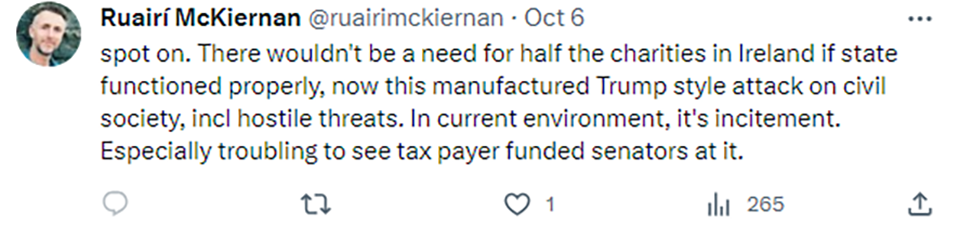
Ruairi, appointed to the Council of State by Michael D. Higgins in 2012, was a founder of Spunout and is undoubtedly pleased that whereas Trump’s alleged interference with “civil society” constitutes an attack, that the fact that Spunout would never have become what it is without the interference of another American billionaire in our civil society is somehow an example of great selflessness.
Civil society as a matter of interest is generally understood as denoting a public sphere that is independent of the state. That is the clear historical origin of the concept in western political thought at a time in the 17th and 18th centuries when an autonomous public sphere not dependent on either state stipends or in the pockets of the great lords was regarded as an essential bulwark against feudalism.
In what possible way might these advocacy NGOs – which are not only almost exclusively funded by the state and billionaire liberal political foundations, and which are generally fully on board with the positions of the state and political establishment on key issues – actually ‘non-governmental organisations’ or part of ‘civil society’.
Gript as an independent media source is part of civil society. So too is the Irish Times. The farmers’ organisations, and the trade unions and the employers organisations are part of civil society. Organisations who would not exist were it not for the support of a state with which they have a symbiotic relationship are not within the classical definition of what constitutes an autonomous civil society or public sphere.
If Spunout wish to campaign for all of the ideologically driven matters which clearly have priority with them then they are, of course, free to do so. They might however have the common courtesy to do it on their own bat rather than on the tab of taxpayers who if they wish to support left liberalism can do so by making individual donations or by voting for any number of political parties.