The occupation of the former Ardee House premises in Dublin is rapidly becoming more than a dispute over one building. It should be a test of Sinn Féin’s credibility as a potential party of government.
For years Sinn Féin has sought to reassure voters that it is no longer simply a party of protest. It wants the public to believe it can govern the State, manage the economy, deliver housing, attract investment, create employment and provide stable leadership.
That is why the events surrounding Ardee House are so politically significant.
Two Sinn Féin councillors, Daithí Doolan and Ciarán Ó Meachair, have publicly attended and promoted events connected with the occupation. Photographs and social media posts have placed elected representatives of the party alongside activists involved in a campaign centred upon a privately owned property.
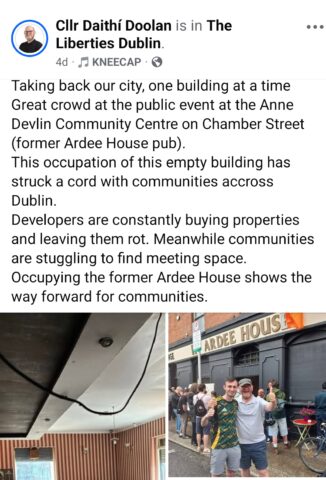
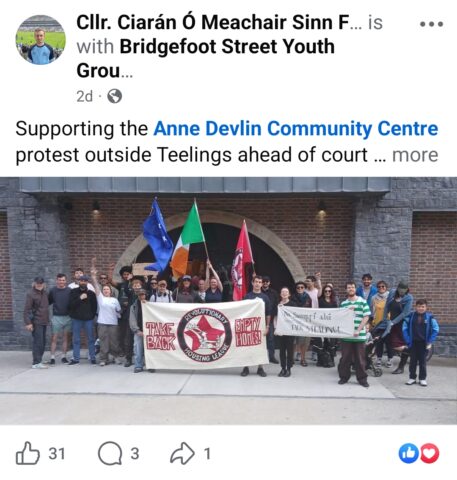
The obvious question is why? What exactly are elected representatives doing associating themselves with an occupation of private property? Doolan says the occupation amounts to “taking back our city, one building at a time” – and that occupying Ardee House “shows the way forward for communities”.
Many ordinary people, including many republicans and supporters of Sinn Féin, will find this deeply uncomfortable.
One does not have to agree with every developer. One does not have to support every planning application. One does not have to like every investment proposal. But there is a fundamental difference between opposing a development through democratic means and supporting the occupation of somebody else’s property.
That distinction matters.
The revolutionary socialists occupying the premises say that they are acting to provide a community centre because local people are being deprived of essential spaces. The owner of the site is Jack Teeling, a businessman who has invested heavily in Dublin’s Liberties. Through the Teeling Whiskey Distillery, he has helped create employment, attract tourism, generate tax revenue, and contribute to the regeneration of an area that suffered decades of neglect. He says that he has submitted plans, through his Black Sheep Investments fund, for housing and the development of a community space for the residents of Dublin 8 on the site.
Whether people agree or disagree with every proposal he has brought forward is beside the point. The question is whether elected representatives should be seen lending support to those occupying his property.
If this is considered acceptable, where exactly does it end?
Can any vacant property now be occupied? Can sites awaiting planning permission be seized by campaign groups? Can buildings undergoing redevelopment become targets?
Can family businesses find themselves under pressure from activists simply because they disagree with future plans? Can properties tied up in probate or awaiting sale be occupied by those who decide they have a superior claim?
They might seem like far-fetched questions but they are the natural consequence of normalising occupations as a legitimate political tactic. They are the likely outcome of dismantling the right to private property which protects every family home.
As Matt Treacy highlighted previously on Gript, People Before Profit have already proposed a bill which stated that: “The State, accordingly, shall delimit the right to private property where it is necessary to ensure the common good and to vindicate the said right to housing for all residents of Ireland.”
PROPERTY RIGHTS
Are Sinn Féin’s actions regarding Ardee House sending a signal that they might also believe that property rights can be set aside?
Ireland is already facing a housing crisis. Construction costs are high. Financing is difficult. Planning delays are frequent. Investors have many alternative locations where they can place their money.
Yet elected representatives are publicly supporting activists illegally occupying a site. What does that tell developers? That there are easier places to do business? The consequences of that decision are not borne by wealthy investors. They are borne by construction workers, tradesmen, suppliers, local businesses and families waiting for homes to be built.
That is why this issue extends far beyond one property. So what exactly is the relationship, if any, between Sinn Féin and the groups involved in this occupation? Have party members been involved in organising events? Have party resources been used to assist activities connected with the occupation? Do senior figures within Sinn Féin support what is taking place or are local members acting entirely on their own initiative?
Sinn Féin has spent years attempting to reassure business owners, employers, investors and middle-income families that it is ready for government. Is this really the behaviour of a party preparing to govern Ireland? Republicanism was never supposed to mean mob rule.
Irish republicanism, at its best, sought to establish democratic government, national self-determination and the rule of law. It sought to place authority in the hands of the Irish people acting through institutions, not through whoever happened to occupy a building first.
Many republicans fought and died believing Ireland should be governed by laws made by the Irish people, not by direct action campaigns capable of overriding property rights, legal processes and democratic decision-making.
That is why this issue matters – and why the public deserves clear answers.
—————————————————————————————————————
Tomás Mac Cormaic