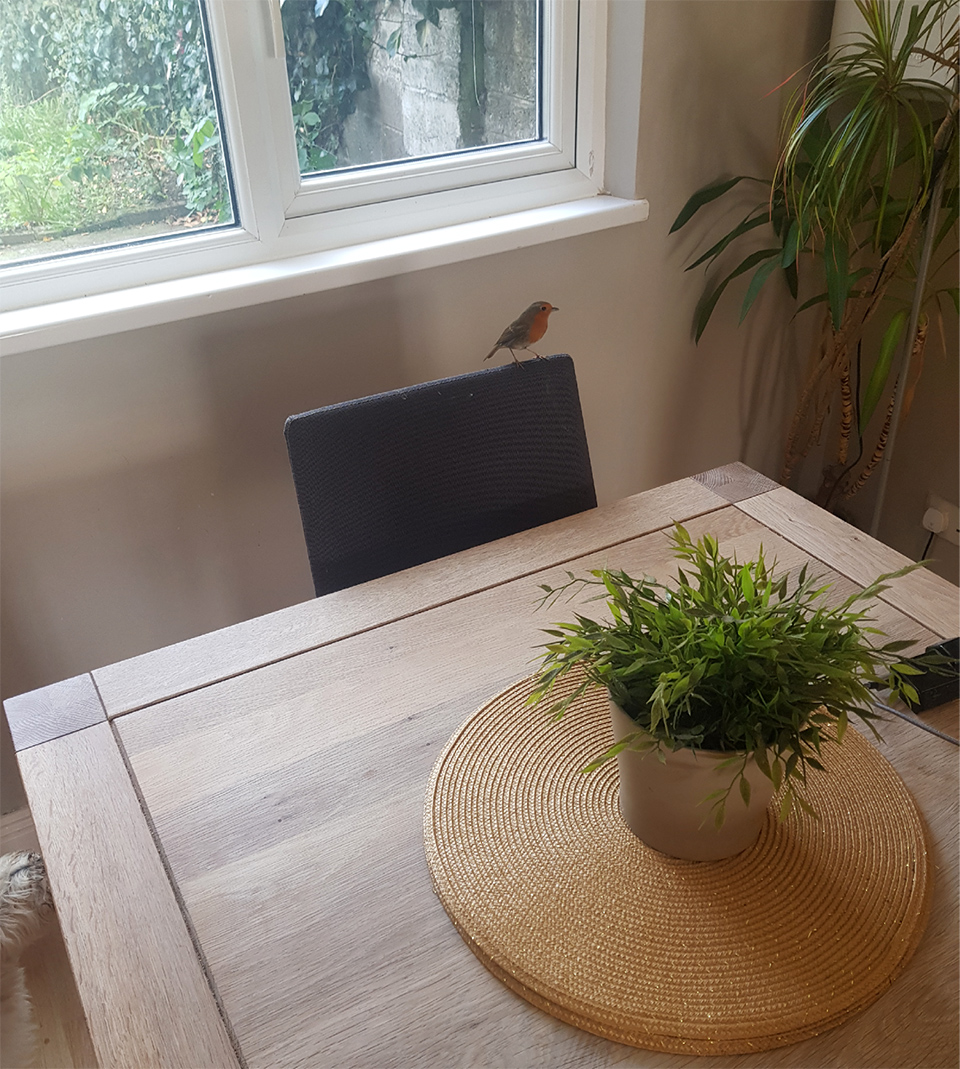
I confess to having developed a bit of an obsession with a robin who appears to have taken up residence in our garden for some time past. Thanks to my unselfish and sustainable application of the concept of “wilding” there are plenty of places for all manner of lads to make their own.
Bonnie and Barney the terriers, of respectively West Highland and Yorkshire extraction, have become remarkably tolerant in their dotage. They do draw the line at the largest of the rodent species whose occasional visits from nearby fields are greeted with outrage as their ancestral DNA is triggered. It has been a few years since they caught one, thankfully.
Ar ais go dtí an Spideog. Tá nós aige, nó aici – ach shilím is fear é mar tá dathanna an fear fásta níos gile ná an ban spideog – teacht ag iarraidh a bhricfeasta timpeall athmhaidin.
Cloisim tic – tic- tic ó bharr an sceach lasmuigh mo fhuinneog. Caithfidh mé an cháis a thabhairt amach sa clós. Agus fanacht.
Down he comes. Tuirlingíonn sé anuas go tapaidh. Alpann sé ceann amháin, agus tógann sé ceann amháin eile leis ina gob. B’fhéidir go bhfuil a bhean ag fanacht leis an proinn? Is duine uasal é gan amhras.
Cheddar cheese is his meal of choice. I had no idea they liked cheese until informed of this by my brother. It has several advantages. Not least of which is that it tends to be beneath the attention of the ranking scavengers such as the seagulls, crows, ravens, rooks and magpies. none of whom are friends to the robin.
Occasionally he comes into the house.
There is much lore about the robin in Ireland. Perhaps the best known reference is that Seán Ó Ríordáin entitled his first collection of poetry Eireaball Spideoige, published in 1952. He took that from a line in his poem about his mother’s funeral, ‘Adhlacadh mo mháthar’. In the poem Ó Ríordáin mentions a robin who landed on the grave and who he imagines has some otherworldly connection with his dead mother, which the poet envies. He ends the poem wishing that he might take hold of the robin’s tail, banish the other mourners, and spend the rest of the day alone in his sadness.
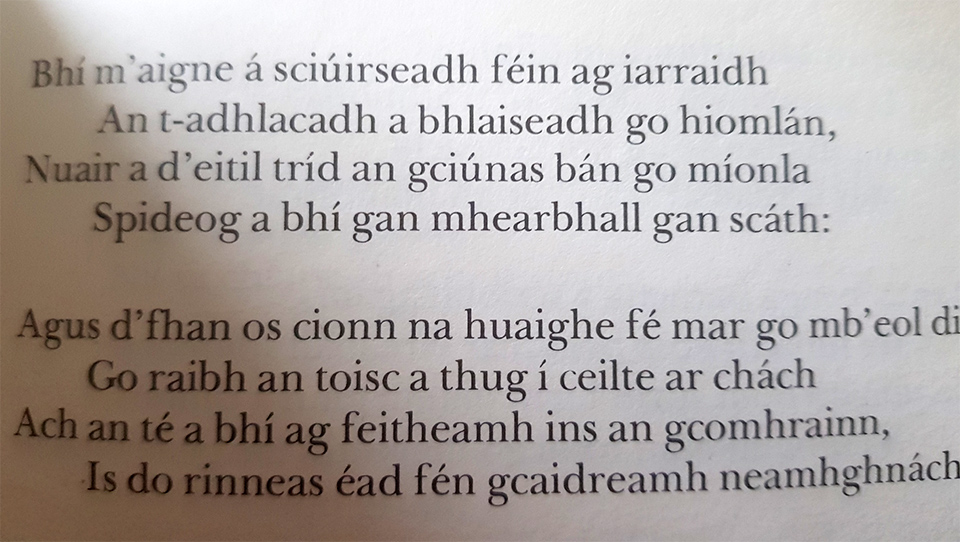
Seán Ó Ríordáin, Eireaball Spideoige, Sáirséal – Ó Marcaigh (1986)
This set me off on a search for other references. There are more than 3,000 mentions of our red breasted friend, 154 of them as Gaeilge or to the surviving use of the Gaelic name for the robin in local usage and place names, in the schools collection amassed by An Cumann le Béaloideas Éireann that you can find on the Duchás site. These are all from the 1930s.
Mar aon le fís An Ríordánach, bionn cuma neamhghnách, diamhaireacht fiú, a bhaineann leis an spideog nuair a bhionn teagmháil idir an spideog agus saol an cine daonna. Teachtaire an bhás- nó ón “taobh eile – ” nó faoi duine ag “imreacht ó’n dteallach” dar le páistí An Clochán. “Má thagann spideog isteach i dtigh is cómharta bháis é.” Ar an láimh eile is dea comhartha í an spideog i roinnt mhaith foláireamh; “An dá éan is deise ar bith: an spideog agus an Eala.”

Bean ón mBás – Scéal · Inis Cléire, Dún na Séad · The Schools’ Collection | dúchas.ie (duchas.ie)
The best-known tradition across all of Christian Europe associated with the robin is that the bird acquired its unique colouring when attempting to pull the nails from the Saviour’s hands and feet. This caused the blood to fall upon the robin’s breast where it remains to this day. “Ní mharbhuigheann duinne ar bith an spideog mar bhí gradh ag ár slánuightheoir air.”
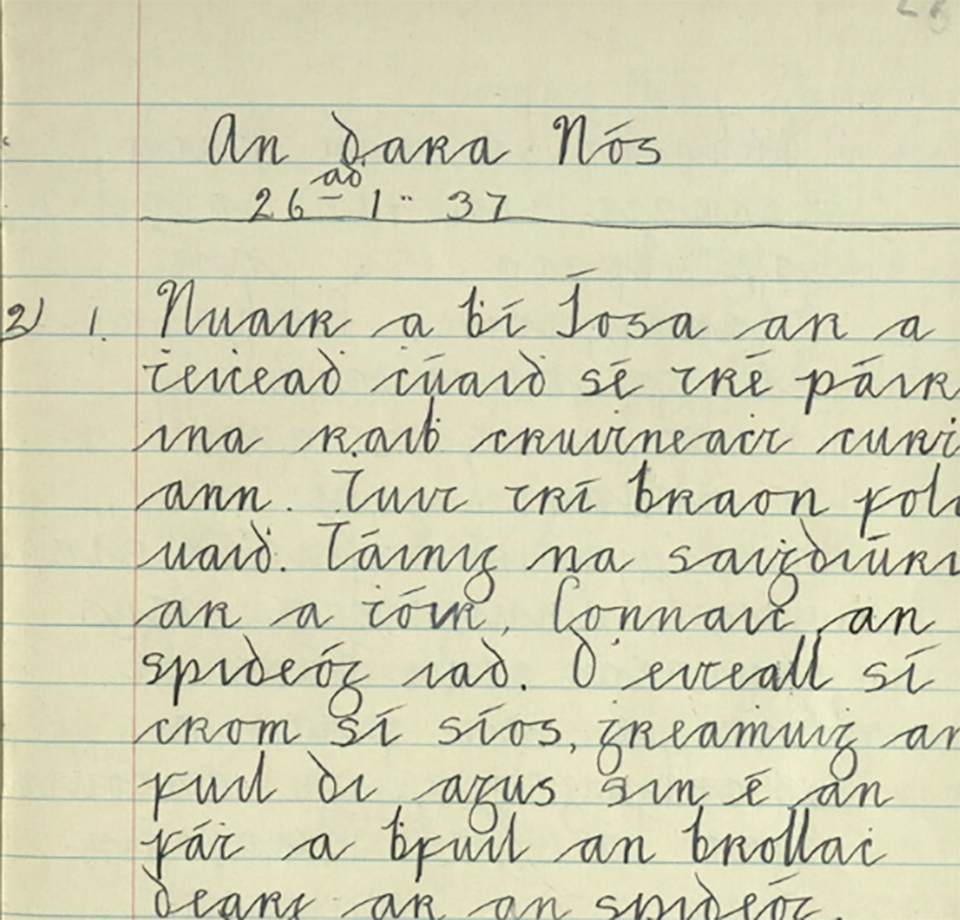
An Mhainistir · The Schools’ Collection | dúchas.ie (duchas.ie)
Agus bhí ár gcara bheag pairteach í scéal an t-éanín eile, an dréoilín. I scéal amháin, “ó bhéal Micéal Mac Gallóglaigh, Bun an Coire, Conndae Muigheó”, diúltaigh an spideog na saighdiúirí nuair a bhíodar ar thóir Iosa. Rinne an dreóilín an feall, agus gabhadh Íosa chun Crann na Páise. “Sin é an fáth a marbhuigtear an dreóilín gach lá Feile Stiopháin.” B’fhéidir go bhfuil an éiric íoctha ag an dreólín bocht.
Other notions associated with the robin include numerous references to robins being a portent of a change in the weather; sometimes good, other times not so good. “Má tá sé ag báisteach agus an spideóg ag cantan fé thor sin cómhartha go leanfaidh de’n bháistig, ach má tá sé in áirde ar an dtor ní leanfaidh an bháisteach i bhfad.” Sounds a bit like any other unreliable weather forecaster one might encounter. A person who sees a robin might also expect to receive a letter.
Agus ag deireadh, olfaidh muid sláinte an spideog, agus sláinte na h-éanlaith go léir. Ta sé ráite nach bhfuil ach saol gearr ag an spideog, Níl fhíos agam faoi an méid sin. Is sean chairde muidne, mé fhéin agus an fear sin. Níl ár rás rithe fós ….
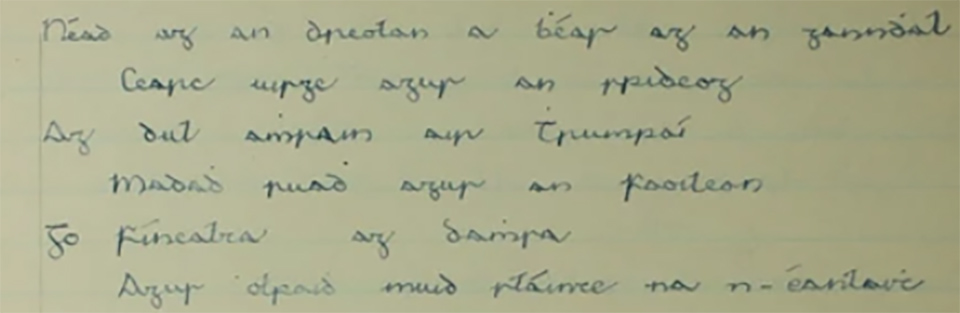
Leitir Fhada · The Schools’ Collection | dúchas.ie (duchas.ie)