According to the Central Statistics Office (CSO) the number of new jobs created in the first six months of the year was 21,500. During that period there were 19,108 work permits issued. Which would indicate that almost 90% of net jobs created went to persons with work permits.
Given that persons coming here from other EU states to work do not need a permit this means that ALL of the new jobs created in 2026 to the end of June have been filled by persons from other countries.
The statistics indicate that this was the case and it is baldly set out in the Central Bank’s 3rd Quarterly Bulletin for 2026 published last week, where it states that:
“Non-Irish workers accounted for all the net increase in year-on-year employment in Q2 2026, with employment levels of Irish workers declining by 0.5 per cent (Figure 29). This continues a trend in recent years in which non-Irish workers have accounted for most of the expansion in aggregate employment.”
Long term Trend
As the Central Bank states this is a long-term trend. Business in Ireland 2025 – Labour Market and Social Sustainability, published by the CSO in May this year, shows that of the increase in the workforce of 355,332 between 2019 and 2024, that 61% or 218,261 of those new jobs were filled by persons from outside of Ireland.
A Department of Social Protection labour market report in October 2025 found that 21% of all employees were non-nationals. According to the CSO that figure was not evenly spread. The proportion of non-nationals in public service jobs was notably lower compared to 45% in accommodation and food, and 41% in IT who were workers from overseas.
The figure for the proportion of non-nationals as part of the workforce is lower than the proportion of the population born overseas. Which rather undermines the claim by some that ‘most’ immigrants are working.
I also looked at social welfare statistics last year which indicated that almost one third of those on long-term unemployment benefit were non-nationals.
CSO population and labour force projections indicate that, depending on which of their three migration scenarios transpires, the labour force in Ireland will grow by between 337,000 and 610,000 people between 2022 and 2037. Almost all of those jobs are being filled by people coming to Ireland from overseas.
Job Replacement?
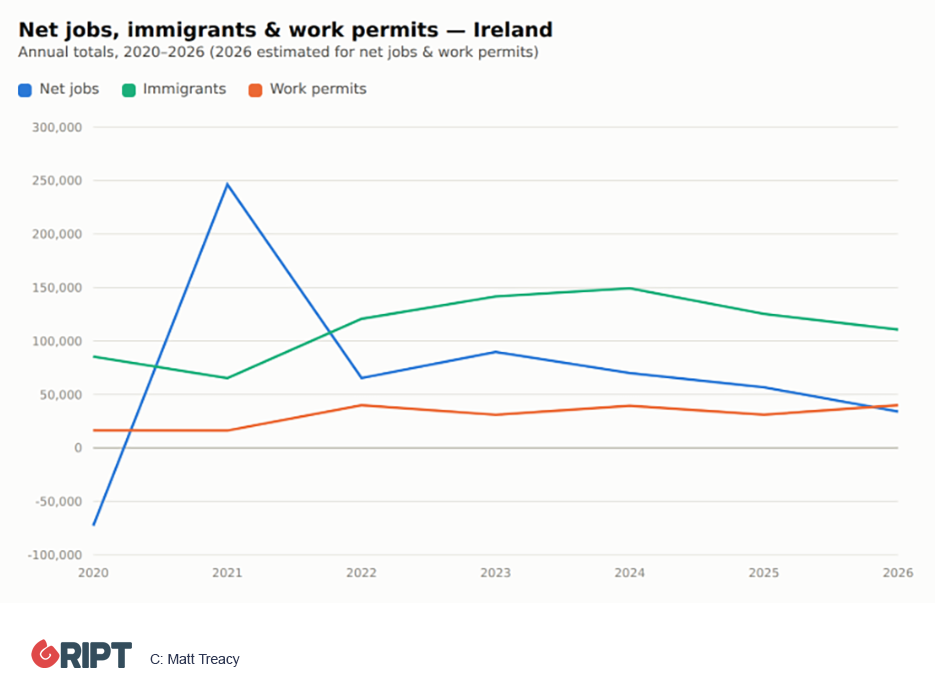
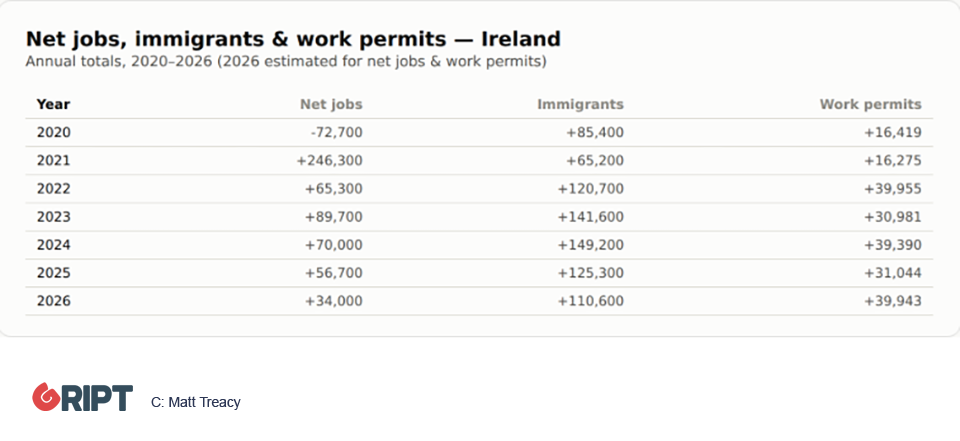
The table and graph above indicate that while there has been a steady fall in the number of net new jobs in the Irish state since 2023 that immigration has remained high, at an average of 131,675 over the past four years.
The vast bulk of those immigrants have come here to work, or as relatives of people who work, and to study. Many students are also entitled in line with their visas to work and overseas students clearly take up a considerable proportion of part-time jobs in certain sectors.
What is most evident is the growing proportion of jobs postings that are taken by persons with work permits – a trend that has led to the current situation where ALL new jobs are going to people from overseas.
If the estimates for job creation and work permits – based on figures to date – remain accurate, then more work permits will be issued in 2026 as there are new jobs created.
Nobody in official circles or among the business or trade union organisations will mention the word ‘replacement’ but in the context that 135,600 young Irish people have left the state since 2022 it could be argued that it is a term that serves as good a descriptive as any.
Is it the case that young Irish people are leaving existing jobs to emigrate due to issues around housing and other factors? And that those jobs are also being filled by persons coming here from outside the country?