74% of Dubliners surveyed in the Northwest of the city feel unsafe walking local streets at night – with 81% feeling unsafe in parks and public spaces at night, according to results from a survey by Dublin City Council, with results from the same survey yet to be made available from other city areas.
Just 45% agreed that their community was a “safe place to live” – with the same percentage disagreeing. Only 22% agreed that Dublin was a safe place to live – though 47% of those surveyed agreed that Ireland was a safe place to live. However, 64% said they felt safe in their community during the day.
66% of those who took part in the survey feel unsafe using public transport at night, while 81% have little or no confidence in public services responding effectively to community safety concerns. Just 4% are very confident of an effective response.
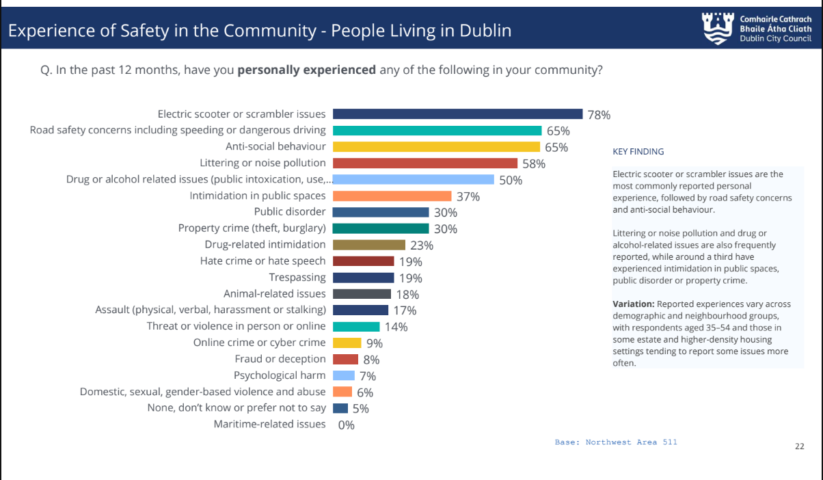
78% had personally experienced scrambler or electric scooter issues, with 37% experiencing intimidation in public spaces – and 23% experiencing drug-related intimidation.
Independent councillor Gavin Pepper described the results as “alarming”, adding: “Think about what that means: feeling unsafe walking home, waiting for a bus or using a local park, and having little confidence that your concerns will be addressed.”
“The clearest recommendation was greater Garda visibility, community policing and response, mentioned by 58% of those answering the action question,” he said. “People are asking for the most basic thing: to feel safe in their own community. The council has gathered the evidence. What concrete action will follow? I’ll be following this up in the Chamber.”
Earlier this year, Dublin City Council said that the five Dublin City Local Community Safety Partnerships (LCSP) – Dublin Central, Dublin North Central, Dublin Northwest, Dublin South Central, Dublin Southeast – had launched an online survey to gather public feedback on community safety issues across the city.
The survey ran from 9th of July to 5th of August 2026, with the Council saying that the feedback received would “play a vital role in shaping Community Safety Plans across Dublin City, including Dublin Central, helping to ensure that local priorities, concerns, and ideas are reflected in future actions to improve safety and wellbeing in our communities.”
The survey results reported by Cllr Pepper today are from the DCC Northwest LCSP report and represent 577 Northwest responses.
Cllr Pepper said the results from the Northwest represented an “enormous failure” of the government to ensure that a “fundamental need, the right to feel secure and safe, was being met.”
“It’s 3 years since Helen McEntee did her walkabout stunt to show us how safe Dublin was, and now these preliminary results are showing that 81% feel they have no confidence that the state will respond to their safety concerns. That’s no way for people to live,” he said.
He said the survey results were a “no-confidence vote in government’s ability to make the residents of the capital city feel safe” and that “action, not empty reassurances, was now required.”
The DCC report said that 3,948 valid responses to the survey were received, of which 577 refer to the Northwest Area of Dublin City Council and that the findings “should not be interpreted as statistically representative of Dublin residents”.
“Respondents in the Northwest Area are considerably more positive about safety during the day than at night. 64% feel safe in their community during the day, compared with 29% at night, while 45% agree that their community is a safe place to live,” the report said.
“Results are generally somewhat less positive than the DCC-wide pattern.”
“Feelings of safety vary substantially by setting. During the day, respondents feel safest when accessing local services and going to shops or shopping centres. At night, feelings of safety fall sharply across all settings, particularly in parks and public spaces, on streets and when using public transport.”
“Community safety is understood broadly. Respondents associate it most often with freedom from fear and peace of mind, alongside Garda visibility and local response, community cooperation and shared responsibility, trust and inclusion. Freedom from intimidation and loitering and responsive local services are the factors most often identified as helping people feel safe.”
“Everyday community-safety issues are widely experienced and witnessed. Electric scooter or scrambler issues are particularly prominent, alongside anti-social behaviour, road safety concerns, littering or noise pollution and drug or alcohol-related issues. These same issues feature strongly in both personal experience and what respondents have witnessed.”
“Feeling safe has a substantial impact on quality of life. 88% say it affects what they do, where they go and when, either significantly or quite a bit, broadly in line with the DCC-wide result,” the report for Dublin Northwest found.
“Awareness of reporting routes is higher than the DCC-wide result, although a sizeable minority do not know how to report safety concerns. 68% say they know how to report, and among those who do, 74% feel comfortable doing so. Anonymous online reporting is the most commonly selected alternative route to reporting directly to Gardaí/police,” it said.
“Views of local public-service response are relatively critical. Only 16% give a positive assessment of how well local public services work together to address safety concerns, while 17% express confidence in services responding effectively. Around one in five feel local people are quite or very involved in safety decisions.”
!Respondents place strong emphasis on visible local response and community engagement. Greater Garda visibility, community policing and responsiveness is the most frequently recommended action for improving community safety. Other recurring themes include enforcement, addressing anti-social behaviour and intimidation, better reporting and follow-up, and community participation and partnership working.”
“The analysis shows consistent differences between respondent groups,” the report noted. “Older respondents and those in predominantly residential areas tend to report stronger feelings of safety and more positive views of local services, while women tend to report
lower safety in several night-time settings. Housing and neighbourhood context, caring responsibilities and accessibility also show recurring differences across the survey.”