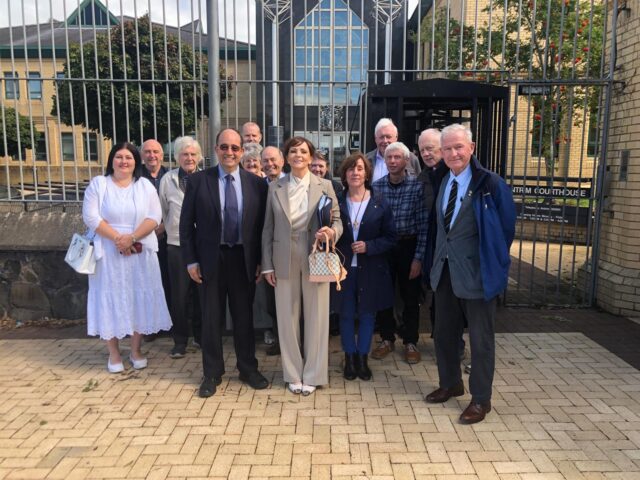
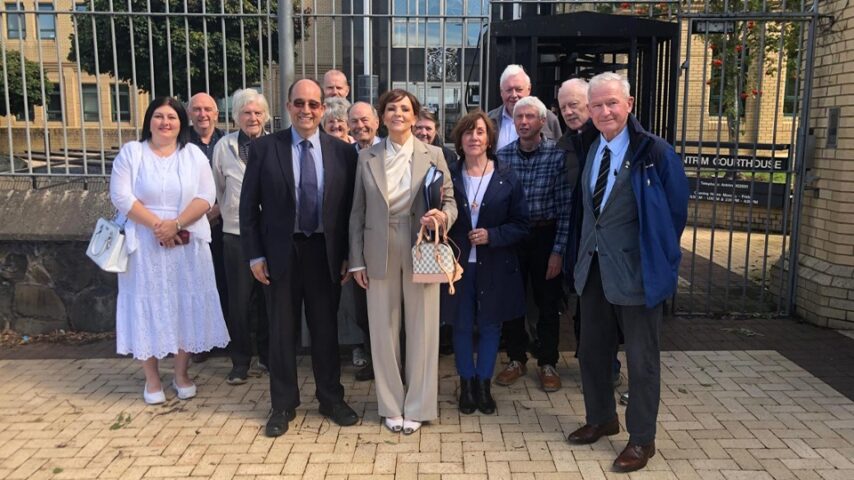
A woman from Northern Ireland who became the first person to be convicted under the province’s abortion “censorship zone” law has had her conviction quashed.
Claire Brennan was convicted in December 2024 for speaking to women outside of a hospital in Coleraine, Co Derry. The prosecution’s case fell apart at Coleraine Magistrates Court on Thursday night.
Mrs Brennan, a mother of four from Ballymena who is being supported by the Christian Legal Centre, had been charged for alleged breaches of the Abortion Services (Safe Access Zones) Act 2023 after peacefully praying and offering support to women outside Causeway Hospital in Coleraine.
However, at her trial hearing, the conviction was overturned by District Judge King after key charges were dropped, witnesses failed to attend, and the remaining evidence was deemed insufficient to sustain a conviction.
The case related to three alleged incidents in September, October and November 2025, in which Mrs Brennan was accused of “influencing” individuals within a 150-metre “safe access zone” around the hospital.
In 2024, District Judge Peter King on Monday ruled that a 2022 ruling by the Supreme Court correctly balanced the rights of those praying or protesting outside places offering abortion, with those of women seeking abortion. However, the pro-life campaigner appealed her conviction.
Under The Abortion Services (Safe Access Zones) Act (Northern Ireland) 2023, which received Royal Assent on 6 February 2023, pro-life protests and other behaviours are prohibited within any Safe Access Zone once it was been established, and this may be enforced by the PSNI.
The Public Prosecution Service had sought to rely on some written witness statements, CCTV evidence and called three live witnesses to give evidence, but the absence of two witnesses resulted in the collapse of the final charge as the Crown were unable to prove that Mrs Brennan was the person that approached the final complainant.
Supporters of Mrs Brennan argue that such laws disproportionately target Christians and pro-life individuals, effectively criminalising the expression of deeply held beliefs about the sanctity of life and restricting the ability to offer practical and emotional support to women in crisis pregnancies. Many of whom do not know of the alternatives to a crisis pregnancy other than abortion.
Court documents show that Mrs Brennan’s legal position relied in part on protections under Articles 9 and 10 of the European Convention on Human Rights, relating to freedom of thought, religion, and expression.
Her defence maintained that peaceful prayer, consensual conversation, and offering a religious token fall squarely within protected rights, and do not meet the legal threshold of harassment, alarm, or distress.
Mrs Brennan has consistently denied any wrongdoing, maintaining that her actions were peaceful, prayerful, and motivated by compassion, including offering conversation and small Christian medals to those willing to engage. Her case was that she was always guided by the Holy Spirit in her actions and only sought to bring comfort to those in pain.
She said today that the ruling was a “huge relief, not just for me, but for everyone who believes that compassion should never be criminalised.
“I have always acted peacefully, praying, offering hope, and trying to help women who may feel they have no alternative,” she added.
“These censorship zones are unjust. They silence prayer, restrict free speech, and prevent women from hearing that there is another option besides abortion.”
Andrea Williams, Chief Executive of the Christian Legal Centre, said: “The collapse of this case exposes serious flaws in the enforcement of these so-called ‘censorship zones’.
“Claire Brennan was engaged in peaceful, compassionate activity, praying and offering support. Yet she faced criminal prosecution for living out her Christian faith.
“These laws are having a chilling effect across Northern Ireland, criminalising ordinary people who simply want to offer women real choice, including alternatives to abortion.
“No society committed to freedom can justify punishing prayer or quiet offers of help.”
It comes just days after a 78-year-old retired pastor was convicted under the same law. Pastor Clive Johnston was convicted and fined after holding a Sunday Service in the abortion zone at the same hospital.
The Christian Legal Centre says Mrs Brennan’s case is one of a growing number of incidents where individuals are being investigated or prosecuted under abortion buffer zone laws.
The organisation has raised concerns that the zones are being used not only to prevent harassment, but to suppress lawful, peaceful expression and the provision of support options to women facing crisis pregnancies.
Claire Brennan remains involved in wider legal challenges relating to censorship zones and freedom of religion and expression in Northern Ireland after she was appealed a conviction for saying ‘The Lord’s Prayer’ and holding a sign against abortion outside of the same hospital.
That case has already seen an unprecedented judicial recusal of County Court Judge Ciaran Moynagh, after concerns were raised about perceived bias due to the judge’s previous activism on abortion issues.