Every year I complain that Christmas is foisted upon us too early by the commercialism that sees the supermarket shelves full of tinselly stuff before Halloween, and I mutter ‘come the revolution we’ll have no more of this nonsense’ because by the time you reach middle-age you know how to adjust your expectations.
But every year I also spend the entire month of December singing Christmas carols and songs in my head – or, as is my wont, much to the eternal mortification of my teenagers, think I am singing in my head while I actually giving loud voice to same.
This week, I attended the Ceolchoirm na Nollaig at the school and it was beautiful and wonderful and magical, and brought, for some strange reason, a lump to my throat: a reaction I thought peculiar to me until other Mams said the same. Nostalgia maybe, or just that the magic of Christmas really is, in fact, in the retelling of the story of a child born in a stable come to save the world. It is the “most tremendous tale of all” as John Betjeman wrote.
And so, as I perused the aisles in Dunnes with the usual inadequate small basket when a giant trolley was required, singing Suantraí na Maighdine to the flaked almonds (you need a mountain of them for florentines) and to the cranberries (bought just once a year), I was thinking about much-loved songs and almost-lost carols.
Not enough carols as Gaeilge survived the sustained onslaught on our language though those that did are tremendously beautiful, such as Carúl Loch Garman, and the cadences of the language in the original are often unmatched by the translation. You feel the loss of those riches when you are singing those that did remain with us.
In Suantraí na Maighdine, a deeply poignant exchange between the Christ Child and his mother is recounted in a scene that is intensely personal, something also found in the great hymn of Holy Week, Caoineadh na dTrí Mhuire. That tradition speaks strongly to me. Fr Conor McDonagh, a tremendous font of knowledge on these matters, reveals that Blathmac, an Irish poet of the eighth century, wrote most expressively in an intimate tone and with a “natural, affectionate fashion” of a imagined conversation between the file and Mary to whom he offers to accompany in keening her beloved Son in a manner befitting his significance.
The Christmas suantraí or lullaby uses repetition of the comforting phrase ‘Codail a linbh go sámh‘ – Sleep my child peacefully – to contrast Mary’s joy at the birth of her baby son with her anguish at what is to befall him, and the ChristChild answers to comfort her in turn. It is exquisite.
The wonder of that night in Bethlehem, in my opinion, is best understood through the eyes of Christ’s mother and her realisation that her son would forever change the world, a realisation as glorious as the chorus of angels that were heard on high.
The tradition of a dialogue which referenced both the birth of Christ and his crucifixion reminded me of the discovery of “a Curious Christmas Carol” or “Carúl Nollag Neamhghnách” revealed by Catherine Cullen in the UCD School of English who wrote about it in this blog post in 2023.
“For the month that’s in it,” she wrote, “here’s an intriguing broadsheet or slip ballad that I came across in a box of songs recently donated to UCD Special Collections. It’s a Christmas carol, in fact, it’s entitled ‘Christmas Carol’, but it’s not what you might expect with such a heading.
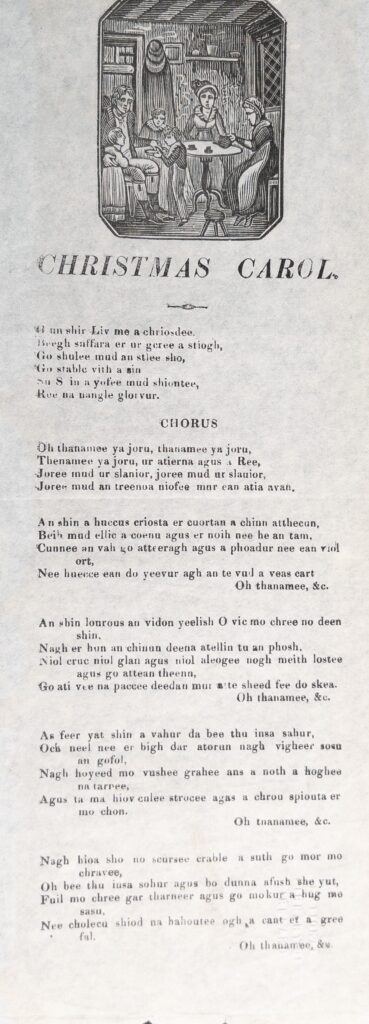
“It’s clearly an Irish language text, printed in a phonetic rendering of Irish for an English-speaking audience, or perhaps for an audience literate in English but familiar with, or indeed fluent in, oral Irish,” she continues.
Ms Cullen shares a response she received from Deirdre Ní Chonghaile, an ethnomusicologist, “who generously sent me her brilliant ‘first pass’ on a translation of the text into modern Irish”. The scholars “agreed that it is most likely Donegal or Ulster Irish” and in turn Cullen was answered on the blog by renowned singer and academic Pádraigín Ní Uallacháin who says that “it was not unusual in some sacred song/poems in the Irish tradition to have references to both the birth and the crucifixion in one piece. My reading of this is that it is in the same metre, more or less, as Adeste Fidelis and probably intended to be sung to that melody.”
I tried this week to sing this Carúl Neamhghnách to that familiar melody: “Ansin labhrós an Mhaighdean Dhílis: “Ó ‘mhic mo chroí, ná déan sin, Nach ar shon an chine daonna a d’fhulaing tú an Pháis”. (And then spoke the Faithful Virgin: ‘O son of my heart, don’t do that. Isn’t it for the sake of the whole world that you will suffer the Passion’.)
It’s both profound and remarkable to me that a carol as Gaeilge, transcribed phonetically, lost in time, found in a box of songsheets, can be sung again long after it vanished from use. There are treasures to be found everywhere, and wonders to be shared.
There’s another lost carol too – or rather a Christmas poem – that has also come to my attention. Written by JRR Tolkien, no less, who needs no introduction but whose 1936 verses about the light and hope of Christmas lay forgotten until they were discovered in 2013 in a copy of The Annual of Our Lady’s School (a school magazine) from the year of composition.
That’s remarkable too, isn’t it? Tolkien isn’t just popular, he is beloved by legions who can recite lengthy passages from his prodigious output verbatim, and yet this paean to Christ’s birth was only unearthed a decade ago.
Written before Lord of the Rings, before even The Hobbit was penned, there are familiar Tolkien themes of hope after desolation, courage after despair, light after darkness. It is not yet a hymn, perhaps it needs just to be paired with the right air.
Glad is the world and fair this night
With stars about its head,
And the hall is filled with laughter and light,
And fires are burning red.
The bells of Paradise now ring
With bells of Christendom,
And Gloria, Gloria we will sing
That God on earth is come.
But hark! It has ready been done. Nollaig Shona gach éinne.