The latest statistics from the European Union on the number of asylum seekers who have applied for International Protection in member states show that numbers have continued to drop and are now at their lowest since April 2022.
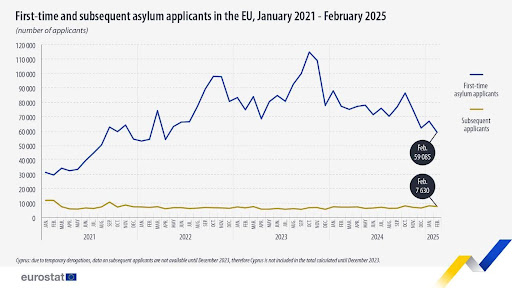
The number of first-time applicants for asylum was 59,085 which was down from 66,800. It is further evidence of a longer-term trend as there were 77,170 new applicants in February 2024. That represents a 23% fall since the same month in 2024.
The monthly influx had peaked at 115,000 in October 2023 but there has been an evident reaction on the part of the EU as a whole and a growing number of member states who have implemented more stringent policies. This has seen formerly liberal states such as Denmark and Sweden move from more restrictive criteria to deportations.
Even the Polish government of Donald Tusk whose defeat of PiS (Law and Justice) in the last Polish general elections was lauded as the harbinger of a more “open” and “inclusive” immigration policy has mostly retained the strong line on asylum migration of its predecessor. The huge vote for the Polish right in Sunday’s first round of the Presidential elections indicates that there is little stomach for any loosening of those criteria.
The Eurostat figures for the Irish state, drawn from the International Protection Office here, show a similar pattern. There were 1,090 new applications for International Protection in February this year. That showed a sharp decline of 30% compared to February 2024. That is obviously reflective of the fewer numbers who are coming to Ireland from states such as Georgia which had accounted for a significant proportion of applicants until it was placed on the list of countries of safe origin. The year on year figures also show a decrease of 43% for the first four months of 2025 compared to the same period in 2024.
However, the Irish state remains an outlier compared to other EU states in the origin of the bulk of persons who come here to claim International Protection. The headline EU figure is that Venezuelans accounted for the largest – 14% – of new applicants in the EU 27, followed by Afghans and Syrians. There are very few Venezuelans in IPAS care here, and only Afghans continue to arrive in any significant numbers.
It is evident that the main factor is that Ireland is perceived, is in fact, part of the Anglosphere and that being an English-speaking state it provides a large magnet to Anglophone Africans from countries such as Nigeria, South Africa and Zimbabwe. And indeed, is a significant fact most likely in the numbers who come here to claim both asylum and to work from east Asia.
As was pointed out recently here by John McGuirk that is likely to become an even bigger pull if the UK continues to tighten up on immigration under the Labour Government there who have mostly resisted the madder demands of the party Left to open up the doors even more.
It is also logistically easier to enter the Irish state from the UK which includes, of course, the 6 Counties over whose land border at least 80% of those who apply from asylum here through the IPO arrive. Many of them – and this will increase if Starmer follows his words with deeds – move over here when England, Scotland and Wales become less welcoming environments for various reasons. Few of them good.
There is another difference perhaps between the UK and the Irish state. Apart from the fact that Starmer made reference to the dangers of Britain becoming an “island of strangers.” But pause there for a moment. Can you even imagine the wrath that would descend on any establishment politician here who included that in a keynote address?
The other difference is that this state is way more dependent upon international capital whose human resources departments basically dictate Irish state policy towards the main source of immigration which is people coming here to work and their dependents.
Whereas Starmer made reference to businesses basically abusing the system to bring in lower paid unqualified worker, the Irish state largely under pressures from the leading business organisations and the overseas corporations is relentlessly lowering the barrier.
A work permits system that was initially designed to facilitate the recruitment of vital workers is now being used to bring in people to work in takeaways. Niamh Uí Bhriain has recently reported several cases of abuse that have been facilitated by this. As someone who regularly examines the permits lists, I am often struck by the fact that, while the main beneficiaries remain the big sectors like tech and pharma, and health, there is evidence of a rush to the bottom. And indeed, it might be argued that some of the big three, and undoubtedly the hospitality sector, are not immune from that trend.
The point being that it is possible to restrict mostly dubious asylum immigration without actually addressing the problems that face Europe and in particular this state which is ahead of almost every other in the rapid and profound nature of the demographic change that is taking place. With 22% of those now living in Ireland being foreign-born, its a factor we can’t keep ignoring.