The Annual Consultants Conference of the British Medical Association (BMA) has passed a motion saying that “assisted dying is not a health activity and it must not take place in NHS or other health facilities.”
The motion, which was passed by the medical consultants as legislation which would make assisted suicide lawful makes its way through the British parliament, also said that “an opt-in model is adopted for providers, and no consultant shall be expected to be involved in any part of the assisted dying process, including having no obligation to either suggest assisted dying to patients, nor refer patients for it.”
The Spectator reports that: “Motion 46 was proposed by the South Regional consultants committee and argued that Kim Leadbeater’s bill raises ‘serious potential moral hazards for consultants, and serious potential adverse impacts on health services.’
The two-part motion proposed that the BMA must, in discussions on assisted suicide with the government if the bill were to become law, make it clear that conscious rights of consultants be respected, including the right not to refer patients – and that the medical association recognise that assisted dying is not a health activity.
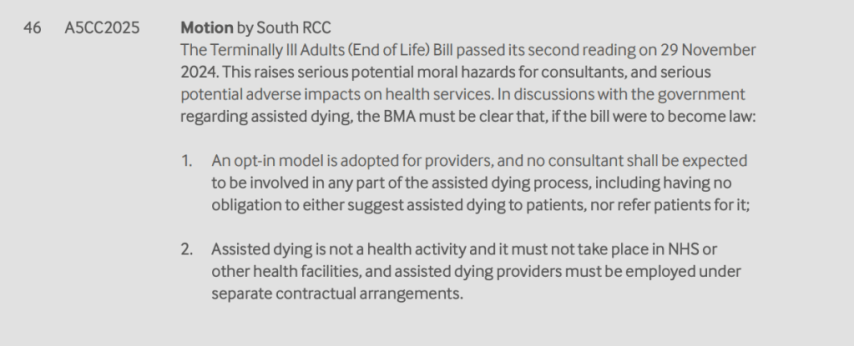
The consultants conference, in supporting the motion, also agreed that the assisted suicide Bill, proposed by British Labour’s Kim Leadbeater, raises “serious moral hazards for consultants”, with “serious potential adverse impacts on health services.”
The committee examining the bill has come under fire in recent weeks after it rejected amendments which MPs, medical experts and campaigners say were necessary to safeguard patients.
In addition, an amendment put forward by Kim Leadbeater, the bill’s sponsor, proposed – in a reversal of what was seen as a significant safeguard – that a high court judge would not need to investigate each case and that a panel of social workers and psychiatrists among others should oversee applications for assisted suicide.
Right to Life UK says that 24 psychiatrists have written an open letter expressing concern both about the “haste” of the assisted suicide legislation and the consequences of the Bill becoming law which, they argue, could put pressure on vulnerable people to end their lives.
The week following the letter’s publication, the Committee rejected amendments that would have strengthened the Bill. The Committee voted down an amendment that would have raised the bar of the Mental Capacity Act to ensure an appropriately high test for mental capacity; rejected an amendment to make it explicitly illegal for someone to ‘encourage’ another person to seek an assisted suicide; and rejected an amendment to protect people from choosing assisted suicide because they feel they are a burden. The Bill’s supporters on the Committee also spoke against attempts to protect prisoners, where suicide rates are already high, and the homeless.
Calling for the Bill to be “overwhelmingly rejected”, the psychiatrists warned that the legislation would undermine their work, which includes suicide prevention, and put vulnerable people under considerable pressure to opt for assisted suicide instead of seeking medical or psychiatric solutions.
They wrote “A law on doctor-assisted suicide will undermine the daily efforts of psychiatrists across the United Kingdom to prevent suicide. Those who have suicidal ideation at any time in life may be vulnerable to pressures to take their own life by the introduction of doctor-assisted suicide”.
“Vulnerability can arise due to external factors such as lack of decent palliative or social care; overt coercion or undue influence; personal losses including bereavement, poor housing or financial hardship. Internal factors may include major depressive disorder, a sense of burdensomeness, loneliness and social isolation. Understanding and responding to these vulnerabilities is at the centre of suicide prevention”.
ROYAL COLLEGE CRITICISES BILL
The Bill has been criticised by the Royal College of Psychiatrists in the UK, who described November’s vote as a “significant societal shift.”
In written evidence submitted to the committee, RCPsych argued the Act is “not sufficient for the purposes of this Bill”. Three psychiatrists testified before the committee, stating that the capacity test was too weak to ensure patients were fully capable of choosing to end their life
RCPsych referred to debate around consent procedures, palliative care and what the passing of legislation could mean for vulnerable people, doctors and the NHS.
RCPsych said that a number of “unanswered questions” remain about “whether it is possible to provide adequate protections and safeguards for all individuals and, if so, what these measures would be. The College believes these details must not be left to the relevant professions to be dealt with through amendments to existing or new codes of practice.”
RCPsych has urged British parliamentarians to “carefully consider outstanding questions about whether a person’s capacity to decide to end their own life can be reliably assessed and the adequacy of consent as a safeguard against coercion in this context.”
“It is also important to consider the potential implications for those with mental disorders, intellectual disabilities and neurodevelopmental conditions (who do not always have good access to palliative care), as well as on suicide prevention efforts, palliative care and the NHS,” it added in a statement.
KEY FACT WRONG
Previously, Professor Chris Whitty, England’s Chief Medical Officer, admitted that he got a key fact wrong in evidence given to a committee of British MPs looking at the UK’s Assisted Suicide proposals.
Prof Whitty last month told MPs that Kim Leadbeater’s Bill would require a higher level of mental capacity for assisted suicide decisions than for other medical choices, however he later made the admission that this was incorrect, as reported by The Daily Telegraph.
In November, a total of 330 MPs voted in favour of moving the Terminally Ill Adults (End Of Life) Bill to the next stage of the legislative process, while 275 voted against it.
Speaking to MPs, Prof Whitty claimed that the Mental Capacity Act (MCA) carried the “absolute expectation” that “the more serious the decision, the greater the level of capacity that someone needs to have”.
However, when he was pressed on the issue by senior barrister, Alex Ruck Keene KC, who said this was incorrect, he retracted the claim. Mr Keene pointed out that the MCA does not impose a stricter requirement for life-or-death decisions compared to less serious medical choices.
Sir Chris penned a letter for the committee, which is currently underway to scrutinise the Bill ahead of its next stage in parliament. He wrote that he could have phrased his evidence to the committee “more clearly.”
However, Conservative MP Danny Kruger told the British newspaper that the correction had come too late – given that MPs had already used Sir Chris’s testimony, given in January, to reject a number of amendments aimed at tightening mental capacity assessments.
“The clarification comes too late for MPs who voted against our amendments based on his assertion that the MCA explicitly requires a higher degree of capacity for a more serious decision. As he admits, it doesn’t,” Mr Kruger said.
Nikki da Costa, the former Director of Legislative Affairs at 10 Downing Street, took to social media to say that Prof Whitty’s correction “proves the point – doctor overconfidence is a risk for the vulnerable.”
“This is an insane way to legislate,” the former senior political advisor wrote on X.
“Too late for the debate on the amendments that sought to tackle the problem. Whitty’s evidence was used as justification for rejecting amendments and sticking with a simple threshold of capacity. It was cited multiple times by MPs,” da Costa added.
AMENDMENTS
Ms Leadbeater recently questioned the need for the amendments tabled the Bill, despite having tabled some 87 amendments herself. In an interview with The Independent, Ms Leadbeater said she shares “genuine concerns” about ensuring safeguards are strong, but that MPs must be able to give their final verdict at the third reading.
However, Leadbeater tabled a number of last-minute amendments to the Bill, including scrapping the involvement of a High Court judge and ensuring that a three-member panel comprising of a psychiatrist, a social worker, and a lawyer would make the final decision instead.
Professor Katherine Sleeman, the Laing Galazka Chair in Palliative Care at the Cicely Saunders Institute of Palliative Care, Policy & Rehabilitation, King’s College London, reacted on X, stating: “Oh. This really says it all. Complaining about MPs tabling too many amendments, when you yourself have tabled 87 is probably not the best look.”
Professor of Industrial Economics at Nottingham University Business School, David Paton, meanwhile, claimed on X that his analysis showed that the majority of supportive evidence submitted to the committee came from individuals or assisted suicide campaigning groups.
“Of the written evidence on the #assistedsuicide bill submitted by medical & patient groups, 36 were broadly critical and 0 supportive (others were neutral),” Paton wrote.
MP for Twickenham, Murina Wilson, took to X over the weekend, writing: “I wrestled for weeks with how to vote on assisted dying. I was in absolute bits. Yet with every passing day, I’m more convinced I was right to vote against in Nov.”