More than €141 million was spent in 2024 alone on the Ukrainian Accommodation Recognition Payment scheme – where €800 per month is paid tax-free to anyone hosting a person or persons from Ukraine.
The expenditure on the scheme is separate, and in addition to, the cost of providing accommodation centres and services for those who have arrived from Ukraine. More than 15,000 people are currently claiming the monthly Recognition Payment, which has been criticised as radically distorting the rental sector.
Currently, over 15,500 hosts are accommodating almost 36,000 Ukrainians in over 19,000 accommodations. The number of private individuals hosting refugees from Ukraine quadrupled from just over 4,000 at the start of 2023 to the current number, with costs rising accordingly.
The spend was detailed by the Minister for Social Protection, Dara Calleary, in a breakdown of payments in 2024 by Social Welfare scheme. The Minister advised that the figures are draft and are subject to audit by the Comptroller and Auditor General.
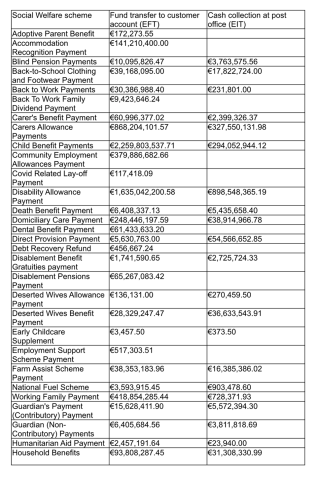
The Minister was responding to a question from Sinn Féin’s Paul Donnelly, who had asked for a breakdown of Social Welfare payments.
Introducing the payment in 2022, the government said it wished “to recognise the generosity of people who have opened their homes and provided accommodation to host people arriving in Ireland under the EU Temporary Protection Directive”.
“The payment is €800 per property where there is at least one such person being hosted. A maximum of 15 properties can be added to a single application,” the Department of Integration advises.
“The payment is exempt for means-testing for social welfare payments and grants from other public bodies. It is also not taxable,” the Department adds.
Independent TDs and Sinn Féin have called for the Accommodation Recognition Payment scheme for Ukrainians to be ended, with the latter saying the payment “is creating serious problems of unfairness in the private rented sector”.
Sinn Féin’s Matt Carthy said that “in many areas, including my own constituency, where rents have traditionally been lower than in the large urban centres, it is placing families and those seeking to rent private accommodation at a severe disadvantage because landlords are able to get €800 tax free from the state, which is equivalent to €1,600 rent from any other tenant which is taxable.
“The end result of this is that people cannot find places to rent in their own home towns. This issue is a growing problem in towns in many parts of rural constituencies in particular, and is creating a tension that we, quite frankly, could do without,” he said.
Independent TD Carol Nolan said that the costs for 2024 were “staggering” and indicated the sheer scale of how much of the rental sector was being made unavailable because of what she described as “two-tier preferential model.”
The Offaly TD told Gript: “These costs are not only staggering, they are also a clear indication that the ARP scheme has actively contributed to maintaining a radically distorted private rental sector.”
“It is yet a further indication that a two-tier preferential model is being applied that is grossly unfair,” she said.
The Cabinet is said to be considering a cut to bring the payment down to €600 a month, though fo final decision has been made on the scale of the cut yet.