Perhaps the most bizarre comment on the decision, reported last Friday, by the board of management of Synge Street CBS to throw out the Department of Education plan to transition to a Gaelcholáiste from 2026 came from Gwen Billet a language teacher in the school.
She waxed lyrical about the “incredibly diverse community” in the school and that it was unlikely that such “amazing” diversity could survive the school being transitioned into a Gaelcholáiste. Diversity for me, but not for thee.
This places the teachers and their union the Association of Secondary Teachers of Ireland (ASTI) in direct conflict with the Department of Education which apparently remains committed to its decision last September to meet the clear need – as once again expressed by parents and students from Gaelscoileanna who were at Leinster House just days before the teachers and management rejected the decision – for such an Irish-speaking second level college in south Dublin.
Indeed, for all the talk of diversity and catering to the needs of students from “a range of nationalities and cultures” no heed appears to have been taken of the fact that within a two-mile radius of Synge Street there are several primary-level bunscoileanna. Where are those children supposed to continue their education if they wish to do so in their own language? At least someone in the Department seems to care, even if the diversity-focused teacher’s union does not.
This latest blow to those interested in promoting the language is more proof that contrary to the baseless myths about immigrants becoming Níos Gaelaí ná na Gaeil féin that mass immigration and “diversity” are a direct threat to the survival of Irish even as a core subject within the schools.
Last month we reported how internal Department documents proved the clear link between the huge rise in students being allowed to be exempt from Irish classes and the level of non-national students in schools. One school in which there was a “large number in the process of claiming International Protection” said that it had 250 students with exemptions from Irish.
A Freedom of Information request that I submitted also yielded the fact that more than 20,000 second level students in September 2023 who were allowed an exemption from Irish were planning to sit exams in French, German and Spanish. So, that clearly has nothing to do with “language diversity” as claimed by the Synge Street teacher.
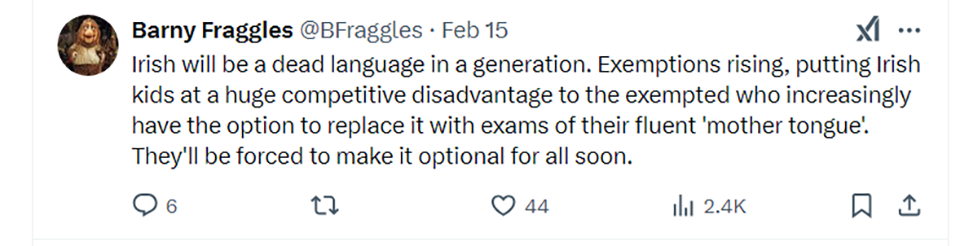
Irish schools are also under threat even within the Gaeltacht where teachers and pupils are expected to carry part of the burden for mass immigration by seeing what are supposed to be solely Irish-speaking schools in Irish speaking communities being expected, even forced, to provide classes in English as a first language.
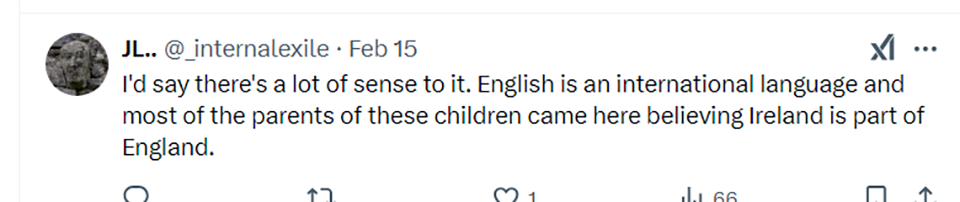
The comment above, however, places this in a much starker context and one that does not reflect well on most of us. – which is that when people come here from other countries to work or as applicants for asylum they are attracted to Ireland because they believe it to be part of the anglosphere.
Anyone who believes that someone in Lagos or Delhi or Algiers is familiar with our “common history” of anti-imperialism or whatever is living in a gum drop house on Lollipop Lane. The impact of diversity and multiculturalism is nothing like the sponsor ads for the GAA that would have you believe that Croke Park and Thurles are mostly full of Africans come championship time.
The question is: Is it too late anyway? Had the state been serious about restoring Irish as the language of the majority of the people – and it was, until the impact of the genocidal Gorta Mór and the anglicisation promoted by many , including the Catholic Church and many “nationalist” leaders deluded by the United Irishmen myth – it would not have allowed this situation to come about.
I have been reading Rónán Mac Con Iomaire’s An Ghluaiseacht, the story of the Gaeltacht Civil Rights Movement that was established in Conamara in the late 1960s. It was born out of the searing anger and frustration of younger people no longer prepared to take the bád bán to the building sites of London or Huddersfield or New York.
The movement was bolstered by the undying anger of older people like Máirtín Ó Cadhain in his last year as a dying man and who had spent a lifetime railing against the economic and social destruction of the only places on earth where Irish survived as a living tongue.
Out of all that at least came some measures that halted or slowed the death of the language. Their pirate radio station Saor-Raidió Chonamara forced the state to establish Raidió na Gaeltachta in 1972. Their direct action led to some greater state support for local enterprise and the establishment of Údarás na Gaeltachta.
Although, one might tend to agree with Desmond Fennell that the movement, and indeed any national movement, is far more effective when autonomous of state dependence. The original Gaelscoil movement in the rest of the state was independent, often attracting the attentions of Special Branch in the 1970s and ‘80s as a potentially “subversive” phenomenon.
It ought to be subversive: subversive of the ongoing and ostensibly inexorable descent of Ireland into a deracinated multicultural and diverse economic and financial centre. Had the state been serious about making Irish the main language of the newly independent state then it would not only have ensured that the Gaeltachts would have survived and expanded economically, but that education was from the start through Irish.
Any serious future attempt would have to start there. In the meantime, hopefully the Department of Education will heed the needs of the Irish speaking community in Dublin rather than those teachers besotted like rabbits in the headlights of “diversity” and stick to their guns on Synge Street. Anything less will indicate exactly what they think of “minorities.”