Yesterday, a man from South America stabbed at least three people in Stoneybatter in Dublin city centre. All three appear to have been strangers to their attacker, and they are in hospital after suffering serious injuries.
One victim reportedly had his key in his own front door when he was allegedly slashed by the assailant, who was carrying a Stanley blade and a scissors when he was apprehended by Gardaí. Residents of the area were “stunned by the sudden violence”, the Irish Times reports.
[E]mergency workers found a scene of fear and confusion. Locals reported a man wearing a face-covering making his way down the long residential street and its side avenues, attacking people with a bladed weapon seemingly at random.
Sudden, inexplicable, and deadly violence now seems increasingly to be a feature of modern Ireland – and, while we have sadly become accustomed , even to the point of indifference – to internal gangland violence and mayhem, random attacks on ordinary citizens are still terrifying, as are the crazed and unprecedented, but planned and pre-meditated, killings such as those that occurred in Sligo in 2022.
Random stabbings produce fear and panic precisely because anyone can be a victim, it may simply be a matter of opening your own front door. If such crimes are increasing, and they appear to be, then surely its incumbent on the authorities to give the public a clearer picture on both the frequency of these attacks and any commonalities amongst the perpetrators.
This tweet from well-respected crime reporter Mick O’Toole, which sought to clarify the facts of what had happened in Stoneybatter yesterday as rumours swirled online about the identity of the attacker, may have inadvertently pointed to a key issue that much of establishment Ireland would rather ignore.
“Gardai initially believed victims were Romanian and were known to the attacker. This is now not the case. It happens. Victims all Irish. Suspect is from South America. Random attack,” he posted on X.
That’s a pretty stark, even stunning, summary of the violence in Stoneybatter. “Victims all Irish. Suspect is from South America”. And the key issue that the tweet inadvertently points to – and which establishment Ireland would rather ignore – is, of course, migrant crime.
The Star’s front page this morning also had some additional, deeply concerning information on the alleged mindset of the suspect, who remains in Garda custody. “The man who stabbed three strangers in a broad daylight attack in central Dublin wanted to murder them, investigators believed” the paper said, quoting a Garda source who said the victims are “lucky to be alive”.
There have been many others in recent times who weren’t so “lucky”: who did not survive, or who are still grievously ill, as a result of a horrifying, inexplicable crime carried out by someone who came to this country as a migrant.
What is becoming increasingly intolerable is that those in authority simply deny this reality, and refuse to gather the data which would allow a honest and open debate about the problem.
The names of some of those victims are now seared onto the minds of the nations, because their deaths were so horrifying, and their attackers often so seemingly indifferent to the suffering they had caused.
Ashling Murphy, beloved teacher, daughter, partner, stabbed to death while out for a run. Her boyfriend Ryan Casey was criticised by one journalist and ignored by others when he said that Ireland was no longer a safe country.
As I wrote previously: “Women are murdered in Ireland, too often and with rising frequency, but a woman being randomly stabbed to death in a violent attack by a stranger was never a common event in this country. Surely Ryan Casey was absolutely correct in saying that this was an issue that needed to be examined?”
Yousef Palani, one of a Iraqi-Kurdish family who had come to Ireland in 2006 under a UN protection programme, embarked on a brutal and gruesome killing spree in Sligo. He inflicted what the judge at his sentencing described as “unspeakable violence” on Aidan Moffit and Michael Snee, two gay men he had contacted through a dating app with the intent of killing them, and seriously injured a third.
Palani decapitated one of his victims, and mutilated the body of another, actions driven by his hatred of gay men, police said. This was a hideously barbaric crime, but instead of a discussion around the potential of a creeping rise in extremism possibly driven by importing cultures very different from our own the media decided it was a time to lecture Irish people on homophobia and our supposed dark and troubled past.
Then we had the stabbings in Parnell Square – at a school, for God’s sake, something that had never happened in this country before – a brutal attack that has left one little girl with traumatic. likely life-long injuries. The suspect in yet another stabbing, of an Army Chaplain, Fr Paul Murphy, at Renmore army barracks, was believed to have been radicalised online.
In all of these cases, and in many others – including a litany of rape and sexual assault cases appearing before the courts – the media seems curiously disinterested in examining whether there are emerging trends, such as the impact of importing non-Western attitudes towards certain crimes, or the danger presented by radical Islamists, or whether transient populations are simply more likely to engage in criminality and what that might mean for Irish society.
But to be honest, the establishment media are largely a lost cause. Instead, the Minister for Justice, Jim O’Callaghan, needs to make changes so that we have an informed discussion on this thorny topic so that we are neither shouted down by leftists or misled by those who see every foreigner as a threat.
Many other European countries are now seeing public support for a crackdown on immigration partly driven by concerns around crime – and because studies and reports undertaken by the authorities showed that offences carried out by migrants was having a real and substantial effect on crime rates.
Yet in Ireland we still refuse to record and publish crime data on the basis of nationality – date which is essential to any mature and transparent discussion about immigration and crime in Ireland. This absence of data means that there is vacuum which the public are perfectly capable of filling with the evidence of what they can plainly see happening with their own eyes.
Commentator Karl Deeter responded to the anodyne tweets of assorted TDs yesterday with a perfectly reasonable question about deportation – which led Professor of European Politics, Jean Monnet Chair of European Integration, John O’Brennan to chide him for failing to have empathy for the possible reasons that may have motivated the alleged Stoneybatter attacker.
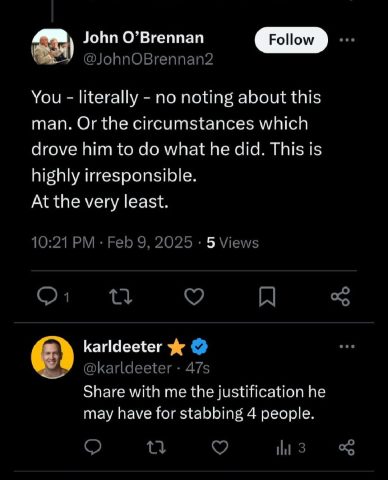
How is it irresponsible to talk about deportation after a stabbing spree? This sort of bizarre thinking – and the urge to smack down any honest debate about the possible impact of migration on crime, often accompanied by a desire to immediately impugn bad motives to anyone who is asking questions or making common sense observations – is far too common, not just in academia but in the corridors of Leinster House.
But most of us, just like that man entering his own home in Stoneybatter when he was attacked and slashed, live in the real world. And we deserve to have a Minister for Justice who gathers the sort of data on crime that is necessary to ensure that Irish people are protected and kept safe.
