Statistics from the Department of Education show that the majority of new exemptions from the study of Irish granted to post primary students at the beginning of each school year are granted to “Students Coming From Abroad.”
As the number of exemptions granted has sharply increased since 2022 there have been 20,757 students who have come from overseas who have been granted an exemption. That amounts to over 52% of exemptions in the past two years. Presumably overseas students are also proportionately represented in the total of exemptions granted under the other category of special educational needs.
A total of 97,486 new exemptions have been granted in the period from the beginning of the post-primary school year in 2017 and the beginning of the school year in 2023.
The number of new exemptions has almost doubled within that period from 10,374 in 2017/18 to 19,827 in 2023/24.
That represents an increase of 91%. The dramatic increase in the rate of exemptions which has caused some concern of late is underlined by the fact that the number of enrolments in post-primary schools only increased by 16.6%.
That is also significant given that it is substantially greater than the 10% increase in the population of the state over the same period – further proof of the fact that the vast bulk of that population increase as indicated by other official statistics is made up of immigrants. The cohort of post-primary school students who were born outside of the state is increasing in comparison to the numbers of Irish-born students.
That is obviously manifesting itself within the education system and one of the stark impacts is on the teaching of Irish. Despite, as we have pointed out previously, an ideologically but illogically-based notion that mass immigration is in some strange manner going to strengthen Irish culture and the language.
The evidence as supplied by the principals of some of the schools contacted by the Department due to the unusually high numbers of exemptions is conclusive. Their statements show that the high proportion of exemptions – many times the average and with 250 exemptions in one school alone where there was a “large number in the process of claiming International Protection” – is directly and disproportionately attributable to the increase in immigration.
The exemptions are broken into two categories: students who are allowed not to study Irish on the basis of a “Significant Special Educational Need” and for “Students Coming From Overseas.” The criteria governing exemption are found in Circular 0055/2022.
The former include students with literacy problems, other significant needs, who have shown that they are unable to learn Irish or attend a special school or class. The criteria outlined in applying and being granted an exemption appear to be strict, but this has not prevented the large increase in the number of exemptions being granted.
Those coming from overseas can only be granted an exemption where they have attended school for three consecutive years outside the state and where Irish was not taught, and are over 12 years of age, or has already completed a post primary education outside the state prior to enrolment here.
I also submitted a series of requests to the Department under the Freedom of Information Act. These sought information on:
1) The total number of students who have applied for and been granted exemptions from
sitting examinations in Irish for each of the years since that became an option;
2) A breakdown of the schools – or school district areas – from which the students claiming
and being granted exemptions are situated;
3) The main reasons why exemptions are sought and are granted;
4) The birthplace and/or nationality of those seeking and being granted such an exemption.
5) The number of students who have been granted an exemption in Irish but who have sat
exams in another language other than English’
6) A breakdown of which languages, and the numbers sitting each.
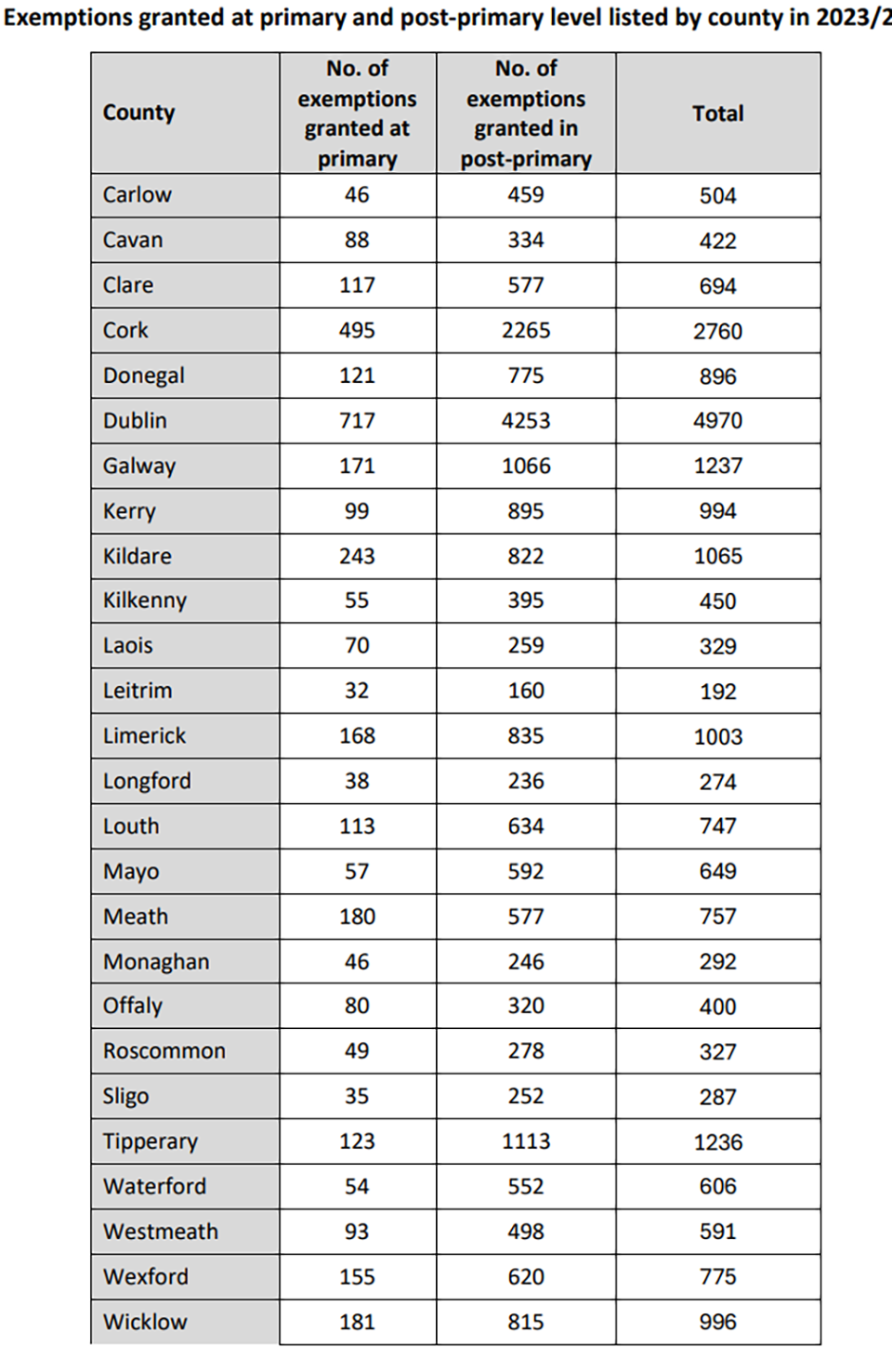
Most of the information requested has not been supplied as explained in a detailed response outlining the refusals on various grounds. Of the information that was supplied, there was a breakdown of the exemptions on a county basis, as contained in the table above. They do not provide a breakdown showing which categories the exemptions were granted under.
The only other information supplied concerned the numbers of students who were granted an exemption in Irish but who sat another language examination other than English. The information supplied appears only to provide details on students with an exemption for special education needs rather than those who have come from overseas.
Miraculously, this turned up in an Irish Times report published yesterday, apparently from their very own Freedom of Information request seeking the same information.
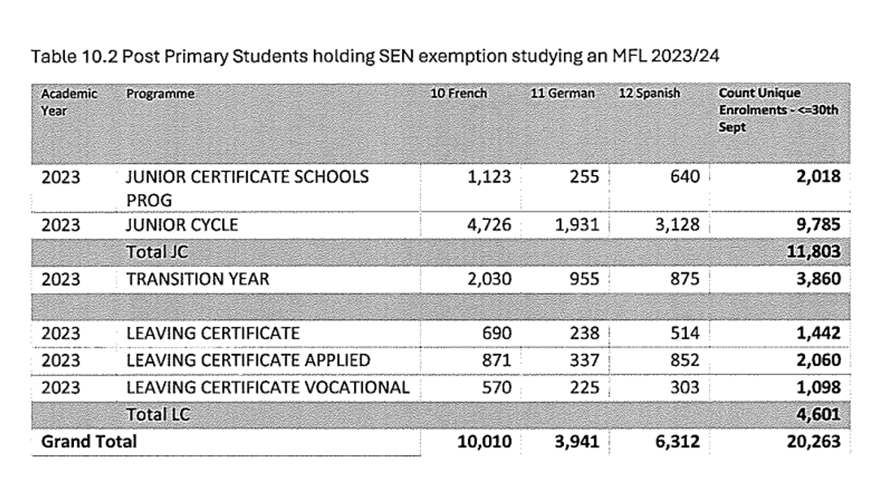
The figures released to me (above) show that more than 20,000 students who had an exemption from Irish were enrolled in French, Spanish and German classes for the term beginning in September 2023. This might be considered to be rather odd as one might assume that students with difficulties learning Irish would be similarly disadvantaged in the study of any other language.
I hope to shortly have further information on this, perhaps not so dependent on the vagaries and other quirks of the Department of Education’s Freedom of Information procedures.