The economist Dan O’Brien posted an interesting stat yesterday on X which summed up the reality of the crash in Irish birth rates which is likely the most under-discussed impending disaster in the history of our national media.
According to the Central Statistics Office, the number of children is falling sharply: with the number of 0-4 year olds in Ireland down 20% on the peak recorded in 2012, and a 7% fall in the 5-9 cohort since 2017.
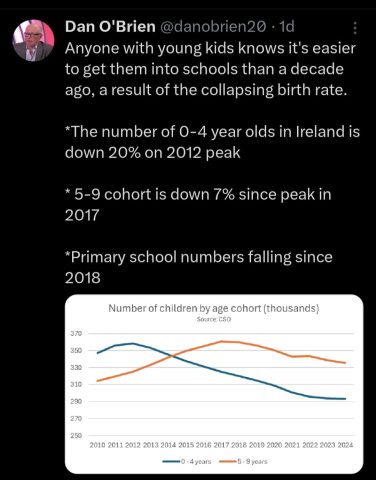
O’Brien says that primary school numbers are falling – and official projections show that the number of children attending primary school is projected to drop by 100,000, or almost a fifth, over the next decade.
A 20% fall in the number of babies and toddlers in just twelve years is startling, even though its the obvious outcome from a rapidly declining birth rate which, in common with the rest of Europe, has not so much fallen as collapsed in Ireland in recent years. Legalising abortion hasn’t helped: almost 50,000 abortions estimated since 2019 will leave a lot of empty classroom seats.
Our fertility crash started long before the referendum, however. The number of children born per woman on average was approximately 4 in 1960, now its 1.5. That’s a huge, unprecedented decline, and, to date, we have mostly tended to ignore the reason for the collapse, just as we are mostly ignoring very certain consequences that will follow, which are going to hit our economy and much else like a speeding train. As the CSO outlined in its Vital Statistics report:
Over the last decade, the number of births registered fell from 68,930 in 2013 to 54,678 in 2023.
The fertility rate for 2023 stood at 1.5, a decrease of 0.5 from the 2013 fertility rate of 2.0.
For most of my adult life, this country was in complete denial about falling fertility, subjecting all of us to lectures about overpopulation while being sniffy and openly contemptuous of marriage and motherhood. Big families, which seems to be any more than two kids these days, were treated with derision when they should have been applauded for raising up the next generation.
These cultural factors matter: the decline in marriage and in cultural support for having and raising families, the denigration of child-rearing as a fulfilling pursuit, plus the negative effect of hook-up culture on women’s belief in the likelihood of the kind of enduring relationship necessary to raise children, were all contributors to the fertility crash in my opinion.
As is illustrated in the graph below, while the birth rate fell rapidly in the 70s and 80s, clearly there are more than economic factors at play, since it did not recover in the boom times. Demographers say that, in general, fertility rates fall as a country gets richer, but they struggle to full explain why it has continued to plummet almost to a “perilously low” point beyond recovery in some countries in recent times.
Some factors are obvious: encouraging women to postpone motherhood to the point where women are then fighting the biological reality of a fertility slump once they are over thirty isn’t easily resolved with IVF or other treatments.
Similarly, while Irish fiscal policy matters – such as the discrimination against full-time mothers introduced by tax individualisation, and the failure to increase Child Benefit in 13 long years – its obvious that cultural factors have also had an impact. Apart from the relentless negativity towards having and raising children, there is obviously a complete lack of the kind of positive reinforcement from the Irish establishment that is so prevalent on other issues.
Our schools for example, have been used as avenues to push messages about climate change for years – why isn’t the same focus on positive messaging about marriage, families and children?
Source: Global Economy.com
I’d ask the same question about the taxpayer-funded behemoth that is RTÉ, its coffers stuffed to the gills with millions of your taxpayer funds, but we all know the answer to that one: they are too busy with Pride month, or Black History month, or scary documentaries about the rise of the ‘far-right’.
There’s also the factor that we have, as always, been blindly following the path of other EU member states, because God forbid we might have a political establishment that can think for itself and might, maybe, see that a plummeting birth rate is not generally a good thing or a positive sign for the future, before some EU Commission decides that for us.
The EU is now in a panic regarding its ageing population and the economic decline that will bring, and are finding that once you embed a cultural hostility to marriage and children into a culture it is very, very difficult to reverse. It’s easy to blame Millennials for their self-absorption and fascination with avocado toast but, in fairness, that’s what they were told really mattered for their entire lives.
It’s now also a fact that young people in Ireland cannot afford to buy a family home which would enable them to marry and have children – and they are leaving the country in their droves, which is pushing the birth rate down even further. They aren’t so much spoilt Millennials as a generation that has been utterly failed by the political establishment.
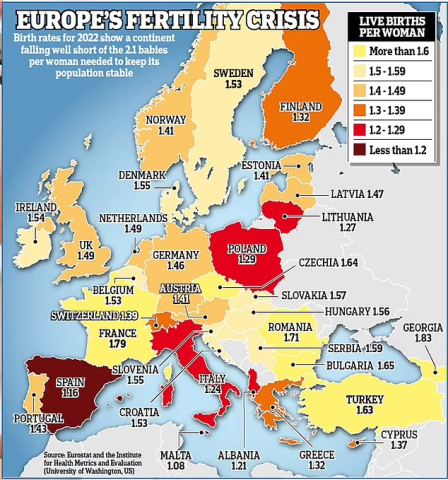
The gloomy statistics around the fertility collapse are by now well-known. Japan, with 25% of the population aged over 65, is selling more adult nappies than baby diapers – and the Lancet’s latest study says that by 2050, over three-quarters (155 of 204) of countries will not have high enough fertility rates to sustain population size over time – increasing to 97% of countries (198 of 204) by 2100.
The authors of that research “warn that national governments must plan for emerging threats to economies, food security, health, the environment, and geopolitical security brought on by these demographic changes that are set to transform the way we live”.
Think less workers, less economic growth, less innovation, less people to provide healthcare, a general decline and inability to care for an ageing population because there are too few children. None of this seemed to hit home with Irish voters until the last election when the pension retirement age was set to go up. We then saw a flurry of talk about the population implosion until everyone forgot about it again except for a persistent few, mostly on platforms like Gript, who are of the certain belief that the impact of the baby bust will make Covid look like a walk in the park.
So what can be done? Incentivise marriage and child-rearing obviously, since there is no point flinging a few extra bob at women if they feel they will be left to raise children on their own. And change the culture so that the people who are currently stretched beyond breaking to provide everyone with a future are valued and appreciated.
The Coalition has given a measly double Child Benefit payment in Budget 2025 after 13 years of ignoring families – but these are once-offs and the payment for children (only given, mind you, in the absence of any tax credits for parents which would recognise the cost of raising said kids) has, almost incredibly, remained the same.
Simon Harris is also now promising €1,000 per baby – invested and handed over once the child is 18 – but that seems like a very far-off and remote payment to parents for whom the cost of living crisis is currently being borne, not for one person, but for many.
Any future government can look for inspiration to the programmes rolled out in Hungary and some other countries which have sought, with some success, to assist and support those having children. But we’d need to see a significant shift in culture and in political thinking here in Ireland for any such programme to work. Unless that is achieved, we are looking at fewer and fewer children being born and a crisis that is out of control.