In all of the ongoing controversy regarding the increasingly explicit and unscientific nature of SPHE for Irish schools, both DCU and the Minister for Education have failed to answer a key question.
Gript has been in correspondence with DCU and Minister Foley’s Department repeatedly as part of our coverage of the controversies that have arisen around SPHE, including a viral video featuring teacher Mary Creedon discussing the materials she was presented with on DCU’s SPHE Diploma course.
We’ve also raised questions with them regarding our investigative articles which uncovered that key academics who are seeking to reshape RSE in schools support the idea of challenging the assumption of sexual innocence in children – a view that the vast majority of parents responding to the revelations appear to find disturbing.
Similarly we asked both DCU and the Department for comment when we published an audio recording of participants in the DCU course discussing the SPHE ‘intimacy’ exercise which included fisting and rimming – with the teacher praised for giving “space” to school students to “get dirty”.
It is noteworthy, however, that despite the strong denials regarding the use of explicit materials for the classroom, DCU, the Minister, and the Department of Education, have failed to answer key questions regarding the content that SPHE teachers were brought through on the DCU course.
At the core of the controversy around the viral video in particular is the question as to whether the multiplicity of activities the SPHE teachers were presented with were included on the course as ideas for classroom learning or were only for the teacher’s own benefit – including those which featured the concepts of fisting and rimming, or instructed that ‘porn or real’ words be evaluated, or told students to write a sexually explicit scene about a pleasurable sexual experience.
I’ll come to the likelihood that teachers – in a professional development course – are being shown multiple SPHE activities which are not meant for the classroom in a moment.
But there’s a more fundamental issue that those who are denying Mary Creedon’s testimony with such vehemence – even hostility – are clearly skirting.
THE KEY QUESTION
I wrote to DCU and the Department of Education to ask them the following regarding their assertions that “certain explicit and inappropriate topics and materials” were not for use in the classroom – and that “no graphic or explicit material is intended for use by teachers in a secondary school classroom setting”.
I asked:
- Where in the written outline(s) or description(s) of the course provided to Ms Creedon or other students did DCU or any of its agents specify that any explicit materials or activities were not, in fact, intended for the classroom?
- Where in the written outline(s) or description(s) of the HD532 SPHE/RSE module [the part of the course causing controversy] provided to Ms Creedon or other students did DCU or any of its agents specify that any explicit materials or activities were not, in fact, intended for the classroom?
- If written clarification was not provided, at what point in the course was this clarification verbally provided, and specifically:- By whom?
– When : what date and time?
– To whom?
– How was it noted that the clarification was received and understood? - Multiple teachers have told Gript that they raised concerns regarding the appropriateness of course materials and that at no point did DCU’s lecturers state that the activities were not for classroom use. What is your response to that?
Question 3, in particular, really gets to the heart of the matter, doesn’t it? And it should surely be a straightforward matter for DCU to answer that question: when was this clarification regarding explicit material given?
Since there has been no evidence provided of a written clarification, and if what DCU and the Department are saying is to be believed, evidently DCU and its lecturers must have relied on a verbal clarification.
If so, who gave that verbal clarification, and when did they give it? Was it given to the SPHE teachers as a group? And how did DCU ascertain the clarification was received and understood?
Given that DCU and the Minister have denied the testimony of teachers who say no such clarification took place, they should be obliged to answer those questions.
The fact that they have chosen not to do so is a legitimate matter of concern.
Gript has reviewed hours of video and written materials from the DCU course, and teachers were told that the course workshops would explore what the SPHE course material would look like “in a classroom space”, and that creative approaches to teaching RSE/SPHE would be “actively modelled”.
The use of “fictional stories, drama and visualisation” would be explored in the Curriculum module, teachers were told, for example – with a lecturer explaining that new ideas for assessments in the course and workshops could be incorporated into the teacher’s “own practice in meaningful ways”.
A “workshop style” and “hands-on” approach to modelling approaches to teachers was adopted, the DCU lecturer said.
ARE WE TO BELIEVE THAT THE RSE EXERCISES STUDIED WERE NOT FOR CLASSROOM?
It’s worth looking at the SPHE activities in the module HD532 of the DCU Graduate Diploma course entitled Curriculum, Pedagogy & Assessment in SPHE/RSE, which is the model that has led to controversy.
It was as part of that module that exercises which brought teachers through answering questions such as “What is your best advice on giving head” or rating words like ‘fisting’ and ‘rimming’ took place.
In total, the SPHE teachers were brought through at least 11 exercises in this module. Is DCU expecting us to believe that not a single exercise on the course was expected to be replicated in the classroom?
If it is the case that some of the exercises – for example the ‘What is the Harm’ case studies on sexual harassment, or the activity where sexual organs were made using playdough – were for the classroom and the others were not, then why haven’t DCU, the Department, or the Minister, clarified that this was the case? On what basis is this distinction made?
The current line from DCU – denial without evidence that this supposed clarity was provided in some way; denial, without saying which exercises specifically were not meant for the classroom – just doesn’t cut the mustard.
The 11 RSE exercises noted by Ms Creedon were as follows: (for further photos see here)
- ‘Intimacy’ activity: Sorting words, including rimming, fisting, anal sex etc, into categories of ‘sexual or intimate’.
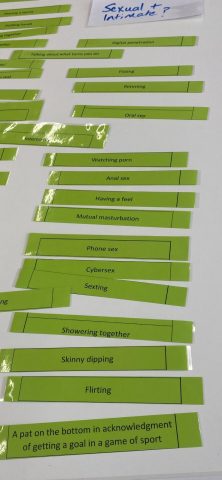
2. ‘Rewriting the Script’: Writing a detailed “script that tells a story of a mutually pleasurable, respectful and consensual sexual experience of two people” – with students told the script “should include detail character descriptions, scene-setting information (where and when it is set, what are the key notes on space etc), line by line dialogue, notes on actions central to scene(s) (non verbal), and any music or sound ques (where applicable).”
3. Answering Student Questions such as ‘What is your best advice on giving head’ and ‘Do chest binders hurt?’ and ‘Do you think there are more than two genders?’
4. ‘What’s the harm?’ activity, ranking examples of sexual harassment on a scale showing most harmful at top. Examples were “grabbing someone’s arse in a nightclub” and “sharing a short film of two people from the year above having sex”.
5. Discussion of case studies on sexual and gender based violence and activations for change bystanders.
6. Watching a Swedish RSE video which included an animation of a woman masturbating and a detailed ‘sex map’ where threesome and other naked sexual activity was portrayed in an outdoor setting.
7. A ‘Porn World vs Real World” sorting activity where students were be instructed to sort statements such as: “I’m a great big dick and I’m the star of the show!”; and “Women like sex to be rough and mean”.
8. A ‘Planet Porn’ exercise activity which also asked students to sort through statements featuring cartoonish cut out cards such as: “Where males usually cum over their partners” and “where sex can involve domination and pain”.
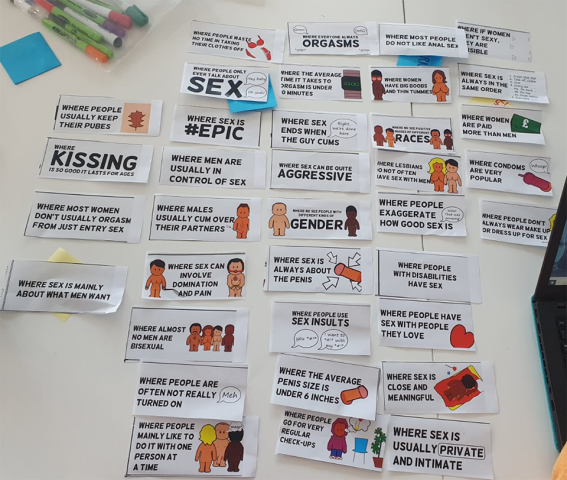
9. A critical thinking ‘Porn, What you Should Know’ presentation, outlining that ‘ethical’ porn is “rights-based”, “empowering” and “inclusive” – including an animated video outlining that in porn “the penis is the boss of the show” with a cartoon of an erect penis, and also explaining that “some porn is really rough on women” and does not examine emotional connections.
10. A craft exercise making penises, vulvas, and breasts from playdough, pipe cleaners, and balloons.
11. A ‘Shaping the Body’ exercise where a student lies down and the shape of that student’s body is outlined on paper and then all the features of a changing adolescent body are marked out.
One of the teachers Gript has spoken to said it was “simply absurd to expect anyone to believe that the multiple interactive exercises that teachers were asked to undertake in the course were not examples of classroom exercises”.
Teachers also say that when they raised questions regarding the appropriateness of some of the exercises, they were not told by any of the DCU lecturers that the exercises were not for the classroom.
An interview by DCU Communicatons with some of the teachers (see below), published on DCU’s website, confirms that discussions around age-appropriateness and suitability of material had been had.
“Does Norma Foley think that I was making vaginas, breasts and penis with play doh, balloons and pipe cleaners so I would learn about anatomy, or is it a more realistic prospect that it was shown as an example of what we could do with students?” one teacher asked.
In the audio recording reported by Gript, in which a teacher notifies lecturers that they had used the intimacy exercise (above) in their own classroom, the information was not met with a reply that the exercises were not intended to be replicated in Irish classrooms, but rather with praise – it was ‘great’ – that the teacher had done so.
In addition, it is clear from the NCCA’s Information for Parents Guide that the SPHE curriculum referred to by Minister Foley when denying Mary Creedon’s testimony is a very high-level guide and that teachers are free to choose classroom activities which they believe are appropriate.
“The SPHE curriculum sets out the topics to be taught in schools, and teachers have freedom to choose the classroom resources they will use when teaching the curriculum.”
The Guide says that topics should be taught “in a way that is sensitive to the age and stage of development of their students and meets their needs”. The use of the word development is curious, but resonates with a push in the DCU course to persuade SPHE teachers to use “developmentally appropriate” in addition or instead of “age-appropriate” as a guide.
THE PURPOSE OF THE COURSE
The purpose of the DCU Diploma in SPHE is, as per their website, to continue teacher’s professional development with a course “specifically designed to upskill and enable registered post-primary teachers to acquire, develop and advance their core competencies in the teaching of SPHE/RSE at Junior and Senior Cycle levels.”
Alongside the development of specialist subject knowledge, a focus on teachers’ own personal development and on the development of a skills-set needed for the SPHE/RSE classroom are key components of this programme.
The course is described as “transformative” in an article from DCU Comms.
Interestingly, one teacher interviewed acknowledged: “Not everybody in that room agreed about everything, or agreed about how things should be taught, or what age things should be taught”.
The same teacher added: “I know that my lessons are better than they were before”.
Similarly, one teacher who appeared with DCU lecturers Leanne Coll and Dr Kay Maunsell on a podcast discussing the DCU SPHE Diploma said that the course improved the skills of SPHE teachers who then brought those skills “back into the classroom”.
She also added that what the teachers were learning was “useful” and “applicable” and that the learning methodologies were “very imaginative and very creative”.
Dr Kay Maunsell, the Programme Chair, told DCU Comms “is full of praise for the programme’s first graduates, describing them as ‘pioneers’ of a new approach to an important subject,” the article said.
“They stepped up in a field that is quite challenging in relation to the current public discourse around the teaching of Social Personal and Health Education and Relationships and Sexuality Education,” she said, saying the SPHE teachers had “put themselves at the forefront of change”.
The extent of that change is now the issue causing controversy. But two things seem clear to me:
- DCU’s failure to state when the supposed verbal clarification giving warning to teachers not to use the explicit materials being presented in the course in the classroom took place leaves parents with serious questions for both DCU and the Department of Education;
and
- The idea that most of the RSE activities undertaken by teachers attending a SPHE Diploma course were not meant for the classroom seems highly unlikely. Again, the onus is on DCU to provide clarification.
Parents, teachers, and most of all school children, deserve a full and frank explanation. At this point that is not being provided.