Regional elections in two German states on Sunday saw Alternative für Deutschland (AfD) become the largest party in Thuringia and the second largest party in the state of Saxony.
Both states were once part of the German Democratic Republic controlled by the Communists whose successors as part of Die Linke suffered a massive loss of 18% of their votes and 17 of their 29 seats in Thuringia.
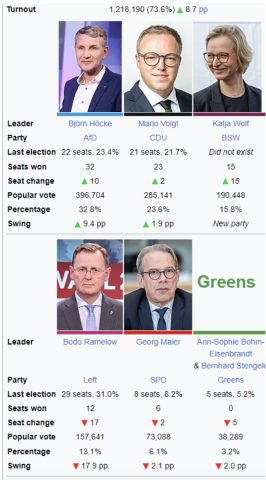
The results based on the official returns last night show that in Thuringia AfD increased its vote share to 32.8% making it the largest party on 32 seats. The centre-right CDU also had marginal gains but have stated categorically that they will not enter a coalition with AfD.
Nor will BSW (Reason and Justice), a split from Die Linke which takes a hard line on immigration and opposes the genderist and other liberal positions of Die Linke and the ruling SPD which also did badly on Sunday. BSW was first regarded as a potential electoral threat to AfD, but its 6% in the June European elections and more than twice that in yesterday’s polls have been at the expense of the left.
Two of the current governing parties, the Greens and the Free Democrats, lost all of their seats in Thuringia.
In Saxony, CDU pipped AfD by just one seat to become the main party. AfD were up 3% to 30.6% and BSW won 11.8% of the vote and 15 seats, all at the expense of the left whose combined total fell by 15 seats and 10%.
The reaction to the results have been predictable. Chancellor Olaf Scholz of the SPD claimed that “The AfD is damaging Germany. It is weakening the economy, dividing society and ruining our country’s reputation.” There were also violent incidents in some places as left extremists expressed their disappointment in the traditional manner.
Many have opted for a specious comparison between the electoral success of AfD, which was only founded in 2012, and the Nazis. AfD was founded as a split from the CDU with similar centre-right economic policies linked to Euroscepticism. It has become more radical over the past decade as the party has become the main focus for disaffection over the impact, often violent and increasingly perceived to be dysfunctional, of mass immigration.
Its policies have likewise shifted with more of an emphasis on small local businesses and the protection and promotion of traditional communities based on family incentives. It supports what it describes as a social market economy and opposes statism but promises to allow citizens to decide on privatisation of public companies.
Attention will now turn to the German general election for the Federal Bundestag parliament due to be held next year. The latest opinion polls are showing the centre right CDU/CSU significantly ahead as the largest party on 32%. AfD are in second on 18% and three points in the lead of the SPD.
AfD have doubled their vote in the past three years and are climbing steadily towards the 22% peak polling which they had in June. BSW is on 9% in the polls and its vote if translated into seats may also be a contributory factor in what is likely to be a fractious election with the strong possibility of neither the CDU or the SPD being in the traditional position to form a government with smaller parties – unless they agree to form one between themselves.