In the aftermath of the guide I wrote two weeks ago about how to use your vote in Ireland’s PRSTV electoral system, we received a large number of questions and queries and requests for further information.
Here are some of those questions, and the answers (as best as I can muster) to them:
Hi John,
If possible, could you please explain how surplus votes are distributed? As in, if a candidate has 200 votes over the quota, how are those 200 votes to be distributed chosen from all of that candidates votes?
This is a very good question, and it is without a doubt the single most arbitrary part of the Irish electoral system.
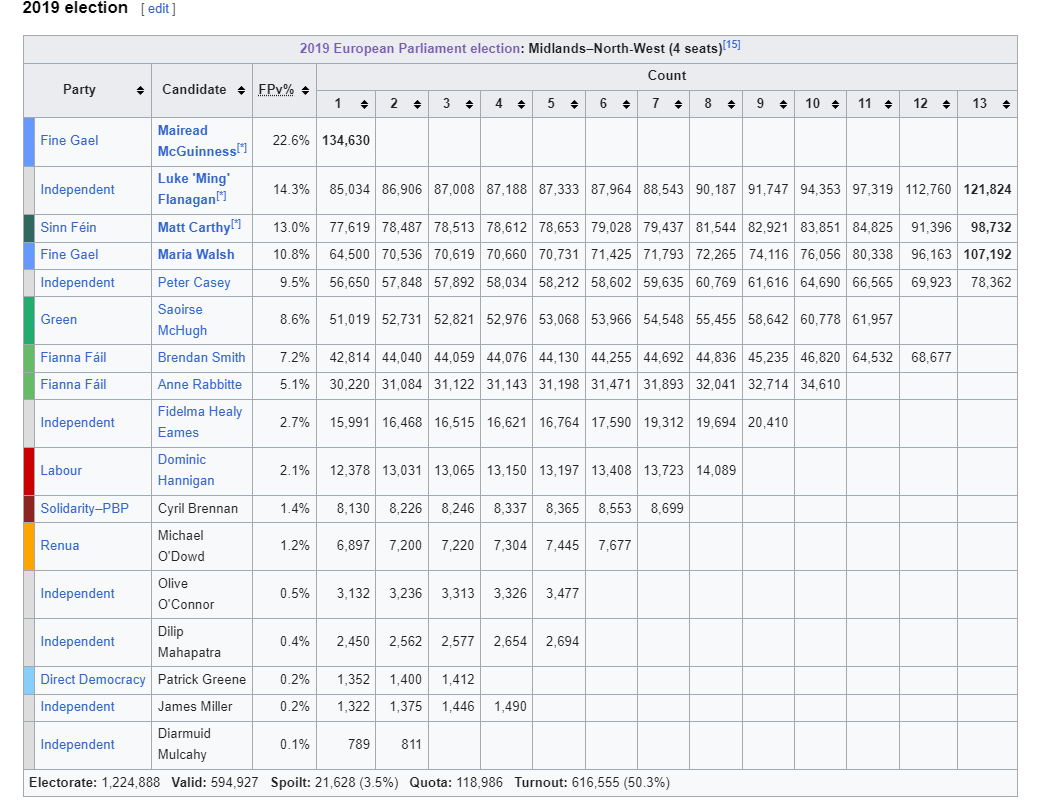
First, a word on what a surplus is: As mentioned in the original guide, the “quota” is the number of votes a candidate needs to be guaranteed a seat. A candidate can be elected with, or without reaching the quota – the count ends either when all the seats have been filled by candidates who reached the quota, or when the number of candidates remaining matches the number of seats remaining. This happened in the 2019 European Election in Midlands North West, for example, where Sinn Fein’s Matt Carthy and Fine Gael’s Maria Walsh were elected over Independent Peter Casey despite none of them reaching the quota of 118,986 votes: Because there was just two seats left to be filled and three candidates left, Carthy and Walsh took the seats by virtue of having more votes at that stage than Casey:
As to the answer to the actual question: Surpluses are distributed using random selection. That is to say, a returning officer will select random bundles of votes from the top of the pile of votes of the elected candidate. In other words, if the quota is 10,000 votes and a candidate has 11,000 votes, then the 1,000 votes will be lifted at random from the top of the pile of votes the elected candidate has.
Senator Michael McDowell was kind enough to take a call about this yesterday, and he added another caveat: In an election where a candidate has been elected on a later count than the first count, it is only the vote that has “travelled” that is used in the surplus.
That is to say: Imagine the quota is 10,000 votes, and candidate A gets 9,999 votes on the first count. Then, when on the second count, a candidate B is eliminated, with 101 of his votes going to candidate A, candidate A has a surplus of 100 votes. On the next count, those 100 votes will be distributed – but they will be 100 of the 101 votes, chosen at random, that he received from candidate B.
This is, to some degree, a random process: In a close election, it could be argued that the random selection of surplus votes creates a degree of chance that is unfair to other candidates, who might argue that they would have done better had different votes been used. Nevertheless, as Senator McDowell pointed out to me yesterday, random sampling of a large pile of votes is usually pretty representative, under the laws of statistics.
Anyway, that’s the answer.
Hi gript media I read your article about voting and I’m still unsure are your recommending you vote the whole way down the ballot paper and say put ff fg etc no 11 and 12 I don’t want any of the party’s we have now in power
Look it really is this simple: Vote until you no longer care.
The important thing is someone who gets your 11th preference vote will only get it if everyone listed 1-10 is already elected, or eliminated. After that, it’s a system of binary choices: Imagine the last seat comes down to Fine Gael and People before Profit, or between Fianna Fail and the Greens, or between The Social Democrats and the Irish Freedom party: The question is, in that situation, do you care who wins?
Personally, in each of those examples, I would have a preference for one party over the other. As such, I’d vote for one ahead of the other. If you genuinely don’t care, then you can leave those boxes blank.
The other way to think about this is that if your 11th preference is being counted, then you’re really down to the tail end of the count, and all the candidates you really wanted elected are either in or out. Your choice at that stage is really for the last seat. If you want to keep Party A out, then rank Party B higher. If you want to keep Party B out, then rank Party A higher. This far down the ballot paper, it’s more about keeping people out than it is voting people in.
Hey John: If I vote a no.1 for a candidate almost guaranteed to be knocked out in the 1st round, will my pr vote (the entire list ticked) carry through the entire count?
Whereas if my no.1 goes to a candidate that doesn’t meet the quota but is in the mix right through to the last count, does that mean my list votes are never used as my vote sits with my number 1 candidate?
The answers here are yes and yes: Because votes that “travel” (ie, move from one candidate to another) are prioritised in the distribution of surpluses, voters who vote for no-hoper candidates first will almost certainly have their vote counted more often than someone who votes for a candidate well in the mix.
In the example from earlier, a candidate with 9,999 votes on count one when the surplus is 10,000 will see his surplus distributed from the votes he gets from other candidates. So the 9,999 people who voted for him on count one will never have any preference other than their first preference counted.
John, you advise to leave the person you DO NOT want to be elected as your last choice on the ballot paper, would not giving any preference vote to this person not serve the same purpose (presuming you have ticked the boxes of all other candidates)
Yes, functionally it is the same thing. We use a ranking system: That means that the vote always goes to the candidate ranked highest on your ballot paper. So if there are 15 candidates and you vote 1-15, then the 14th candidate will get the vote ahead of the 15th, meaning that your last preference will never get that vote and it will ALWAYS be available to someone else.
Equally, leaving the box blank but voting 1-14 does the same thing.
However, if you leave more than one box blank, and it comes down to two of the candidates you left blank for the last seat, then you are telling the counting staff that you do not care. As such your vote will be called “non transferable” and will benefit neither.
One important point about transfers. If the candidate you vote No 1 is eliminated your No2 effectively becomes your new No1. But if the candidate you vote for is elected your No 2 may not feature in the transfers. For example if the quota is 12,000 and your No 1 candidate gets 14,000, leaving a 2,000 surplus, only 2,000 of those ballot papers are redistributed to the No 2 candidates leaving 12,000 papers which are never transferred. The 2,000 papers which are redistributed are usually out of the last box opened so the transfers are quite random in that regard.
So if you want to get ‘best value’ for your vote then use your high preferences for those who are likely to be eliminated early!!
This isn’t a question but is something I wanted to address: The commenter here is correct in that if you wanted, for pure fun, to see your vote counted as many times as possible, voting for no-hopers down the ballot would be the best way to do it.
The problem is that this isn’t what our system is designed for. You should ALWAYS, in all circumstances, just vote in order of your genuine preference for who you want to see elected. The system will do the rest.
In other words, if your first preference candidate exceeds the quota on count one, it’s true your vote may not be counted later on. But that’s because the system has worked: You’ve had your first preference elected. Other voters won’t be as lucky, and will have to settle for later preference candidates representing them – that’s why their votes are prioritised in transfers.
A simple way of thinking about this is to match the number of seats to the top preferences on your ballot paper: You are not voting to elect one person, but several: In the EU elections in Midlands North West, for example, there are five seats available. Your top five preferences should be the five people you hope to see elected, in order. After that, it’s really about choosing between people who you aren’t keen on seeing elected, but who will be getting elected anyway because your top five haven’t all made it.
Our system, for all its flaws (and I could write a whole article about them) is designed to reflect your choices as best as possible. The best thing you can do is make those choices, and let the count work out as it will.
As ever, if there are any more queries about voting or the process of voting, send them in to news@gript.ie and we’ll try to answer them ahead of polling day.