Much attention has been paid this week to Britain’s policy of transferring asylum seekers to Rwanda and the implications that has for immigration into the Irish state across the border with Northern Ireland.
While a large part of the spin here among the political establishment – and that includes Sinn Féin, the other left liberal parties and the migrancy NGOs – has been a rather simplistic dump on the wily Tories, the point is being missed.
Which is that, Brexit and the Tories aside, there is nothing, as John McGuirk pointed out here, preventing the Irish state making exactly the same sort of arrangement to transfer bogus and, let us be honest, unwanted asylum seekers to a third country with the financially assisted agreement of that third country once that country complies with international standards of human rights.
Nor is it the case the Brits have been able to seal the Rwanda deal just because they are now post-Brexit, free of any constraints imposed by an overweening European Commission and left liberal dominated Parliament.
That is not the case because as John points out, fellow EU member state Denmark – under a left government it ought to be noted – has framed exactly the same policy as the UK Tories.
That has come about as a consequence of the Danish Folketing, in June 2021, passing Bill L 226 to allow the Danish state to arrange “the transfer of asylum seekers to a third country outside the EU for the purposes of both asylum processing and protection of refugees in the third country.”
This required the amendment of the existing legislation, in particular the 2019 Aliens Act. The key part of this was to repeal the existing Section 29 of the Aliens Act and to tighten up the criteria for “Transfers etc. according to the rules of the Dublin Regulation.”
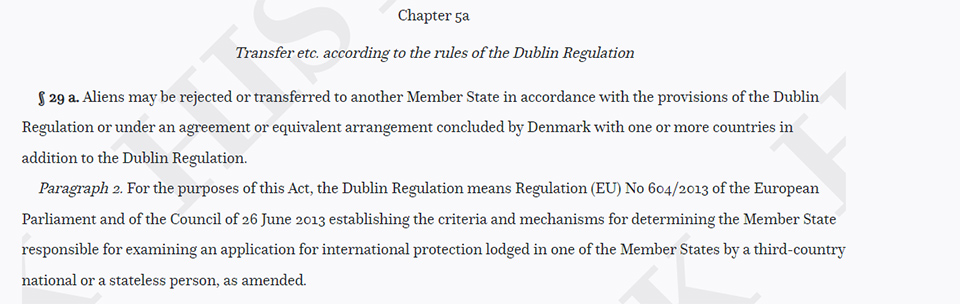
The new Section 29a allows for the transfer of a person who has been rejected to another member state in accordance with the Dublin Regulation.
That provision already existed for EU member states but it was difficult to enforce due to the fact that certain member states such as Italy. Greece and Cyprus have been the target and destination of the bulk of north Africans travelling across the Mediterranean.
It is that which has led to the new Migration and Asylum Pact which allows for transfers from states which under the initial Dublin Regulation are responsible for processing asylum applications.
What the Danes have done by amending the Aliens Act and inserting a new Section, 29a, has, similar to the UK, allowed Denmark to either transfer rejected applicants to “another Member State,” or “under an agreement or equivalent arrangement concluded by Denmark with one of more countries in addition to the Dublin Regulation.”
Which means that Denmark is not strictly bound by the new Migration Pact as it can make arrangements with third countries to take asylum applicants who have failed to meet the conditions required to be granted asylum and residency in Denmark. Any country which has ratified and adheres to the 1951 Convention on Refugees can be considered for this purpose.
What is significant from an Irish perspective is that none of what the Danes have done in this regard is in contravention of any existing EU legislation or human rights provisions nor in conflict with any of the wider international legislation and charters dealing with the treatment of refugees and the human rights of persons claiming asylum.
Rwanda has ratified and observes the 1951 Refugee Convention.
The initial official EU comment on the Danish legislation was made in June 2021 by Commissioner Yiva Johannson who claimed that it was contrary to the “spirit” of the overall EU approach, and that it might send a “strong and wrong signal” that the EU itself was “disengaging.” Johannsson also claimed that the then proposal for the now approved Migration and Asylum Pact would not allow for such arrangements. Well, that remains to be seen. The Danes choose not to accept this.
The Danish insistence that their domestic reforms comply with EU and international law is exactly the opposite to the impression given here where the political establishment and mainstream media in exceptional instances has even deigned to refer to Danish immigration policy.
Thus we have had Minister Helen McEntee and others emote about “detention camps” and whatever. We have also had the situation where the UK is absurdly now apparently considered not to be a “safe country” to return illegal and failed asylum seekers to because of the UK’s agreement with Rwanda.
Which, of course, has now had the consequence where perhaps 80% of new applicants here are coming across the border with Northern Ireland having travelled from the UK where, presumably, they have already had their applications for asylum rejected on valid grounds, or are expecting that their applications will be rejected.
The fact that the vast bulk of these applicants are from countries such as Nigeria tells another tale as to the likely veracity of those claims.
Other sections of the amended Danish Aliens Act are also worth looking at as they prove that a far stricter approach can be implemented in line with all of the above referenced EU and international regulations if the elected and legitimate authorities of the state in question have the political and moral will to do so in order to protect the rights and security of their own citizens and other legitimate legal residents of the state.
Section 29b for example provides for applications to be rejected solely on the basis that the applicant has already been granted protection in another member state.
The Irish state can already do so, but there are examples where it has not done so. Section 29c also contains a provision that allows the Danish state to reject an application from a foreign national “where considerations of public order in Denmark dictate that the alien should not reside in Denmark.” Sounds suspiciously like “vetting” does it not?
The whole of Chapter 4 of the Aliens Act deals with circumstances in which a person can be expelled and deported. Section 28 addresses one of the main issues that has arisen here; the failure to present any documentation or the presentation of false documentation on point of entry. The Act makes clear that this constitutes grounds for refusal of entry and expulsion other than in exceptional cases.
If the left liberal Denmark – a state that has been the poster person of our own bien pensants for generations – can implement such reforms then there is surely no excuse for the current government coalition nor for the opposition parties of Sinn Féin, Labour, Social Democrats and People Before Profit not to emulate their icons and put on the Big Persons Pants when it comes to this issue.
Such an approach does not require that the Irish state goes “rogue” or starts building camps. All that it requires is that it enforces existing provisions – as indeed it has already done with regard to Georgia and Algeria – and strengthens domestic law in line with existing EU and international legislation. Just as the Danes have done.
