Ireland’s Long-Established ODA Commitment
In 2019, Ireland published its most recent policy update on Overseas Development Aid (ODA). Titled, A Better World; Ireland’s Policy for International Development, this followed on from Global Ireland 2025, launched in 2018, itself a “multi-annual, whole-of-government strategy to double the scope and impact of Ireland’s global engagement by 2025”. And, help secure a seat on the UN Security Council, when we contest it next.
Global Ireland represented, “the most ambitious renewal/expansion of Ireland’s international presence ever undertaken in terms of diplomacy, culture, business, overseas development assistance, tourism and trade”. In 2018, Government reaffirmed its commitment to the UN target of 0.7% of Gross National Income (GNI) to ODA by 2030. This commitment followed 32% increased ODA funding since 2014. As ODA funding rose alarmingly, Defence Forces budgets, in real terms, decreased to the lowest in Europe.
Our ODA builds on 150-year legacy foundations of our missionaries, volunteers and NGOs in developing, failed and recovering states. These, along with Defence Forces overseas deployments since 1958, help Ireland’s soft power projection abroad. It’s regrettable a greatly reduced missionaries footprint, and worryingly, fewer Defence Forces overseas deployments, can but reduce this influence.
The question might be asked, is this ODA model of continuously “providing the fish rather than the fishing rod” well and truly broken and self-perpetuating? Is ODA as a concept, with its umbilical cord to NGOs for programme delivery, a worrying, less than authentic, outdated and stale business model.
It’s Long Overdue Ireland’s NGO Driven ODA is Reviewed in Forensic Detail
Taoiseach Leo Varadkar’s embarrassing interview during the recent Munich Security Conference highlighted his attempt to deflect the reality of Ireland’s ‘lowest in the EU’ Defence Budget by bigging up Ireland’s large ODA in a vain attempt to suggest that ODA was some form of alternative defence budget. An informed Munich audience found his suggestion, of course, “very typically Irish”!!
While our Defence Forces are in disarray, evidence shows militaries in counties benefitting from our ODA are exponentially expanding and appropriately equipping their forces. Our ODA increasingly helps fund areas their own domestic budgets should. Ireland’s ODA funding model focuses extensively, and appropriately, on food security, clean water, sanitation, health, hospitals, schools and education.
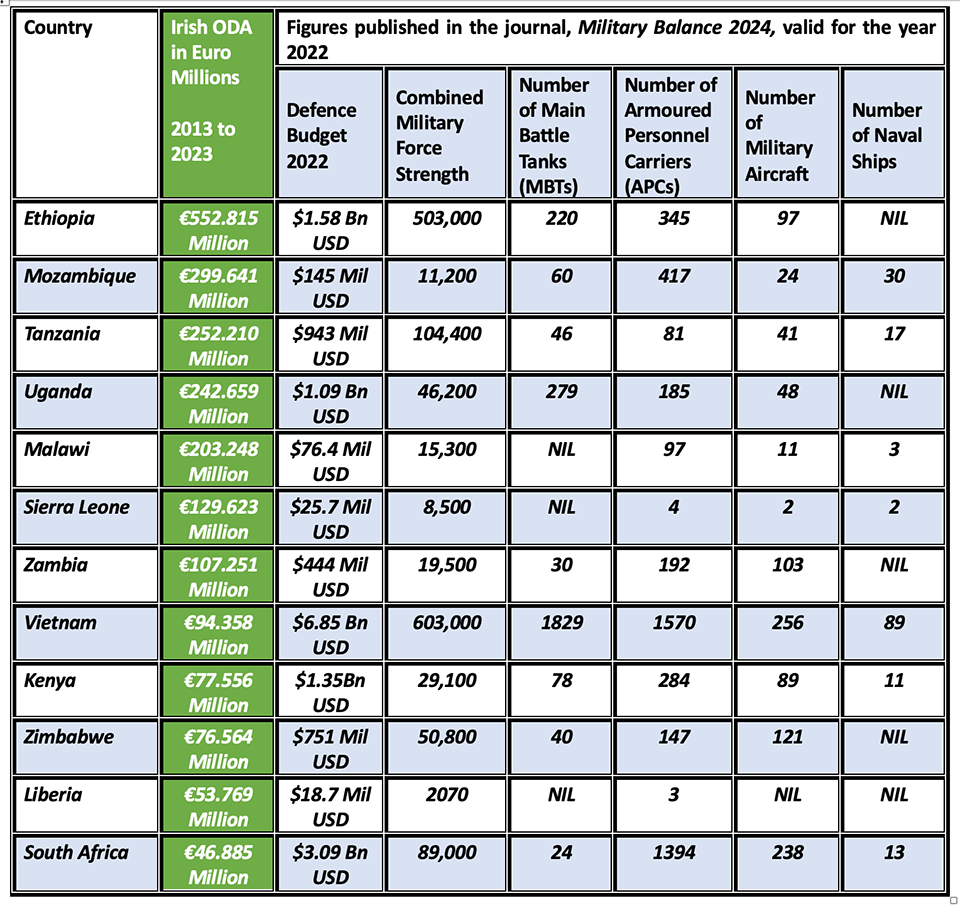
Does Ireland’s ODA surreptitiously increase military expenditure in impoverished recipient countries?
ODA funding of Ireland’s magnitude to the twelve countries listed above, combined with ODA from other countries in Europe and beyond, allows their governments divert domestic budgets that should correctly fund to a greater degree their food security, medical and education provision. These governments do so with full knowledge ODA fills the void domestic funding doesn’t. This domestic de-funding is a factor in increasing their military budgets, but worryingly, enables, clientelism, personal and clique enrichment.
All countries listed above have long-term internal and regional security challenges requiring military forces, armaments and continuous logistical support. Rising military expenditure, in turn, directly influences a country’s level of violence and conflict. It’s overdue Ireland shining a questioning light on the military forces/military hardware in service in these listed countries, eleven in Africa, and one in Asia.
Military Budgets, Force Strength and Equipment in these 12 ODA recipient countries
Military budgets are funded from national exchequers, donations of military equipment from friendly states, or reduced cost procurement “most favoured nations” from allies. In a yearly journal entitled, The Military Balance, listings are provided of state’s military strengths of their armies, air and naval forces, and paramilitary forces like France’s Gendarmerie, Italy’s Carabinieri, or Spain’s Guardia Civile.
Listed above are the 2022 national defence budgets in USD of the identified ODA countries, key headline military hardware items such as main battle tanks, armoured vehicles, military aircraft and naval ships and vessels. The Military Balance is a comprehensive, reliable, trusted and prestigious publication. It’s a revealing comparative contrast of the derisory strength and equipment of the Defence Forces across its three services, Army, Air Corps and Naval Service, and the now barely alive Defence Forces Reserve.
Ireland’s ODA foreign policy requires an inquisitive ‘look under the bonnet’ analysis. This questioning should be not so much what our ODA is achieving in recipient countries, but equally what, perhaps, our ODA is enabling, by default, in them that may not be to Ireland’s liking, wishes or intent. Or more potently, with what this short analysis can reveal, should Ireland be sending ODA to some those countries at all?