As puff pieces go, an article in the Irish Times today about two Irish sisters enjoying the subtropical weather, white sandy beaches, and work-life balance available to them in Miami is a stellar example.
The article, in which sisters Sidhbh and Neasa Gallagher gush about their impressive-sounding transatlantic life running a plastic surgery business, promotes a new show featuring their story, Escape to Florida, tonight and tomorrow, on Channel 4.
Knowing who Dr Sidbh Gallagher is, the first thought that sprung to mind was this: Do Channel 4 no longer do any research the people they feature on primetime slots?
Neither the Irish Times nor Channel 4 seem to have any interest in the fact that Gallagher is controversial for performing gender surgeries on minors and using laughter emojis when talking about breast removal surgeries.
“We have a pretty easy life,” Sidhbh says as she bemoans having to endure “a lot of drudgery in my training.”
The article revolves around the explosion in the use of weight-loss drugs, missing family and friends in Ireland, and how botox and fillers can make people happy.
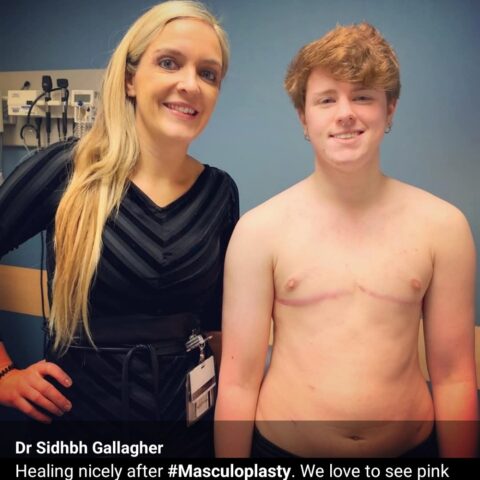
It more or less skims the fact that half of Gallagher’s surgeries (her sister, a teacher, works with her) have nothing at all to do with rather minor cosmetic aesthetic ‘tweakments’ at all – anti-wrinkle injections and dermal fillers and the likes. The surgeries she provides are much more radical, with half of them being gender reassignment. Gallagher’s Facebook page is flooded with client pictures, mainly of young-looking people who bear the scars of gender-reassignment masectomies, while Gallagher smiles broadly beside her customers.
The article doesn’t make any attempt to explain to the reader what’s being referred to are bottom surgeries, vaginoplasty (construction of a vagina) and of course, top surgery (the removal of the breasts) – something which became huge business in the US as transgenderism surged, with girls as young as 13 able to have the operation.
In fact, a look on Gallagher’s website will show you that the list of surgeries she offers is so long it seems endless – for biological females, she offers keyhole top surgery, double incision top surgery, labiaplasty, gender affirming arm lifts, masculising tummy tucks and body lifts.
Males can choose from body feminisation, lip lifts, vaginoplasty, zero depth bottom surgery, rib remodelling, mastoplasty, and more.
And what some readers may not know is that Sidhbh Gallagher is, of course, the Irish transgender surgery doctor who former patients accused of using catchy videos to attract “vulnerable and impressionable” youths to gender reassignment surgeries. Her work with teenagers is a major source of controversy, given that the Association of Plastic Surgeons of America has formally advised members not to remove the healthy breasts of any young person under 19.
Dr Gallagher, in a viral article a couple of years ago, boasted about doing this very thing. The all-out ideological capture of Irish journalists means we reward her with an interview casting her as the golden girl who’s made it big in the States with absolutely zero effort to point out what’s made her just so notorious.
Gallagher, who previously met with Tánaiste Simon Harris to discuss “trans healthcare” back in 2019, has used her large following on social media to refer to the radical surgery she performs as “Teetus Deletus,” using laugher emojis. Teetus Deletus refers to breast removal for gender change purposes.
“Just realized I only get to Yeet 4 Teets next week,” Gallagher wrote in a TikTok that gained her the kind of notoriety that has made her so controversial.
What’s available when you scratch the surface is pretty disquieting. Yet so many important facts, readily available online, are left out of an article that feels like rose-tinted PR.
There’s no mention of the former patient of Dr Gallagher who in 2022 said he was “lucky to be alive” – after a split surgical site became infected. Backlash has come from a number of obese patients, who said they experienced severe post-op complications. At least five former patients of the “Tik-Tok doctor” are alleged to have suffered complications from chest surgery.
Most worrying perhaps is the fact that the Irish surgeon has made headlines for all the wrong reasons abroad – including reportedly performing top surgery on 15-year-old children.
A New York Times article from September 2022 detailed how Gallagher indicated that she had performed surgeries on multiple teenagers, despite it being a clear violation of state health department guidelines in Florida, as highlighted by ABC.
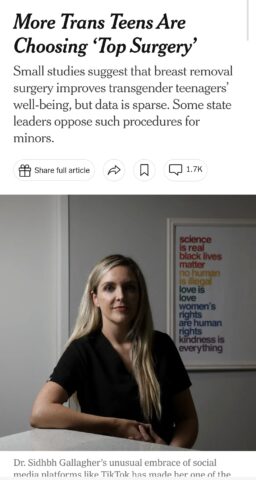
“Dr. Gallagher said she performed top surgeries on about 40 patients a month, and roughly one or two of them are under 18. Younger patients are usually at least 15, though she has operated on one 13-year-old and one 14-year-old, she said, both of whom had extreme distress about their chests,” the New York Times article read.
Complaints to the Florida Department of Children and Families (DCF) alleged that the Louth surgeon had released thousands of social media videos that “glamorise, romanticise, and valorise medical gender transition.”
Gallagher has said that she performs around 480 chest surgeries a year. What the Irish Times reader isn’t told is that this usually means removing the healthy breasts, often of young women, who have gender dysphoria.
Her annual total is well above the average number of plastic surgeries performed per surgeon yearly. According to the Aesthetic Society, a professional group of board-certified surgeons in the US, the average number is closer to 320.
Yet the Irish Times avoids any mention of controversy around Gallagher – speaking instead how the doctor “loves the work’s every evolving reality” and the hand-picked team she uses for her work with gender reassignment. The piece boasts that clients travel from all over the US for gender procedures, as it worries how this has been impacted by Trump administration policies. How old are they? Have any of them regretted such drastic operations? Is this a form of plastic surgery tourism? We’ll hold off on getting answers to any of those questions.
“For all the stuff in the media, we are still able to offer the same services. So it hasn’t affected us day-to-day. But it’s unfortunate how polarised things are,” is what Gallagher has to say. “People are afraid to travel and seeing that is sad,” she adds.
The IT thinks readers would much prefer to learn about how the Gallagher sisters work a four-day week, how one has just got her boating licence for her paramotoring hobby, and how they prefer to schedule their appointments for office days at 10am “after pilates.”
Is the paper now going to run an interview with one of the regretful young women who openly speak out about what is behind the troubling rise in these procedures? There are young women out there who have undergone these irreversible procedures, after seeing one on TikTok, who later realize that their euphoria disappears, leaving them with self-hatred, depression and crushing regret.
One is Sinead Watson, who not too long ago wrote in the Spectator about how, after having a double mastectomy in June 2017 at the age of 26 to become ‘Sean,’ she discovered she had no sensation at all in her chest area, something that continues to this day.
“I realised after about five months my depression and self-hatred was still present, and that the surgery didn’t ‘cure’ me like I thought,’ she says. ‘The complete lack of sensation in my chest is unpleasant, and I realised in 2018 I regretted not only the surgery – I regretted transition as a whole because I still hated my body,” wrote Watson.
Wouldn’t some hard truth on the subject of gender transition be better than a puff piece treating readers like morons?
The shaky evidence base for youth gender medicine has become known not only in the US but closer to home – with the Cass report resulting in the closure of Britain’s biggest youth gender clinic, Tavistock, which was also where so many Irish children were referred.
There are also studies, including one from a leading American practitioner showing that the treatments she championed did not improve minors’ mental health. The internet is awash with reports of young teens being put on a medical pathway after only a single clinic visit.
There’s the legal action by Prof Donal O’Shea and Dr Paul Moran who are seeking a judicial review of HIQA’s alleged failure to review the HSE’s care of children with gender dysphoria.
When the Irish Times instead runs a vacuous lifestyle piece championing Gallagher – and omitting so many key facts – we no longer need to wonder why trust in the Irish press is at rock-bottom.