While much has been made of the recent decision by the Minister for Justice, Helen McEntee, to extend the list of countries of safe origin to include Algeria and Botswana, statistics would indicate that such designations may make little difference to the numbers arriving to claim International Protection in the Irish state.
As reported here yesterday, the numbers of persons arriving here to claim asylum have risen sharply over the first weeks of 2024. The fall in the numbers claiming to be from Algeria in the week ending February 4 obviously reflect its inclusion in that list which now includes Albania, Algeria, Bosnia/Herzegovina, Botswana, Georgia, Kosovo, Macedonia, Montenegro, Serbia and South Africa.
We have seen similar falls in numbers coming from Georgia, but the high numbers of Georgians claiming asylum here had come to be regarded as completely out of kilter with international figures. Ireland received the fourth highest number of applications from Georgians in the whole world in 2022. Public unease about this has led to a stricter enforcement policy by the authorities.
That has certainly led to smaller numbers of Gerogians arriving here in recent months – just as happened in the past with regard to people arriving in the state from Albania.
And yet more than 500 Albanians remain in IPAS accommodation here, along with over 3,700 people from Georgia.
On Wednesday, the Social Democrat leader Holly Cairns asked Minister Helen McEntee why she had added Algeria to the safe list, and on what grounds the decision was made.
The Minister set out the criteria as laid out in Section 72 of the 2015 International Protection Act. This excludes any state in which it is found that the rule of law and basic human rights are protected. Algeria may have problems, but it is not deemed to be in breach of such conditions.
Nor is South Africa, which is also on the list of safe countries. South Africa was added to the list in 2004 by then Minister for Justice Michael McDowell by means of Statutory Instrument 714/2004. This was at a time when the Irish state was experiencing its first crisis around opportunistic applications for asylum. That crisis that led to the overwhelming public endorsement in the same year of changes to the legislation governing citizenship.
Yet, this has not prevented large numbers of people from South Africa coming to claim asylum in Ireland. There were 493 such applications in 2023 and 450 in 2022, and so far in 2024 it remains among the top countries of origin for persons entering the International Protection system.
According to the latest statistics from the Department of Justice, there are currently 1,246 people from South Africa in IPAS accommodation. That figure is higher than the total number on the entire planet of persons from South Africa who claimed asylum anywhere in 2022. Not only that but the Irish state was where over 40% of those applications were made.
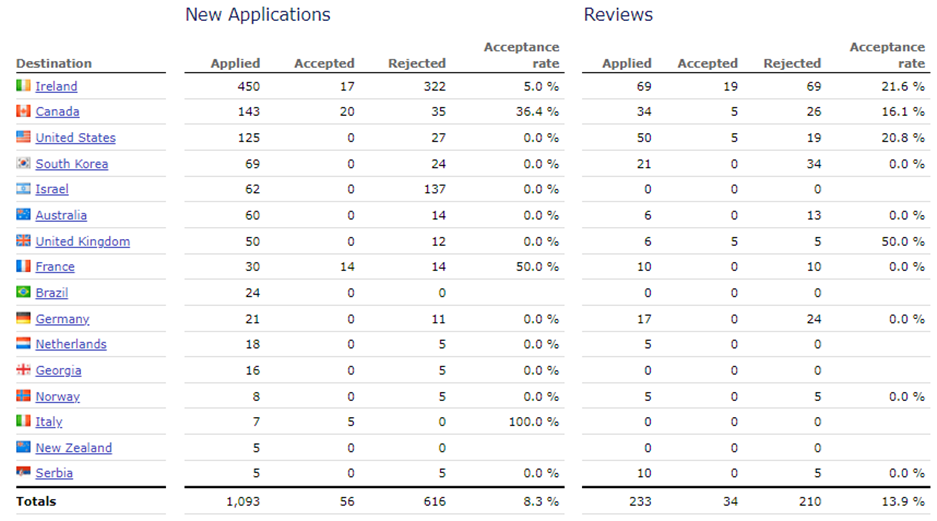
Of that number it can be seen that just 5% of those applications were initially successful, and that the rejection rate at appeal and review stage was almost 80%. And yet we know that very few of those who are rejected are either served with a deportation order, or if they are served with such an order ever leave Ireland.
No one on the Irish liberal left will kick up a fuss over South Africa – which is governed by one of its icons, the African National Congress – being considered to be safe. They do of course defend people who claim otherwise, and indeed several of such failed applicants from South Africa are prominent among the activist migrant sector here.
When I contacted the South African Ambassador to Ireland, Her Excellency Yolisa Maya, in January 2023, she was adamant that South Africa is a democracy founded upon a “Bill of Rights which extends protection to all people within her jurisdiction, without discrimination.”
One other aspect of all of this is that many countries are not included in the list of safe counties in any EU state simply because they are obviously not countries in which you are likely to be murdered, imprisoned, tortured or otherwise persecuted on the basis of your political affiliations, ethnic origin, sexual orientation and so on.
The Irish state does not do so, but a number of EU states specifically include all other member states in their list of countries of safe origin. Other obvious unlisted examples include all of the western and northern hemisphere democracies, Japan, Australia, and the east Asian democracies such as South Korea and Taiwan.
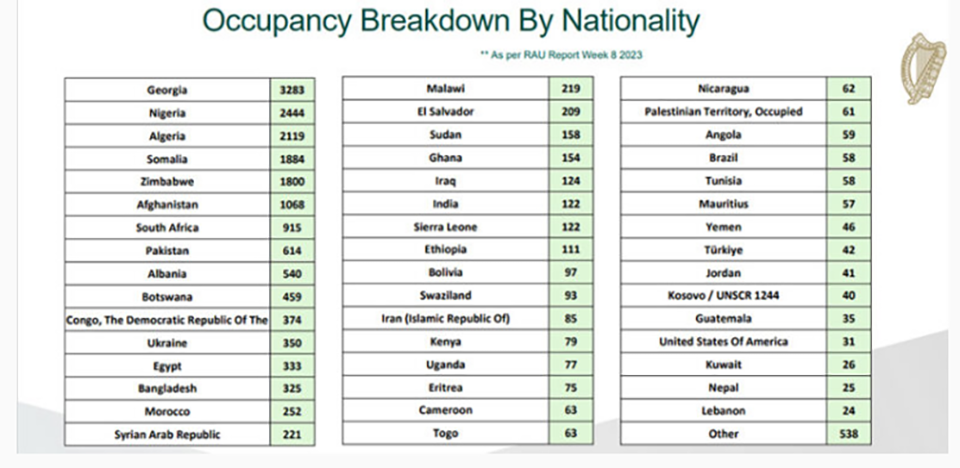
The United States is likewise not named in any Statutory Instrument here as a country of safe origin but you would have to have something amiss with you were you to believe otherwise. And yet, the Irish state continues to receive applications for asylum from US citizens and this time last year there were 31 such persons still here, presumably appealing their having been rejected, and living at the expense of Irish citizens in accommodation provided by IPAS.
Lists and such like then clearly count for nothing if the state is not willing to deal quickly and decisively with what are obviously opportunistic and even bogus applications. The current government constantly refers to its obligations under international law and so on. – but the manner in which it can quickly stem the flow of people arriving from Georgia and Algeria is an indication that it can and does respond to public opinion.
Whether it maintains that position is another matter. The experience regarding South Africa, and indeed other countries which are not designated as safe, but are clearly safe under most understandings of that term, is no cause for optimism.
In addition, despite the falling numbers from certain countries in recent months and weeks, the number of asylum claims continues to rise sharply as referenced above? It seems to be the case that the downturn in applications from Georgia and the like are being met with a surge from countries like Nigeria.