Statistics issued by the Department of Social Protection on Wednesday show that there were 270,081 new Personal Public Service (PPS) numbers issued for the whole of 2023. That represents a fall of over 30,000 from 2022.
Over the past ten years, since 2014, there have been 1,983,380 new PPS numbers issued to persons within the state. During that same period the population of the state has grown by around 660,000.
Just over half of that growth in the population of the state can be accounted for by a net migration of 337,000. The natural population increase between 2014 and 2023 was 358,400 so the two figures in combination account broadly for that population growth.
One aspect of the natural increase is that it has dramatically declined over the same period; from 39,000 in 2014 to just 20,000 in 2023. The falling birth rate, and the numbers of young Irish people leaving the country along with births to the growing proportion of the population – 19% according to the 2022 Census – who were born outside of the state, underline the dramatic and escalating demographic shift.
While the PPS statistics are not a reliable indication of more than the general trend (many people issued with PPS numbers, both Irish and non-Irish leave the country to work abroad, as is clear in the case of Poles for example to return to work in their own country), they do chart the overall demographic shift.
That is most evident in the proportion of those issued with PPS numbers who are of Irish nationality. Most of that is accounted for by new births. In 2023, there were 64,613 new PPS numbers issued to Irish people. There were 55,500 births in the state in 2023.
As a proportion of the total number of PPS numbers issued, people of Irish nationality accounted for just 23.9% of the overall figure. That can be contrasted to 2014 when there were 76,091 PPS numbers issued to persons of Irish nationality. In that year that accounted for 44% of the 172,463 issues. The corresponding figure in 2009 was 52%.
Compounding the population shift driven by inward migration, is the worrying and seemingly increasing rate at which young Irish people are leaving the country. Many of them it would seem are not only highly qualified and secure employment overseas in the technological and health sectors, but are leaving jobs they have in Ireland or turning down positions here.
A poll conducted in 2022 by Red C for the National Youth Council of Ireland found that 70% of 18 – 24 year olds surveyed were considering leaving the country in the next few years. Another poll found that 75% of young people were planning to emigrate. Among the main factors cited in the NYCI report influencing young people in that direction were housing and the overall cost of living.
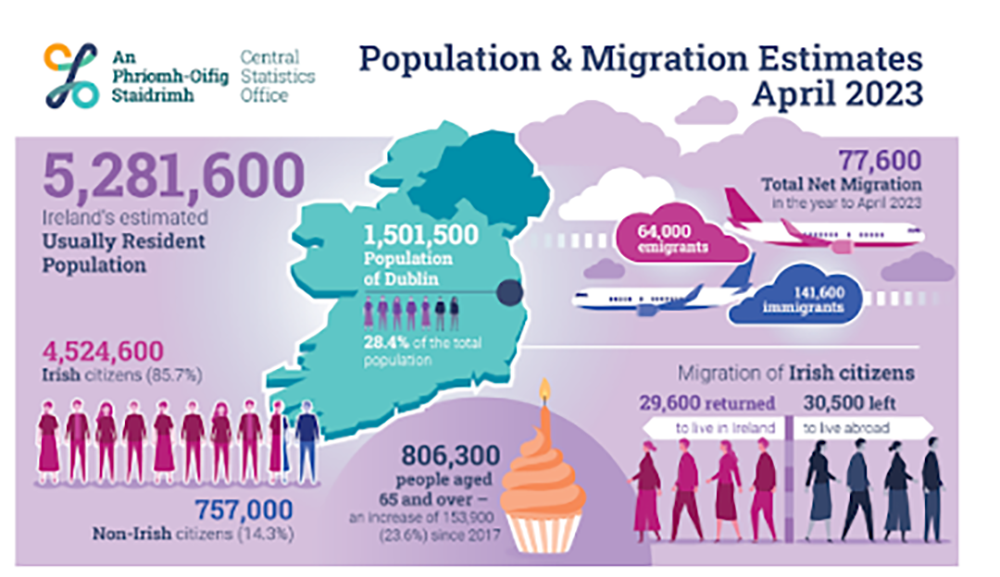
That many have done is borne out by the official statistics on migration. These show that not only are tens of thousands of Irish people leaving, but that there is a net outward migration of Irish people, presumably the vast bulk of them being in the younger age cohort. Presumably also those Irish people who return from abroad are in older age groups.
Some commentators have sought to explain this exodus of young educated working people as a reflection of their dissatisfaction with Ireland not being as liberal as some media pundits would wish it to be. They would have you believe that they are leaving because Ireland is racist, or residually homophobic or some such nonsense.
There may well be more than economic factors at play, although the evidence including anecdotal evidence from those who are leaving would suggest that it is indeed housing in particular that is the major push factor.
It is equally as plausible to argue on cultural grounds that many young people are leaving because the Irish state no longer has an ethos to which any sane thinking person might ascribe. Vacuous liberalism is the perfect guiding philosophy for an Ireland that is no more than an industrial and financial centre.
Is it something that will bind people to their homeland and commit themselves to it through their working and social lives and as a place in which to raise their children? Evidently the tens of thousands of young people leaving Ireland do not believe that it is.